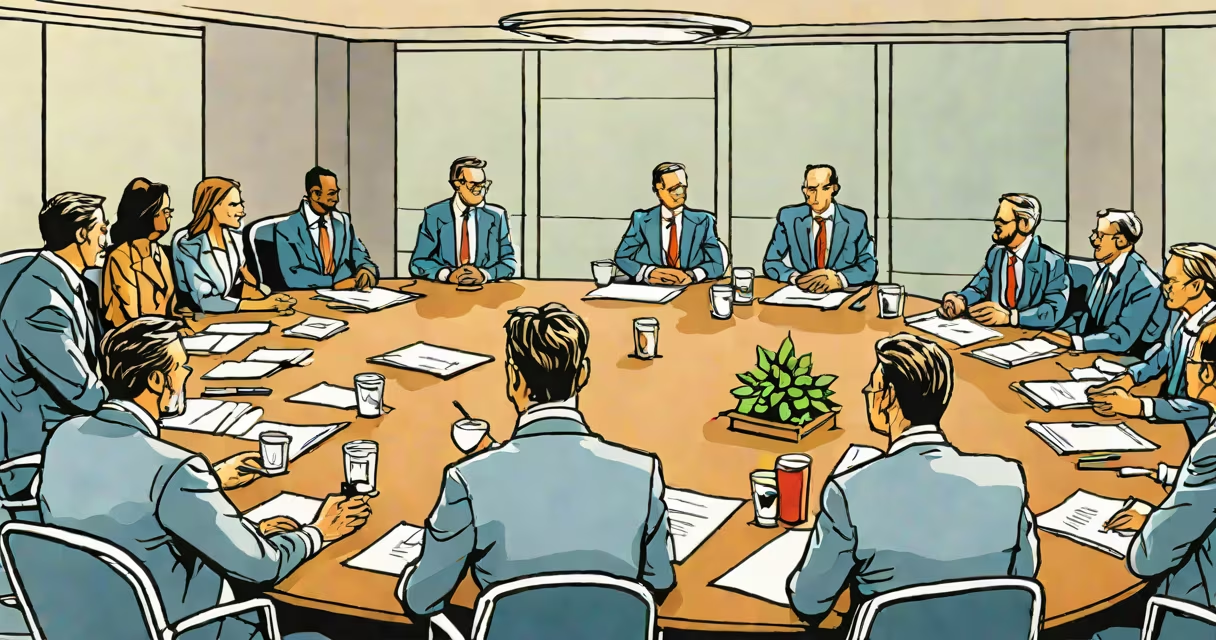
A company director is a legally appointed individual who oversees the strategic direction, financial health, and compliance of a corporation. Directors serve on the board of directors and have fiduciary duties to act in the best interests of the company and its shareholders. This role is distinct from executive management, though directors may also hold executive titles.
Directors are responsible for setting long-term goals, approving major decisions such as mergers or capital expenditures, and appointing senior executives like the CEO. They ensure the company follows laws and regulations, including those set by the Securities and Exchange Commission (SEC) in the U.S. and the Companies Act 2006 in the UK. Failure to fulfill these duties can result in personal liability, including fines or removal from office.
The role of a company director varies by jurisdiction and company structure. In public companies, boards often include independent directors to reduce conflicts of interest. In private firms, founders or family members may serve as directors. A director's authority stems from corporate bylaws and statutory law, not from job title alone.
Company directors operate through formal meetings, typically held quarterly, where they review financial statements, discuss risk exposure, and approve budgets. Decisions require a majority vote unless otherwise specified in the company's articles of incorporation. Directors cannot delegate their legal responsibilities-even if they rely on management reports or external advisors.
Each director owes a duty of care, loyalty, and obedience. The duty of care requires informed decision-making based on available facts. The duty of loyalty prohibits self-dealing or actions that benefit the director personally at the expense of the company. The duty of obedience ensures directors follow applicable laws and the company's constitution.
For example, in 2018, the U.S. Supreme Court ruled in *Tennant v. City of New York* that directors who ignored red flags about fraud in a subsidiary could be held liable under state law. Even if they relied on auditors, the court found that ignoring clear warning signs violated their duty of care. This case illustrates that directors cannot hide behind management reports-they must actively assess risks.
Not all directors serve the same function. The most common categories are:
| Type | Role | Example |
|---|---|---|
| Executive Director | Also serves as a senior manager (e.g., CEO, CFO). Has operational involvement. | Elon Musk, as CEO of Tesla, also serves on the board. |
| Non-Executive Director | Provides oversight without day-to-day operations. Often independent. | Sheryl Sandberg served as a non-executive director at Meta (formerly Facebook). |
| Independent Director | Has no material relationship with the company. Ensures objective judgment. | Many S&P 500 firms require at least 50% independent directors. |
| Alternate Director | Replaces a director during absence. Appointed in advance. | Common in UK-listed companies under the Companies Act 2006. |
Some jurisdictions mandate minimum numbers of independent directors. For instance, the NYSE requires listed companies to have a majority of independent directors on their board. This reduces the risk of groupthink and insider influence.
Every incorporated business-whether private or public-must have at least one director. Public companies typically have between five and 15 directors, depending on size and sector. Private companies may have as few as one or two.
Directors are essential for accountability. Without them, a company lacks checks on executive power. For example, Enron's collapse in 2001 was partly due to a board that failed to challenge misleading financial reporting. Afterward, the Sarbanes-Oxley Act (2002) strengthened director responsibilities, requiring CEOs and CFOs to certify financial statements and mandating audit committee independence.
Even small startups incorporate directors early. A founder might serve as the sole director initially, then add others as funding rounds occur. This structure protects the company during investor negotiations and prepares it for eventual public listing.
Many people confuse "director" with "manager." A manager handles daily operations; a director sets policy and monitors performance. A person can hold both roles-but they are not interchangeable. For example, a regional sales manager is not a director unless formally elected to the board.
Another error is assuming all directors are paid. While public company directors receive fees (average $50,000 annually in the U.S.), many private company directors serve pro bono. Some nonprofit boards pay nothing. Compensation depends on company size, industry, and jurisdiction.
There's also confusion around voting rights. Directors vote on board matters, but they do not vote on shareholder resolutions unless they are also shareholders. Shareholders elect directors, but once seated, directors govern-not elect.
One non-obvious fact: in some countries, like Germany, the board system includes two layers-one management board (Vorstand) and one supervisory board (Aufsichtsrat). The supervisory board appoints and oversees the management board. This dual model exists in over 20 European nations and reflects a different governance philosophy than the U.S. single-board model.
Apple's board consists of ten members, including CEO Tim Cook and independent directors like Arthur Levinson and Susan Wagner. The board meets monthly and oversees major investments, executive compensation, and product safety reviews.
In 2020, Apple faced scrutiny over privacy practices. The board reviewed internal audits and commissioned an external review. Based on findings, they approved changes to data handling policies and increased spending on privacy engineering. This process shows how directors act as oversight bodies, not just rubber stamps.
When Apple launched the Apple Watch, the board approved the initial budget ($150 million) and monitored progress against milestones. They did not manage development-but they ensured alignment with long-term strategy and risk tolerance.
While "director" sounds similar to "executive," "partner," or "officer," each term has distinct legal meaning. A director is a fiduciary; an officer is a manager. A partner holds ownership in a partnership; a director does not necessarily own shares.
For example, a managing partner at a law firm has ownership and profit-sharing rights. A director at a publicly traded firm does not. That distinction affects liability, taxation, and exit planning.
Understanding this difference is important when structuring a business. Choosing the right governance model-such as a board of directors versus a sole proprietorship-impacts legal obligations, fundraising ability, and exit options.
When evaluating a company's leadership, ask: Who makes the final call? If it's not the board, the organization may lack proper governance. This gap increases risk during audits, acquisitions, or crises.
Defining company director correctly ensures clarity in governance, accountability, and legal compliance. It is not a ceremonial title-it is a position of legal responsibility with measurable outcomes.