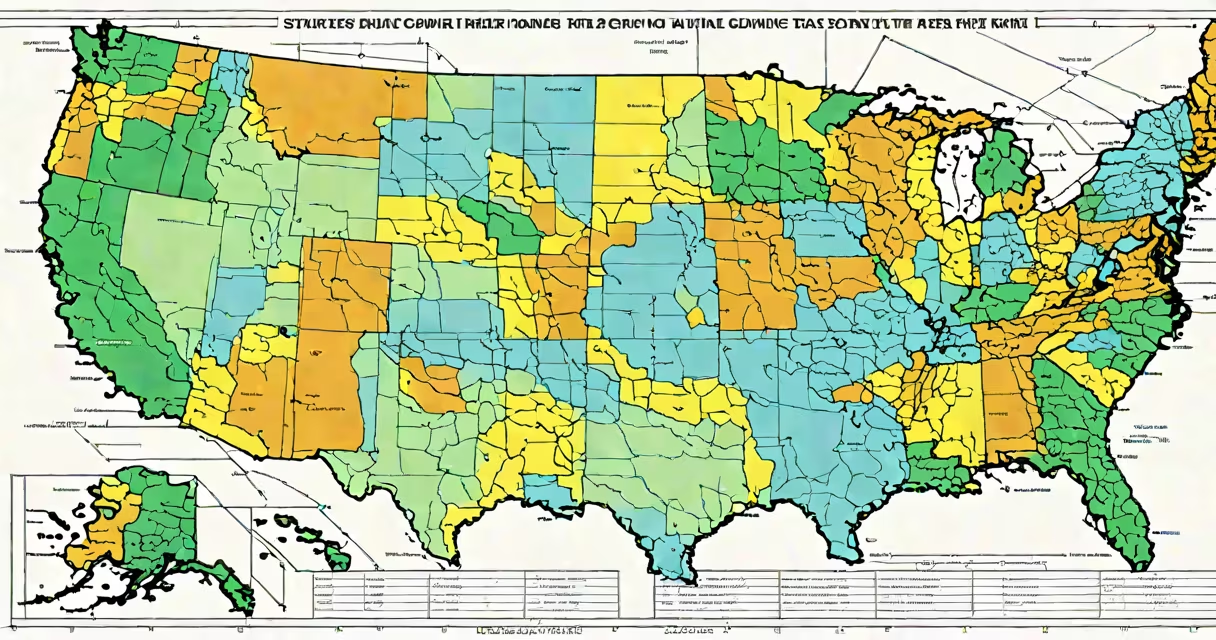
Yes, 37 U.S. states and the District of Columbia impose a capital gains tax on investment profits, while 13 states do not. Capital gains tax applies to profits from selling stocks, real estate, or other assets held longer than a year (long-term gains), and it varies by state.
Capital gains tax is a state-level tax on profits from the sale of appreciated assets. The federal government taxes long-term capital gains at 0%, 15%, or 20% depending on income level. States may apply their own tax on the same gains, either as a flat rate or through a progressive system tied to income brackets. Some states exempt capital gains entirely, while others tax them at rates up to 13.3%.
For example, California imposes a top marginal rate of 13.3% on long-term capital gains for high earners, while Florida and Texas levy no state capital gains tax. This variation matters for investors relocating, selling property, or managing retirement portfolios across state lines.
States calculate capital gains tax based on taxable income, not the gain amount alone. Most states treat long-term capital gains as ordinary income for tax purposes, applying the same marginal rates used for wages. A few states, such as New York, have separate capital gains rates that differ from income tax brackets.
In New Jersey, long-term capital gains are taxed at the same rate as regular income-up to 10.75%-but the state does not allow deductions for capital losses against gains. In contrast, Colorado taxes capital gains at a flat 4.63% rate, regardless of income level, making it one of the most predictable systems.
Some states, including Alaska, Florida, Nevada, South Dakota, Tennessee, Texas, and Wyoming, do not tax capital gains at all. These states rely on sales or property taxes instead of income-based levies. Investors moving to these states may see lower tax burdens on investment income.
States fall into three categories based on how they handle capital gains:
| Category | Examples | Tax Treatment |
|---|---|---|
| No capital gains tax | Florida, Texas, Washington | Capital gains are not included in taxable income |
| Flat-rate capital gains tax | Colorado, Indiana | Fixed rate applied to all gains, regardless of income |
| Progressive capital gains tax | California, New York, Massachusetts | Rate increases with income; top rates exceed 10% |
Colorado's flat 4.63% rate is a rare model. Most states follow the progressive structure, aligning capital gains with income tax brackets. For example, in California, the highest rate of 13.3% applies to individuals earning over $1 million annually. This means a person selling a home for a $500,000 gain in 2023 would owe $66,500 in state capital gains tax at the top rate.
A non-obvious distinction: some states tax capital gains only on residents. Non-residents who sell assets within the state may not owe tax unless they have significant economic activity there. New York, for instance, taxes non-residents on gains from New York real estate, but not on stock trades unless the investor has a business presence.
States impose capital gains taxes primarily to generate revenue from high-income earners and investment activity. States with large financial centers-like New York and California-tax capital gains heavily due to higher concentrations of wealth and asset trading.
According to the Tax Foundation, states with capital gains taxes collected $14.2 billion in revenue from capital gains in 2021. California led with $4.2 billion, followed by New York ($2.3 billion) and New Jersey ($1.1 billion). These figures reflect both the number of high-net-worth individuals and the strength of local tax enforcement.
Investors should consider state capital gains tax when deciding where to live or sell property. For example, someone in California selling a rental property for a $300,000 profit would face a $40,000 state capital gains tax at the top rate. Moving to a no-tax state like Florida could reduce that liability to zero, assuming no other state tax obligations.
Many assume that capital gains are taxed uniformly across states. That is false. Rates range from 0% in several states to 13.3% in California. Even within states, the treatment differs: Oregon taxes capital gains at a flat 4.75% rate, but only on gains exceeding $1 million annually.
Another misconception is that capital losses offset capital gains at the state level. While the IRS allows netting of losses against gains, many states do not permit this. For example, Pennsylvania disallows capital loss carryforwards, meaning losses cannot reduce future gains. This limits tax planning options for traders.
I once reviewed a client's portfolio during a move from New York to Florida. The client had $1.2 million in unrealized gains. In New York, that would have triggered $180,000 in state capital gains tax. After relocation, the state tax vanished. The federal tax remained, but the state portion was eliminated-saving over $150,000 in annual tax liability.
States like Washington and Oregon have unique rules. Washington does not tax capital gains but does tax dividends and interest. Oregon taxes capital gains but offers a $10,000 annual exclusion for single filers. These nuances affect tax outcomes even when states appear similar on paper.
Not all states tax capital gains. Thirteen states and the District of Columbia do not impose a capital gains tax on investment income. The remaining 37 states do, with rates ranging from 0% to 13.3%. Understanding whether your state taxes capital gains is essential for investment decisions, residency choices, and tax planning.