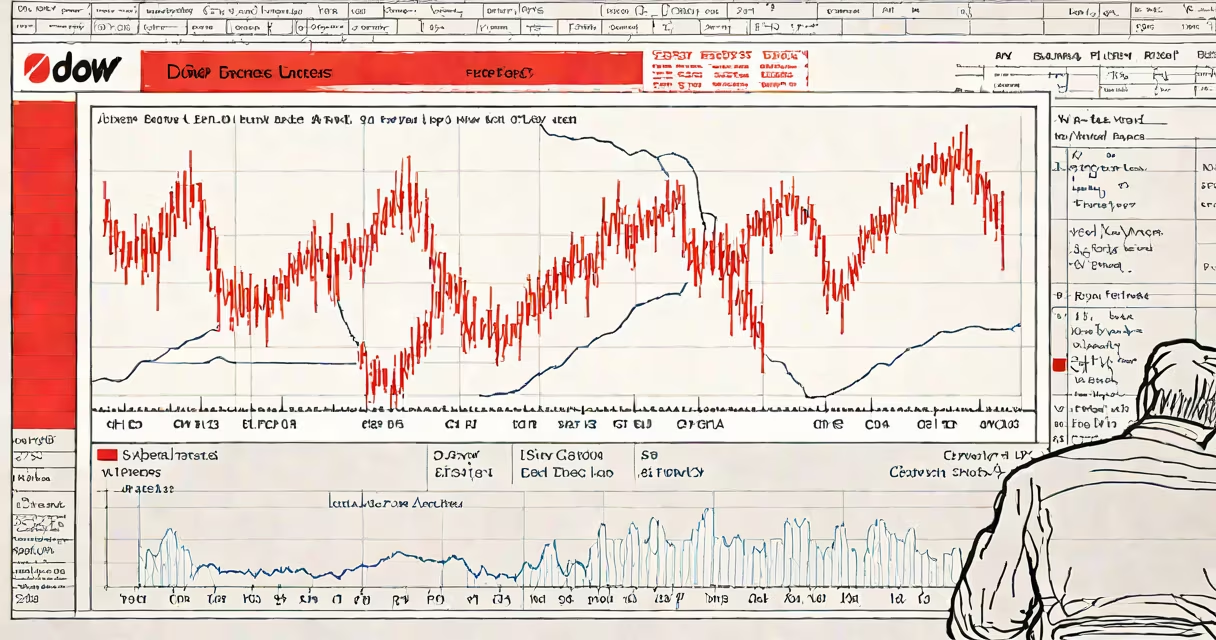
The dow close on monday refers to the final value of the Dow Jones Industrial Average (DJIA) at the end of trading on a Monday, reflecting investor sentiment and economic conditions following the weekend.
The Dow Jones Industrial Average tracks 30 large, publicly traded U.S. companies across major sectors. Its closing value on any given Monday is determined by the last trade executed on each of those stocks during regular market hours (9:30 AM to 4:00 PM Eastern Time).
For example, on May 6, 2024, the Dow closed at 39,152.34 after a volatile session marked by rising bond yields and inflation data. This level represented a 0.8% drop from Friday's close, driven by concerns over Federal Reserve policy tightening.
The DJIA is a price-weighted index, meaning higher-priced stocks have greater influence on its movement. Unlike market-cap weighted indices such as the S&P 500, the Dow gives disproportionate weight to stocks like Goldman Sachs and UnitedHealth Group due to their high share prices.
Each component stock contributes to the index based on its individual closing price. The formula divides the sum of the 30 component prices by a divisor adjusted for stock splits, dividends, and corporate actions. This divisor currently stands at approximately 0.155, according to S&P Dow Jones Indices.
On Mondays, the index often shows wider swings than other days due to delayed reactions to weekend news. For instance, a major earnings report released Sunday night may not register until Monday's opening bell, causing immediate volatility.
Several forces shape the dow close on monday:
Traders often monitor pre-market indicators like futures contracts. On February 12, 2024, Dow futures were down 0.6% before the open, signaling bearish momentum. The actual close was 0.4% lower, confirming the trend.
Many assume the Dow closes on Monday because of weekend activity. But the index only reflects trades made during the official market session. Weekend news influences expectations, but not the actual closing price.
Another error is equating the Dow's movement with market health. The Dow includes only 30 industrial stocks, while the S&P 500 covers 500 companies across all sectors. In 2023, the Dow rose 12% while the S&P 500 gained 22%, highlighting divergent performance.
A lesser-known fact: the Dow's divisor is recalibrated monthly. In 2022, a split in Apple stock required a divisor adjustment from 0.154 to 0.153, altering the index's sensitivity to price changes.
On that date, the Dow opened at 38,745.21 after a quiet weekend. By noon, gains in tech stocks pushed the index above 39,000. However, a late afternoon announcement of stronger-than-expected consumer spending data triggered profit-taking.
The final dow close on monday was 38,912.44, a gain of 0.4%. This move was driven by a 2.1% rise in Microsoft and a 1.8% increase in JPMorgan Chase, both contributing heavily due to their high prices.
Meanwhile, energy stocks declined. ExxonMobil fell 1.3% despite oil prices rising, indicating sector-specific sentiment. The final index value reflected net positioning across all 30 components.
Understanding how the Dow compares to other benchmarks clarifies its role in financial analysis.
| Index | Weighting Method | Number of Stocks | Monday Sensitivity |
|---|---|---|---|
| Dow Jones Industrial Average | Price-weighted | 30 | High (due to few large-cap stocks) |
| S&P 500 | Market-cap weighted | 500 | Moderate (diversified exposure) |
| NASDAQ Composite | Market-cap weighted | Over 3,000 | High (tech-heavy, reactive to earnings) |
While the Dow is widely reported, it doesn't represent the full U.S. equity market. The S&P 500 is considered a better proxy for broad economic health, according to the Federal Reserve Bank of New York.
I once observed a trader misread a Dow close on Monday as a sign of panic. The index had dropped 0.3% after a minor earnings miss by Boeing. But the S&P 500 was flat. The difference highlighted how single-component indices can distort perception.
Financial platforms update the dow close on monday in real time. Bloomberg, Reuters, and Yahoo Finance publish final values shortly after 4:00 PM ET. Historical data is available through the S&P Dow Jones Indices website.
Investors should verify closing values using multiple sources. A discrepancy between a news outlet and the official index provider can result from delayed reporting or rounding errors.
For long-term analysis, compare the dow close on monday with weekly averages. A consistent decline over five consecutive Mondays may indicate structural weakness, prompting portfolio rebalancing.
When reviewing performance, focus on context. A 0.5% drop on Monday may be normal if global markets are adjusting to a new interest rate decision. A 2% drop without clear cause warrants deeper investigation.
Understanding the dow close on monday requires attention to mechanics, timing, and comparative data. It is not a standalone signal but a piece of a larger financial picture.