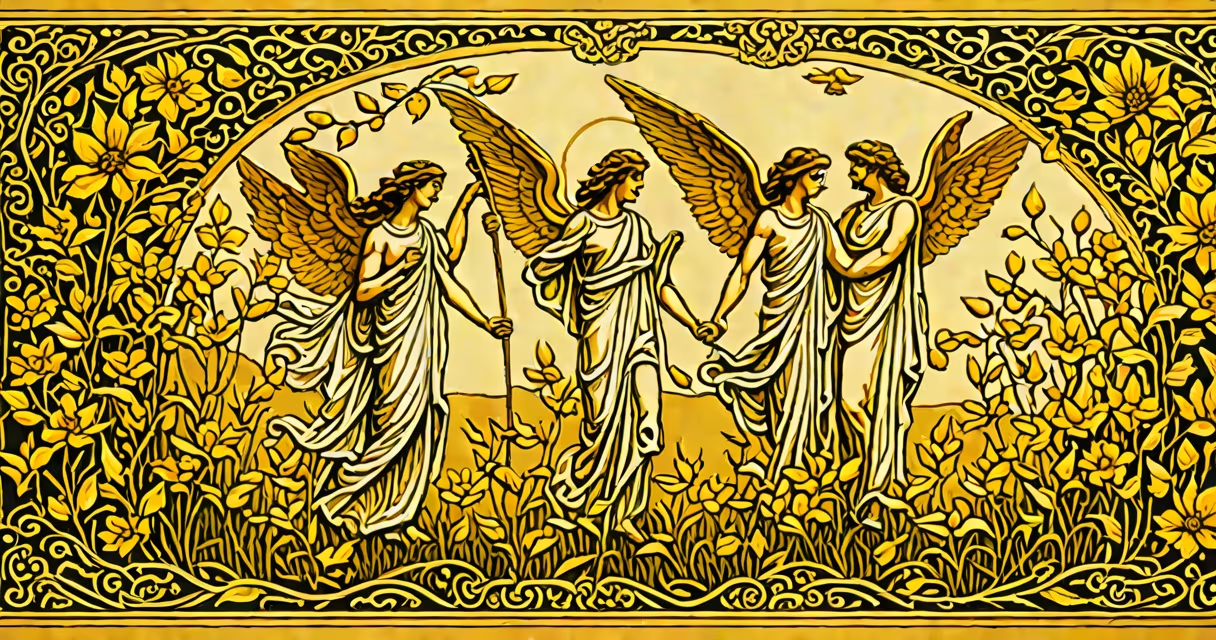
Elysium in Greek mythology is a blissful afterlife area for heroic souls and the morally upright, located within the underworld. It is not a physical place on Earth but a spiritual domain where the righteous enjoy eternal peace, feasting, and music. Unlike the gloomy Hades or the tormenting Tartarus, Elysium represents divine reward for those who lived honorably.
The concept of Elysium emerged in early Greek religious thought, evolving from earlier notions of the afterlife. Homer's *Odyssey* describes a shadowy version of the dead in a distant land beyond the Oceanus, but Elysium appears later in poetic texts as a distinct, radiant area. By the time of Hesiod's *Works and Days*, the idea of a blessed afterlife for the virtuous begins to take shape, though Elysium remains a minor theme compared to the dominant image of Hades.
Modern references often conflate Elysium with Christian heaven or Buddhist nirvana. But in classical Greek belief, Elysium was not universal. Only select individuals-heroes like Achilles, Odysseus, and the children of gods-were granted entry. It was not a destination for all good people, nor did it offer resurrection. Souls entered Elysium after death, but their existence was passive joy rather than active purpose.
Elysium operated as a tiered afterlife. Not all souls went there. Most mortals descended into Hades, a neutral area beneath the earth ruled by the god Hades. There, they lived in silence and shadow, awaiting judgment or memory. Only those who met specific criteria were elevated to Elysium.
Criteria included heroic deeds, divine favor, or strong virtue. For example, Achilles, despite dying young, was granted Elysium due to his unmatched martial prowess and divine lineage. Similarly, the Argonauts, especially Jason, were said to have earned passage through their legendary quests. These stories reinforced the cultural value placed on courage, loyalty, and service to the gods.
Geographically, Elysium was described as lying in the far west, beyond the Pillars of Hercules, or beneath the sea. Some sources placed it near the Garden of the Hesperides, a mythical orchard guarded by nymphs. Others described it as a floating island or a meadow of perpetual spring. These variations reflect regional differences in mythic tradition rather than a single canonical location.
While Elysium was a consistent ideal, its form changed across literary periods and cultures. Early versions emphasized natural beauty and ease. Later Roman adaptations expanded on this, blending Greek ideas with Roman values of civic duty and military glory.
| Version | Description | Source |
|---|---|---|
| Greek Elysium | A meadow of golden flowers, eternal spring, and feasts. Heroes live in harmony with nature and the gods. | Homer, Hesiod |
| Roman Elysium | More structured. Honored soldiers and statesmen received Elysium as a reward for public service. Associated with Augustus's imperial ideology. | Ovid, *Metamorphoses* |
| Neoplatonic Elysium | Philosophical interpretation. Elysium became a symbolic state of union with the divine, accessible through contemplation and virtue. | Plato, *Phaedrus* |
One non-obvious distinction: Elysium was never a place of punishment. Unlike Tartarus, which punished traitors and blasphemers, or Limbo (a later Christian concept), Elysium had no negative counterpart. Its purpose was purely redemptive and celebratory. This reflects the Greek worldview, where moral excellence was rewarded, not punished.
Many confuse Elysium with the Isles of the Blest-a similar but distinct concept in later Greco-Roman literature. The Isles of the Blest were often portrayed as islands in the western ocean, inhabited by the pure of heart. They were sometimes merged with Elysium, but they were not identical. The Isles were more mythic and less tied to heroic identity.
Another common error is equating Elysium with the modern term "paradise." While both imply happiness and reward, Elysium was not a theological promise. It was not likely to anyone. Entry required merit, divine intervention, or special fate. You couldn't earn it through prayer or ritual alone-only through action and legacy.
For example, the poet Pindar wrote that only those who "fought well" and "died with honor" were admitted. A man who lived a long life but committed no great deeds would not enter Elysium. His soul would go to Hades, regardless of personal goodness. This shows that Elysium was not about morality in the modern sense-it was about heroic achievement.
Achilles, son of Thetis and Peleus, died in battle during the Trojan War. According to Homeric tradition, he was buried on the shores of Troy. But in later myths, his soul was taken to Elysium. The *Iliad* says nothing of this, but the *Aethiopis*, a lost epic now known through fragments, claims Achilles was granted immortality and sent to Elysium by Zeus.
This story illustrates how Elysium functioned as a reward for ultimate sacrifice. Achilles' death was not meaningless-he was honored with eternal peace. His presence in Elysium affirmed the Greek belief that true fame came not from survival, but from valor in the face of death.
Even in art, Achilles appears in Elysium scenes. A 5th-century BCE black-figure amphora from Athens depicts him reclining under a tree, surrounded by laurel wreaths and lyres. He is not fighting, not suffering-just resting. The scene emphasizes tranquility, not triumph.
I once visited the archaeological site of Eleusis, where the Eleusinian Mysteries were held. During a guided tour, a local archaeologist pointed out a small relief carved into a temple wall showing a figure being led through a gate into a field of light. He said, "This is Elysium. Not heaven. Not hell. Just peace." That moment stayed with me-not because of the art, but because of the quiet dignity in the gesture.
Today, Elysium appears in literature, film, and video games as a symbol of ultimate reward. But in its original context, it was not a fantasy destination. It was a reflection of how ancient Greeks understood legacy, honor, and the limits of human life. It was not for everyone. And that made it meaningful.
Understanding elysium greek mythology requires separating modern ideals from ancient ones. It was not a place of endless fun or emotional fulfillment. It was a quiet, eternal rest for those who had already done something extraordinary. It was a reward, not a promise.