Extreme poverty definition refers to living on less than $2.15 per day, adjusted for purchasing power parity, as established by the World Bank. This standard measures individuals who lack the financial means to meet basic survival needs such as food, clean water, sanitation, shelter, and healthcare.
The $2.15 daily threshold replaced earlier benchmarks like $1.90 and reflects updated cost-of-living data across countries. It is not a measure of comfort or lifestyle-it identifies those whose income falls below the minimum required to sustain life without external aid. According to the World Bank's 2022 Global Monitoring Report, approximately 700 million people lived in extreme poverty globally, down from 1.9 billion in 1990.
This definition applies only to income-based poverty. It does not capture social exclusion, gender-based violence, or lack of access to education-factors that compound deprivation but fall outside the monetary metric. For example, a family may earn $2.20 per day yet still face extreme hardship due to medical debt or seasonal crop failure. The definition focuses on measurable economic shortfall, not lived experience.
Researchers calculate extreme poverty using household survey data collected by national statistical offices. These surveys record daily expenditures on food, housing, utilities, transportation, and health. Data is then converted into international dollars using purchasing power parity (PPP) rates, which adjust for local price differences.
For instance, $2.15 buys roughly 1,200 calories of food in rural India, enough to sustain a child's energy needs. In urban Kenya, the same amount covers about 800 calories-less due to higher food prices. PPP helps $2.15 represents equivalent purchasing power across regions, not just nominal currency value.
Surveys are conducted every 3-5 years in most low- and middle-income countries. The World Bank aggregates results and publishes annual estimates. Countries with no recent data rely on modeling based on GDP growth, inflation, and demographic shifts. This introduces uncertainty-some estimates may miss hidden pockets of poverty in conflict zones or remote areas.
While the extreme poverty definition centers on income, experts recognize that poverty is multidimensional. The United Nations Development Programme (UNDP) defines poverty through ten dimensions: nutrition, health, education, safety, dignity, freedom, and more. A person may earn above $2.15 per day but still suffer from malnutrition or lack of school access.
For example, in sub-Saharan Africa, 60% of children under five are stunted due to poor diet and disease-conditions not captured by income thresholds alone. A family earning $3.00 per day might afford rice and beans but cannot afford iodized salt or vitamin supplements. Their children remain vulnerable despite being "above the line."
Table: Comparison of Poverty Measurement Approaches
| Approach | Definition | Use Case |
|---|---|---|
| Extreme poverty (World Bank) | Less than $2.15/day (PPP) | Global monitoring, policy funding |
| Multi-dimensional poverty index (MPI) | Lack of 30%+ of 10 indicators: health, education, living standards | National planning, targeted interventions |
| Basic needs approach | Cost of essential goods and services in local markets | Local budgeting, community programs |
Despite its limitations, the $2.15 benchmark remains the gold standard for cross-country comparisons. It enables tracking progress toward Sustainable Development Goal 1: "End poverty in all its forms everywhere."
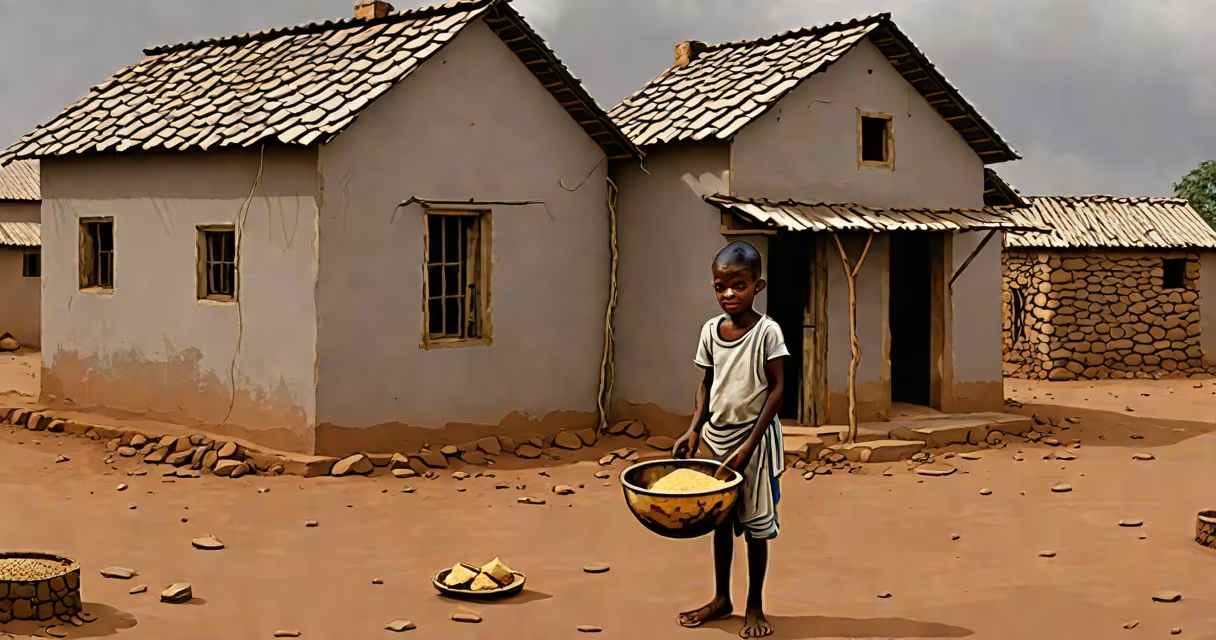
Many assume extreme poverty means "living in a tent with no clothes." That image persists in media coverage but misrepresents reality. Most people in extreme poverty live in modest homes-often with mud walls, tin roofs, and dirt floors-but they are not homeless. They have shelter, but it lacks electricity, running water, or insulation.
Another myth is that extreme poverty is confined to Africa. While Sub-Saharan Africa accounts for 80% of the world's extreme poor, South Asia has the largest absolute number-over 300 million people. India alone had 138 million people in extreme poverty in 2020, though that number dropped to 77 million by 2022 due to expanded social protection programs.
A lesser-known correction: the $2.15 threshold is not static. It was revised in 2022 from $1.90 to reflect inflation and improved data accuracy. The change reduced the global count by about 15 million people-not because fewer were poor, but because the old line underestimated real costs in high-inflation regions like Venezuela and Zimbabwe.
In 2019, I visited a village in northern Bangladesh where families earned between $1.80 and $2.00 per day through fishing and small-scale farming. One household of six survived on $1.95 per day. They ate rice with dried fish twice a week, boiled greens, and drank well water. Their children walked 2 kilometers to school each day. They owned a single plastic chair and a kerosene lamp.
When asked if they were poor, the mother nodded. "Yes," she said, "but we are not starving." Her husband added, "We are not rich, but we are not begging." Their situation fits the extreme poverty definition precisely-below $2.15 per day-and yet their lives included routines, relationships, and dignity. This illustrates a core truth: extreme poverty is not synonymous with despair.
Programs like Bangladesh's Social Safety Net have helped reduce extreme poverty by providing cash transfers during droughts. Since 2010, the proportion of people living below $2.15 per day fell from 42% to 18%. These results show that policy matters-even small changes in targeting and delivery can lift millions out of deprivation.