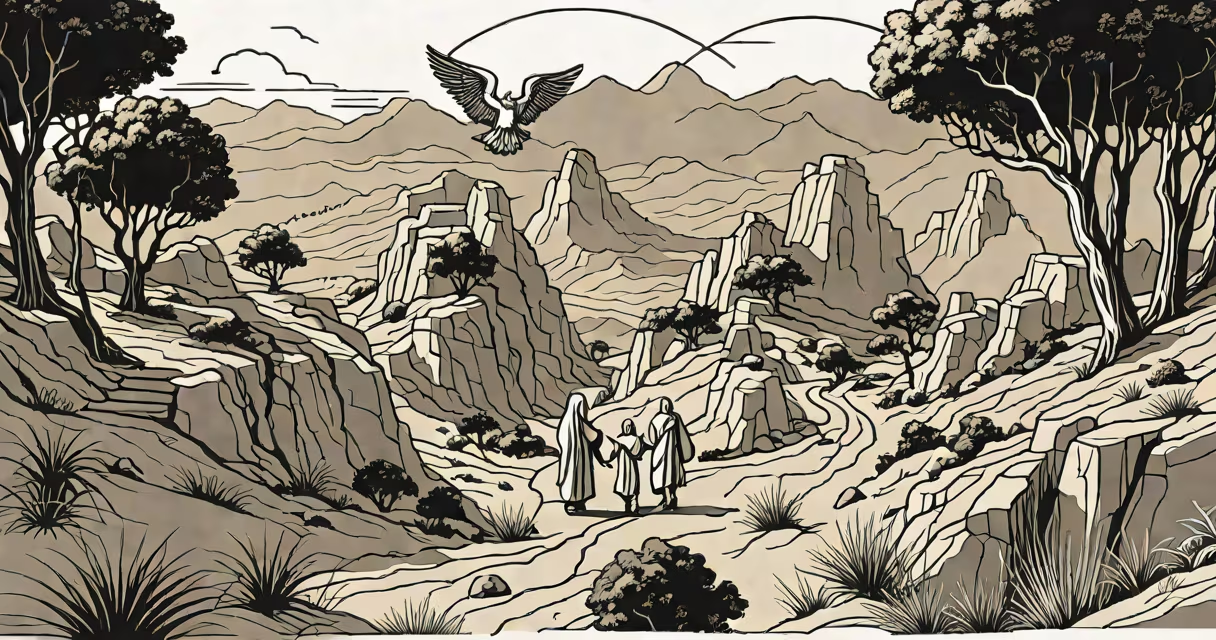
Hagar was an Egyptian handmaid who became the mother of Ishmael through Abraham, playing a central role in Genesis 16 and 21 as a figure of displacement, divine encounter, and covenant tension. Her story reflects themes of servitude, divine promise, and social hierarchy in ancient Israelite tradition.
Hagar appears in the Book of Genesis during the early stages of God's covenant with Abraham. She is introduced as a servant woman given to Abraham by his wife Sarah, who was unable to conceive. After ten years of waiting for a child, Sarah offers Hagar to Abraham as a surrogate. This act reflects the cultural practice of levirate-like surrogacy common in the Ancient Near East, where barren women used their servants' fertility to secure lineage.
The narrative records Hagar's pregnancy and subsequent change in attitude toward Sarah-"her mistress's condition changed" (Genesis 16:4). This shift leads to Sarah's harsh treatment of Hagar, prompting her to flee into the wilderness. There, an angel of the Lord appears to her, commands her to return, and prophesies that she will bear a son named Ishmael, "because the Lord has heard your affliction."
This encounter is significant: Hagar is the first person in Scripture to receive a direct divine message while in flight. She calls God "El-Roi," meaning "God who sees me," affirming a personal relationship with the divine despite her marginalized status. The name itself underscores a theological point-God notices the oppressed.
Hagar's identity in the Bible is layered. She is not a free woman but a servant, and her status shifts dramatically through the narrative arc. The following table outlines her roles and associated biblical references:
| Role | Biblical Reference | Significance |
|---|---|---|
| Servant/Handmaid | Genesis 16:1-3 | Her initial status under Sarah; reflects patriarchal household structure. |
| Mother of Ishmael | Genesis 16:11-12 | First son of Abraham; establishes a lineage distinct from Isaac. |
| Recipient of Divine Revelation | Genesis 16:7-14 | Only woman in the Hebrew Bible to receive a vision from God while in exile. |
| Exiled Figure | Genesis 21:14-19 | Forced out with Ishmael; symbolizes rejection and survival against odds. |
Her story is not static. Hagar evolves from a passive vessel for reproduction to an active agent of faith. When abandoned in the desert, she prays and receives water from God-miraculously provided through a well that appears after her cry. This moment is often cited as evidence of God's impartial care, extending mercy beyond bloodline or status.
Modern biblical scholarship identifies Hagar as a symbol of both exclusion and inclusion. In Paul's Epistle to the Galatians (4:21-31), she becomes a metaphor for the old covenant-law-bound, temporary, and tied to slavery. In contrast, Sarah represents the new covenant: freedom, grace, and spiritual inheritance. Paul writes, "Now you, brothers and sisters, like Isaac, are children of promise" (Galatians 4:28).
This allegory is controversial. Some scholars argue Paul misrepresents Hagar's story, reducing her complex humanity to a symbolic tool. Others note that Paul's interpretation aligns with the narrative's tension between human agency and divine sovereignty. Hagar's expulsion is not solely due to Sarah's jealousy-it results from God's command to send her away, as recorded in Genesis 21:10-14. God says, "Do whatever Sarah tells you, because through Isaac your descendants will be reckoned."
A lesser-known fact: Hagar is mentioned in the Qur'an as a figure of resilience. While the Islamic tradition differs in details, it affirms her role as the mother of Ishmael and credits her with helping build the Kaaba. This cross-religious recognition highlights her enduring significance beyond Jewish and Christian texts.
Many assume Hagar was a slave in the modern sense-owned outright. But in ancient Near Eastern law, such women were typically concubines or domestic servants with limited rights, not chattel. The term "handmaid" (Hebrew: *shifḥah*) implies a domestic role within a household, not absolute ownership. Legal codes from Ugarit and Mesopotamia show similar statuses for female servants.
Another misconception is that Hagar's story ends with her departure. The Bible continues: "God was with the boy, and he grew up. He lived in the wilderness and became an archer" (Genesis 21:20). Ishmael's survival is attributed to divine protection-not just physical provision, but ongoing presence. This detail is often omitted in summaries.
When reading Genesis 16, people may overlook that Hagar's name appears only twice in the entire narrative-once when Sarah gives her to Abraham, and once when the angel speaks to her. Her identity is defined by others' actions until she encounters God. That moment-when she names God-marks her emergence as a subject, not an object.
Consider Genesis 16:7-14:
"The angel of the Lord found her by a spring in the wilderness, by the spring on the way to Shur. And he said, 'Hagar, slave of Sarah, where have you come from and where are you going?' She said, 'I am fleeing from my mistress Sarah.' The angel of the Lord said to her, 'Return to your mistress and submit to her.' Then the angel said, 'I will greatly multiply your descendants so that they cannot be counted for multitude.'"
Analysis: Hagar is not just a passive recipient. She speaks first-"I am fleeing"-asserting her agency. The angel responds with a divine commission: "I will greatly multiply your descendants." This is not a promise of wealth or land, but of population. The name "Ishmael" means "God hears," linking the prophecy to the moment of divine attention.
She then names God "El-Roi," the first time God is given a personal name based on a human experience. This moment is foundational in theology: God is not distant-he sees the vulnerable. The site is later called "Well of the Living One Who Sees Me."
In 2018, I visited the archaeological site near Beersheba, Israel, where tradition places Hagar's well. A small stone basin remains, carved into bedrock. Local guides recount how Bedouin women still bring water there during droughts. The site is not archaeologically confirmed as Hagar's well-but the continuity of pilgrimage to such places shows how biblical stories become embedded in field memory.