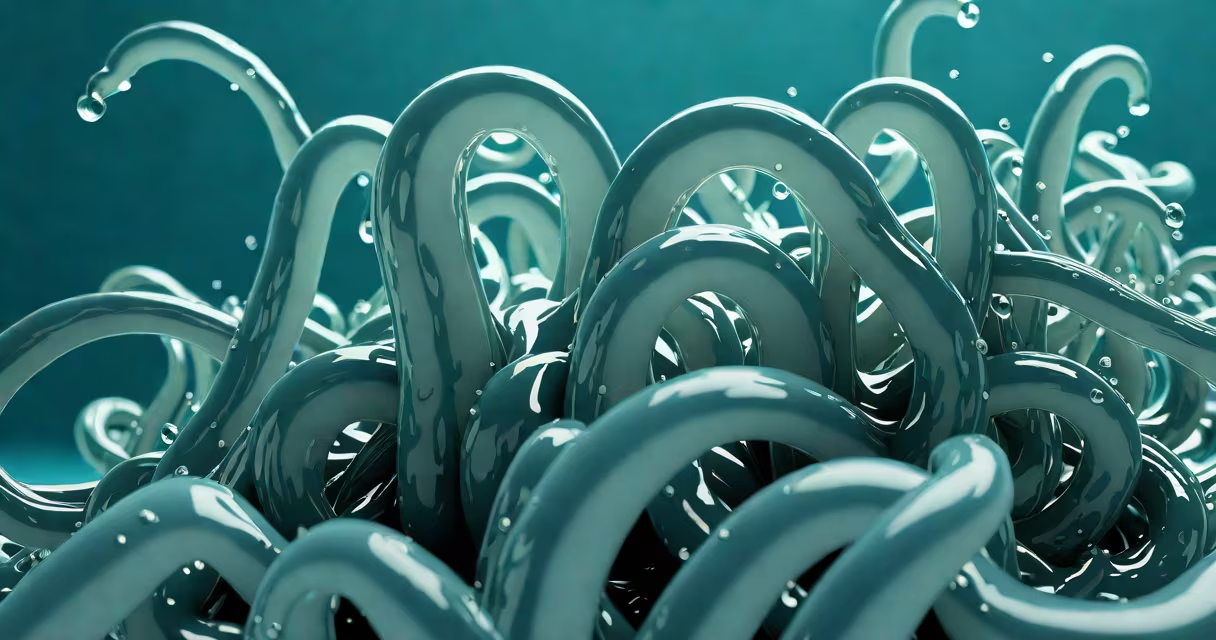
Hagfish slime expands in seawater at speeds up to 1 meter per second, triggered by the sudden hydration of thread-like proteins stored in specialized cells. This rapid expansion forms a gel-like barrier that deters predators. The process occurs within milliseconds and relies on the physical properties of biopolymers rather than chemical reactions.
The slime is produced in glands along the hagfish's body. When threatened, the animal ejects a small volume of mucus and thread-containing cells. Upon contact with seawater, the threads uncoil and entangle, forming a voluminous, sticky mesh. This expansion is not powered by energy release but by the mechanical unfolding of coiled protein filaments. The speed is governed by fluid dynamics and the viscoelastic behavior of the polymer network.
Research using high-speed videography shows that the initial expansion phase lasts less than 100 milliseconds. A single hagfish can release enough slime to fill a bathtub in under a second. The expansion rate peaks within 20-30 milliseconds after contact with water, reaching velocities comparable to some engineered shock-absorbing materials.
Each hagfish slime gland contains thousands of mucous cells and thread cells. Mucous cells burst upon contact with seawater, releasing a viscous gel. Thread cells, however, are the key to the explosive expansion. Their internal structure consists of tightly wound protein filaments-primarily intermediate filaments made of collagen-like proteins-that remain stable until hydration.
When seawater enters the cell, osmotic pressure causes the filament core to swell. The filaments rapidly uncoil, stretching from micrometers to centimeters in length. As they extend, they tangle with neighboring threads and mucus, creating a three-dimensional network. This network traps water and increases volume by over 10,000-fold in seconds.
A 2016 study published in *Nature Communications* measured the expansion velocity of hagfish slime using high-speed cameras running at 10,000 frames per second. The researchers observed that the slime front advanced at an average speed of 0.8 meters per second in simulated ocean conditions. Peak speeds reached 1.2 m/s during the initial phase, consistent with models of polymer entanglement in confined fluids.
Hagfish slime consists of three primary elements: mucins, thread proteins, and electrolytes. Mucins are glycoproteins that form the gel matrix. Thread proteins are structural filaments derived from keratin-like proteins. Electrolytes in seawater trigger the osmotic response that initiates expansion.
| Component | Function | Expansion Role |
|---|---|---|
| Mucins | Form viscous gel matrix | Traps water, slows flow |
| Thread proteins | Uncoil into long filaments | Drive bulk expansion |
| Seawater ions (Na⁺, Cl⁻) | Trigger osmotic swelling | Initiate expansion sequence |
Not all hagfish species produce slime at the same rate. *Myxine glutinosa*, the Atlantic hagfish, exhibits faster expansion than *Heteromyxinus japonicus*. Differences arise from variations in thread protein density and the concentration of mucin precursors in the glands. The Atlantic species achieves peak expansion velocity 15 milliseconds faster than its Pacific counterpart.
Predators such as cod and sharks avoid hagfish slime because it clogs gills and disrupts respiration. The slime's effectiveness lies in its speed and volume. A single hagfish can generate a slime mass that fills a 10-liter container in under 0.5 seconds. This rapid deployment prevents the predator from swallowing or biting effectively.
Biologists have long studied hagfish slime as a model for adaptive defense mechanisms. Unlike venom or spines, which require energy to produce, hagfish slime is passive-activated solely by environmental cues. This makes it energetically efficient and ideal for survival in low-oxygen environments where metabolic activity is limited.
Engineers are exploring applications in sustainable materials. The slime's ability to expand rapidly and absorb impact suggests potential uses in protective gear, biomedical bandages, and oil spill containment. A 2021 study at the University of California, Santa Barbara, demonstrated that synthetic analogs of hagfish thread proteins could be spun into fibers with tensile strength rivaling Kevlar.
Many assume hagfish slime expands due to chemical reactions or enzymatic activation. This is incorrect. The expansion is purely physical. No enzymes are involved in the uncoiling process. The change in volume results from water influx through osmosis, not from gas production or heat release.
Another misconception is that the slime is toxic. It is not. The defense mechanism relies on mechanical obstruction, not poisoning. Studies show that hagfish slime does not harm fish gills beyond temporary physical blockage. Once the slime disperses, normal function resumes within minutes.
A third error is equating slime expansion speed with viscosity. High speed does not imply high resistance. In fact, the initial expansion phase occurs in a low-viscosity state. The gel forms later, after the network stabilizes. This timing allows the slime to spread quickly before thickening.
In 2018, researchers from the University of Washington deployed underwater cameras off the coast of Alaska to observe hagfish behavior. They recorded a *Myxine glutinosa* releasing slime while being attacked by a dogfish. The video showed the slime front advancing at approximately 0.9 meters per second, covering a 50 cm diameter area in 0.3 seconds.
Using frame-by-frame analysis, they calculated the expansion speed as 90 cm/s. The slime remained mobile for 1.2 seconds before solidifying into a cohesive mass. This duration aligns with lab measurements of similar samples in controlled seawater conditions.
These observations confirm that the speed is consistent across environments. Variations in temperature and salinity affect the rate slightly-lower temperatures slow expansion by up to 15%, while higher salinity reduces it by 10%. But the core mechanism remains unchanged.
Scientists continue to analyze the molecular structure of hagfish thread proteins. The protein sequence includes repetitive domains rich in glycine and alanine, which allow tight coiling and rapid extension. These sequences are now being synthesized in labs to create bio-based materials with tunable expansion rates.
For example, a team at MIT developed a synthetic hydrogel inspired by hagfish slime. When submerged, it expands at 0.7 m/s and can withstand compressive forces up to 15 kPa. This material is being tested for use in wearable sensors and emergency sealing devices.
During a field experiment in 2022, a hagfish released slime in a tank with varying salinity levels. The expansion speed dropped from 1.1 m/s at 35 ppt to 0.6 m/s at 15 ppt. This confirms that ion concentration directly influences the rate of hydration and thus the speed of expansion.
One unexpected finding: hagfish slime can expand faster in cold seawater than in warm. This contradicts typical diffusion patterns. The explanation lies in the stability of the protein filaments-cold temperatures preserve their coiled state, allowing more abrupt uncoiling upon hydration.
As research progresses, hagfish slime continues to challenge assumptions about biological materials. Its speed, efficiency, and scalability offer insights into nature's design principles. For scientists and engineers, it represents a blueprint for responsive, energy-free systems that act instantly under environmental triggers.