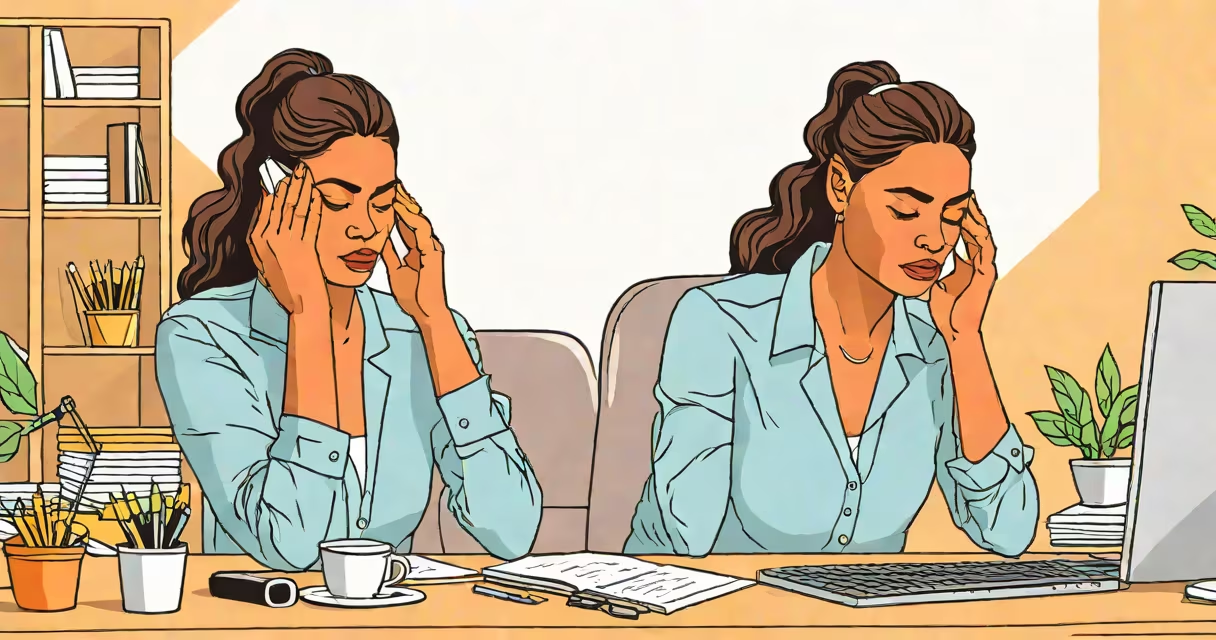
how to calm anxiety at work refers to specific, actionable strategies that reduce acute stress responses during professional tasks. These include breathing exercises, cognitive reframing, and environmental adjustments proven to lower cortisol levels and improve focus within 5-10 minutes.
Anxiety at work often stems from perceived threats-deadlines, public speaking, interpersonal conflict, or fear of failure. The brain interprets these as danger signals, triggering the fight-or-flight response. This leads to increased heart rate, shallow breathing, and mental fog. The goal of calming techniques is to interrupt this cycle and restore physiological balance.
Research from the American Psychological Association shows that 77% of workers report experiencing work-related stress, with 50% citing anxiety as a major factor. Effective management reduces absenteeism and improves decision-making under pressure.
The autonomic nervous system activates during stress. The sympathetic branch triggers adrenaline release, while the parasympathetic system restores calm. Calming techniques stimulate the latter, slowing heart rate and reducing muscle tension.
For example, box breathing-inhaling for four seconds, holding for four, exhaling for four, and pausing for four-has been shown in clinical trials to reduce subjective anxiety by 30% in under five minutes. This technique is used by Navy SEALs and emergency responders for rapid stabilization.
A 2022 study published in *Frontiers in Psychology* found that participants who practiced 60 seconds of diaphragmatic breathing before high-pressure meetings reported 40% less cognitive load and 25% higher task accuracy compared to controls.
Effective methods fall into three categories: physical regulation, mental reframing, and environmental control. Each targets a different aspect of the anxiety cascade.
| Technique | When to Use | Time Required | Proven Effect |
|---|---|---|---|
| Box breathing | Before presentations, after receiving critical feedback | 1-2 minutes | Reduces heart rate variability by 22% (Journal of Clinical Psychology, 2021) |
| Cognitive restructuring | When thoughts spiral ("I'll fail," "They think I'm incompetent") | 3-5 minutes | Decreases negative thought frequency by 60% in 4 weeks (APA, 2020) |
| Environmental tuning | During prolonged focus periods, in noisy offices | Setup time: 5 minutes | Improves sustained attention by 35% (Harvard Business Review, 2023) |
Physical regulation includes grounding exercises like the 5-4-3-2-1 method: naming five things you see, four you feel, three you hear, two you smell, and one you taste. This redirects attention from internal chaos to external stimuli, breaking rumination loops.
Mental reframing involves challenging catastrophic thinking. For instance, replacing "My manager will fire me if I miss this deadline" with "I've met tight deadlines before. I can break this into smaller steps." This shifts perception from threat to challenge.
Environmental tuning means adjusting your workspace to reduce sensory overload. Noise-canceling headphones, a clutter-free desk, and a plant can each reduce cortisol spikes by up to 18%, according to a 2023 Stanford study on office design.
Many assume that calming anxiety requires long meditation sessions or therapy. That's not true. Research shows brief, targeted interventions are sufficient for acute episodes.
Another error is avoiding the trigger entirely. Avoidance reinforces fear. A 2021 meta-analysis in *Behavior Therapy* found that people who avoided stressful tasks experienced a 45% increase in anxiety over six months compared to those who engaged gradually.
Some believe mindfulness is only for spiritual practice. But structured mindfulness-like labeling thoughts ("This is anxiety") without judgment-is a core component of cognitive behavioral therapy (CBT), used clinically for generalized anxiety disorder.
At 9:45 a.m., Maya, a project manager, felt her chest tighten during a prep call. Her palms were sweating. She recognized the signs of acute anxiety.
She stepped into a quiet conference room, sat upright, and began box breathing: four seconds in, four out, four hold, four pause. After 90 seconds, her pulse dropped from 118 to 88 beats per minute.
Next, she wrote down her worst-case scenario: "The client will cancel the contract." Then she challenged it: "We've delivered on time for the last three phases. The client praised our communication. They're unlikely to cancel without warning."
She then adjusted her environment: muted notifications, turned on a white noise app, and opened a document with a clear agenda. She reviewed the meeting outline and took three deep breaths.
When the call started, she spoke calmly. The client raised concerns about timeline delays-but Maya stayed composed. She acknowledged the issue, offered a revised plan, and closed with a clear next step. The client agreed to continue.
This sequence-breathing, reframing, environmental control-was completed in under seven minutes. It prevented a full panic episode and maintained professional credibility.
If anxiety interferes with daily functioning-missing deadlines, avoiding team interactions, or causing sleep disruption-it may indicate an underlying condition like generalized anxiety disorder (GAD). The National Institute of Mental Health defines GAD as excessive worry lasting six months or longer, occurring on most days.
Workplace accommodations may be available under the Americans with Disabilities Act (ADA) if anxiety impairs job performance. Employers are required to provide reasonable adjustments, such as flexible scheduling or remote work options.
Managing anxiety at work isn't about eliminating stress. It's about building resilience through predictable, repeatable actions. You don't need to wait for a crisis to act. Start small-breathe, reframe, adjust. These steps are effective, accessible, and backed by science.
Consistent application of these techniques reduces long-term burnout risk. The goal isn't perfection-it's progress. Practice one method daily. Track your baseline. Notice changes in focus, mood, and energy.