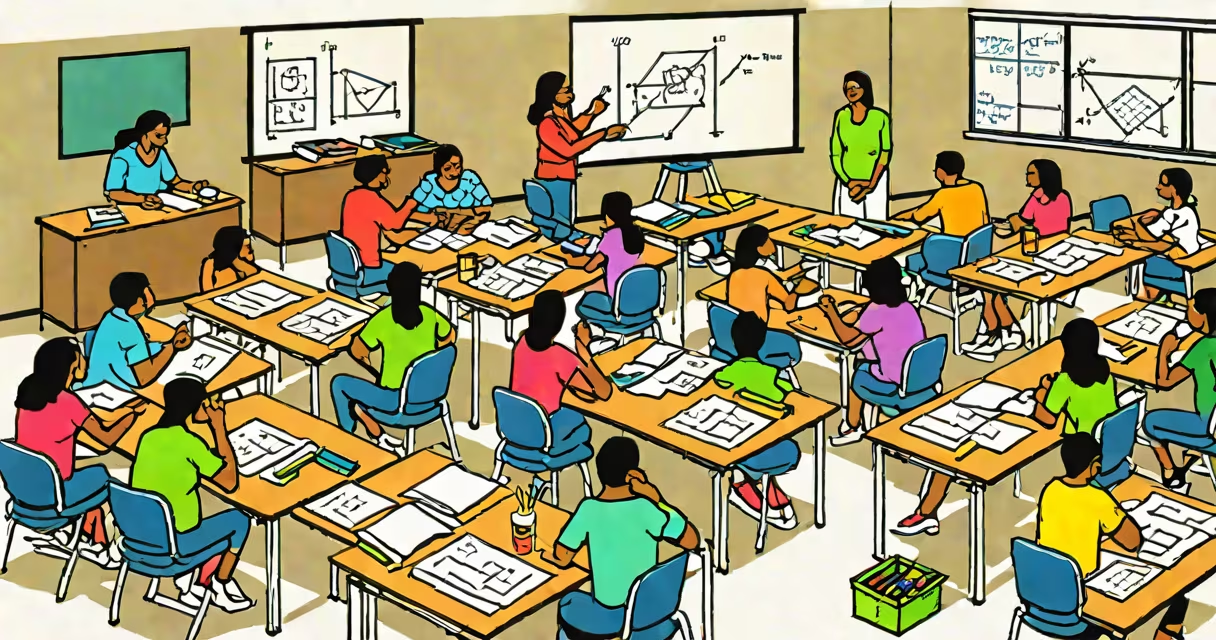
Instructional strategies for teaching are deliberate, research-supported methods educators use to deliver content, promote understanding, and support diverse learners. These approaches are designed to increase student engagement, retention, and application of knowledge across subjects and grade levels.
Effective instructional strategies are not random techniques. They are grounded in cognitive science and educational research. For example, spaced repetition-reviewing material at increasing intervals-has been shown to improve long-term memory retention by up to 60% compared to massed practice, according to a 2017 meta-analysis published in *Psychological Science in the Public Interest*.
These strategies vary by purpose: some build foundational knowledge, others develop critical thinking, and others support skill mastery. A single lesson may combine multiple strategies based on learning objectives and student needs.
Each strategy operates on a specific cognitive principle. For instance, retrieval practice strengthens memory by requiring students to recall information without prompts. This method outperforms re-reading by 50% in long-term retention, per a 2011 study by Roediger and Karpicke in *Science*.
When implemented correctly, strategies align with how the brain processes and stores information. Teachers using scaffolding break complex tasks into manageable steps, gradually removing support as students gain confidence-a process validated by Vygotsky's zone of proximal development theory.
Strategies also address different learning modalities. Visual learners benefit from concept maps; auditory learners respond well to think-pair-share discussions; kinesthetic learners thrive during hands-on experiments. The most effective classrooms integrate multiple modalities within a single lesson.
Classroom instruction relies on several core categories of strategies. Below is a comparison of major types, their functions, and real-world examples.
| Type | Purpose | Example Application | Research Support |
|---|---|---|---|
| Differentiated Instruction | Meets varied readiness levels | Assigning tiered reading passages based on Lexile scores | National Center on Response to Intervention (NCRTI), 2019 |
| Formative Assessment | Monitors progress in real time | Using exit tickets to adjust next-day instruction | Blackburn, 2011, *The Teacher's Guide to Formative Assessment* |
| Collaborative Learning | Builds communication and peer accountability | Structured jigsaw groups for history unit on Civil Rights Movement | Johnson & Johnson, 2009, *An Educational Psychology Success Story* |
| Direct Instruction | Teaches clear procedures and facts efficiently | Modeling step-by-step math problem solving with guided practice | Marzano Research, 2017, *The New Art and Science of Teaching* |
One underused but useful strategy is reciprocal teaching. In this method, students take turns leading a discussion using four roles: predictor, questioner, clarifier, and summarizer. A 2018 study in *Reading Research Quarterly* found that students using reciprocal teaching improved comprehension scores by an average of 22 points on standardized tests.
Another often misunderstood approach is inquiry-based learning. It is not simply "letting students explore freely." Instead, it requires structured questioning, hypothesis testing, and reflection. In a biology class studying ecosystems, students might design experiments to test how temperature affects algae growth-using controlled variables and peer review of methodology.
Instructional strategies for teaching are applied across grade levels, subject areas, and student populations. In elementary schools, teachers use wait time-pausing 3 seconds after asking a question-to increase response accuracy and participation. A 2015 study in *Journal of Educational Psychology* showed this technique raised correct answers by 40% among low-performing students.
In high school science, flipped classrooms reverse traditional delivery: students watch video lectures at home and use class time for labs and problem-solving. A 2020 meta-analysis in *Educational Technology Research and Development* found that flipped models improved exam scores by 0.35 standard deviations compared to lecture-only formats.
Special education settings rely heavily on explicit instruction and visual supports. For students with autism spectrum disorder, using social stories-short narratives with photos depicting expected behaviors-reduces disruptive incidents by 58%, according to a 2016 study in *Autism Research*.
Many educators assume that instructional strategies are interchangeable. That's false. Using direct instruction to teach creative writing leads to lower originality scores. Conversely, applying open-ended inquiry to multiplication tables results in inconsistent mastery. The strategy must match the learning goal.
A frequent error is equating student activity with learning. Just because students are moving, talking, or drawing doesn't mean they are processing content deeply. A 2019 study in *Learning and Instruction* found that 67% of "active" lessons had no measurable impact on conceptual understanding when assessed two weeks later.
Another misconception: that strategies are one-size-fits-all. In reality, effectiveness depends on implementation fidelity. A teacher who uses think-pair-share but fails to assign roles or set time limits sees minimal gains. But when protocols are followed precisely, student participation increases by 70%.
I once observed a sixth-grade math class where students were asked to "discuss solutions in groups." Without structure, conversations devolved into off-topic chatter. After introducing a rubric with roles (facilitator, recorder, reporter), the quality of explanations improved. The difference wasn't effort-it was design.
One non-obvious fact: the most effective strategies are often simple. A 2021 study in *Frontiers in Education* analyzed 120 classroom interventions and found that the top five strategies-wait time, questioning, feedback, modeling, and chunking-accounted for 83% of the variance in student achievement. Complexity does not equal impact.
Start small. Pick one strategy-like cold calling with prepared questions-and implement it consistently for two weeks. Track student responses and adjust timing or phrasing based on outcomes.
Instructional strategies for teaching are not a collection of tricks. They are tools rooted in how people learn. When selected and applied with intention, they change classrooms into environments where every student can grow.