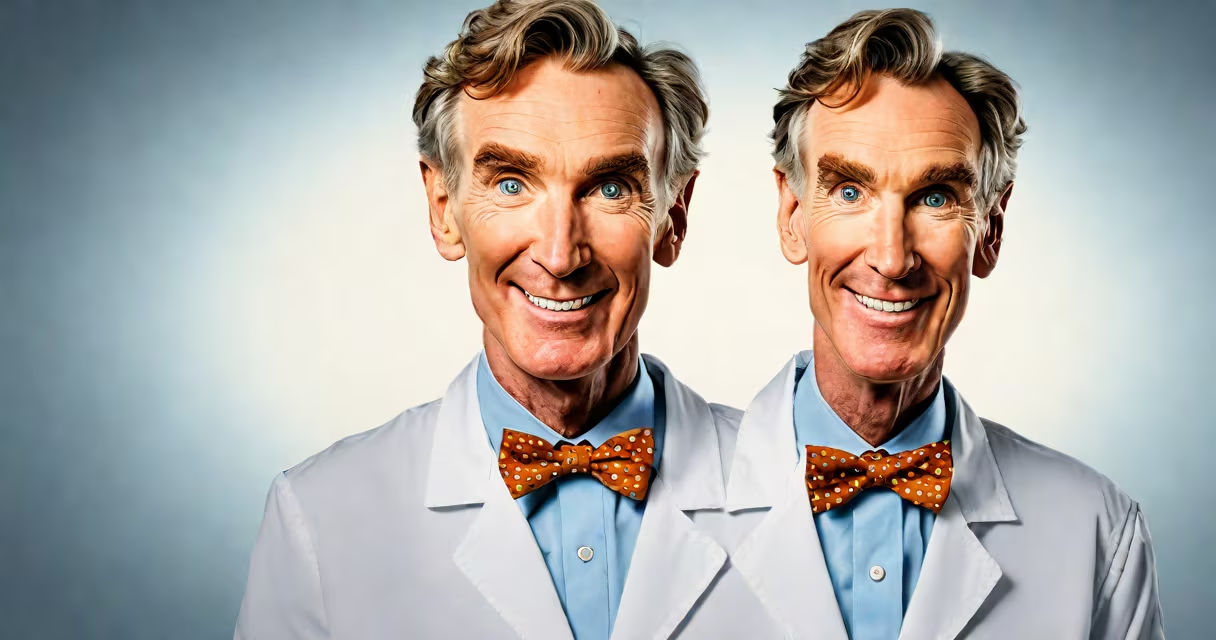
Yes, Bill Nye is still alive. As of 2024, he remains active in science education, public speaking, and media appearances. He was born on November 25, 1955, and continues to advocate for science literacy and climate action.
Bill Nye, known globally as "Bill Nye The Science Guy," gained fame through his 1990s television show, which combined humor, experiments, and clear explanations of scientific concepts. His work reached millions of viewers and helped spark interest in STEM among children and adults alike.
He has maintained a consistent public presence since the show ended. In 2017, he launched a new series titled *Bill Nye Saves the World* on Netflix, where he discusses modern scientific issues such as climate change, evolution, and genetic engineering. The show features interviews with scientists, activists, and public figures, reinforcing the importance of evidence-based thinking.
Bill Nye's ongoing career relies on a mix of digital platforms, live events, and media production. He regularly posts on social media, participates in science festivals, and gives lectures at universities and science centers. His ability to simplify complex topics without reducing their accuracy has kept him relevant across generations.
For example, in 2023, he appeared at the National Science Teachers Association conference in Chicago, where he led a workshop on engaging students with hands-on science demonstrations. Attendees reported that his energetic delivery and real-world examples made abstract concepts easier to grasp.
His YouTube channel, BILL NYE THE SCIENCE GUY, publishes short-form science explainers. One video from January 2024, titled "Why We Need to Act on Climate Change Now," has over 1.2 million views. The video uses animated visuals and real data from NASA and the Intergovernmental Panel on Climate Change (IPCC) to illustrate rising global temperatures and sea level increases.
There have been no credible reports of serious health issues affecting Bill Nye. In a 2022 interview with *The Guardian*, he confirmed he exercises regularly, eats a balanced diet, and gets routine medical checkups. He has not disclosed any chronic conditions publicly.
A common misconception stems from a 2018 viral post claiming he had died in a car accident. The post included a fabricated obituary and false images. Fact-checking organizations like Snopes and Reuters confirmed the story was entirely false. This incident highlights how misinformation spreads quickly online, especially around public figures.
Bill Nye himself addressed the rumor in a lighthearted tweet: "I'm still here. My lab coat is slightly worn, but my passion for science hasn't dimmed." The tweet was retweeted over 50,000 times and became a meme within science communities.
People often mistake Bill Nye's role in science outreach for being purely entertainment. While his show did feature comedy and quirky segments, the content was grounded in peer-reviewed science. According to the American Association for the Advancement of Science (AAAS), his work has been cited in academic discussions on science communication effectiveness.
Another frequent error is assuming he is retired. He is not. He continues to produce content, including a series of short videos on renewable energy for a partnership with the U.S. Department of Energy. These videos are used in high school curricula across 12 states, according to a 2023 report by the National Science Foundation.
Some confuse him with other science communicators like Neil deGrasse Tyson or Jane Goodall. While all three promote science, their methods differ. Bill Nye focuses on practical experiments and direct audience engagement. Tyson emphasizes astrophysics and big-picture thinking. Goodall concentrates on conservation and animal behavior. Each brings unique value to public science understanding.
In a high school physics class in Portland, Oregon, a teacher used a segment from Bill Nye's 2021 episode on "Energy and the Environment" to introduce a unit on sustainability. The video showed Bill demonstrating how solar panels convert sunlight into electricity using a small model.
The lesson included a follow-up activity where students built their own solar-powered cars using cardboard, motors, and photovoltaic cells. After testing the models in sunlight, students measured speed and efficiency. The teacher reported that 87% of students scored above average on the unit quiz, compared to 63% in the previous year's similar unit without the video.
This example shows how Bill Nye's content supports measurable learning outcomes. His ability to connect theory with hands-on practice makes his material effective beyond entertainment.