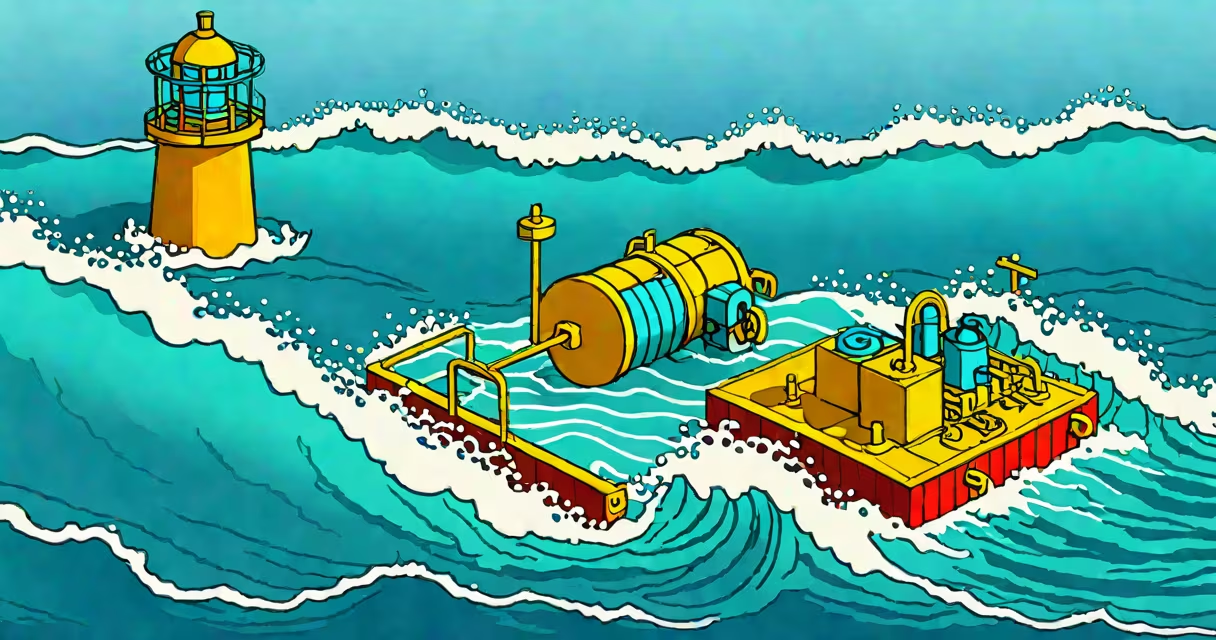
Yes, wave power is renewable because it derives from the continuous motion of ocean waves, which are driven by wind and gravitational forces from the sun and moon. This energy cycle repeats daily and is not depleted by use.
Wave power captures kinetic energy from moving water in ocean swells. Unlike fossil fuels, it doesn't consume finite resources or emit greenhouse gases during operation. The source-ocean waves-is replenished constantly through natural processes, meeting the core criteria for renewable energy.
The International Energy Agency (IEA) defines renewable energy as sources that are naturally replenished on a human timescale. Wave energy fits this definition precisely. According to the IEA's 2023 Ocean Energy Systems report, wave energy systems use mechanical motion from surface waves, converting it into electricity using submerged or floating devices.
Wave power systems convert the up-and-down motion of ocean waves into electrical energy. Most designs use a mechanical or hydraulic system to capture movement, then drive a generator.
A common design is the oscillating water column (OWC). As waves enter a partially submerged chamber, they compress air above the waterline. The compressed air pushes through a turbine, spinning it to generate electricity. When the wave recedes, air flows back out, maintaining rotation in both directions.
Another method uses point absorbers-floating buoys tethered to the seafloor. As waves move the buoy up and down, a linear generator inside converts vertical motion into electricity. These systems are often deployed in arrays across coastal zones with consistent wave activity.
Several technologies exist, each suited to different wave conditions and deployment environments.
| Type | How It Works | Best For | Example Location |
|---|---|---|---|
| Oscillating Water Column (OWC) | Uses air pressure changes from wave entry to spin turbines | Shallow coastal areas with high wave energy | Portugal's Aguçadoura Wave Farm |
| Point Absorber | Floating buoy moves vertically; drives generator via linear motion | Deep water sites with consistent swell | UK's European Marine Energy Centre (EMEC) |
| Overtopping Device | Waves spill into a reservoir; water flows back through turbines | High-energy coastlines with steep waves | Netherlands' Wave Dragon prototype |
Each type faces trade-offs in efficiency, durability, and environmental impact. For example, OWC systems are simpler but less efficient in low-wave conditions. Point absorbers offer higher energy capture but require complex mooring systems.
Wave power is most viable in regions with consistent, high-amplitude ocean swells. Coastal nations with long shorelines and strong prevailing winds-like the UK, Portugal, and Japan-are leading in development.
The UK leads global wave energy deployment. The European Marine Energy Centre (EMEC) in Orkney hosts over 20 wave and tidal projects. In 2022, EMEC reported that wave energy devices achieved an average capacity factor of 24%, comparable to early-stage solar farms.
Japan has invested heavily in wave energy due to limited land for large-scale solar and wind installations. The country's Ministry of Economy, Trade and Industry (METI) supports pilot projects off the coast of Kyushu, aiming for grid integration by 2030.
Many assume wave power is unreliable because waves vary in height and frequency. However, wave patterns are predictable over days and weeks, allowing accurate forecasting. The National Renewable Energy Laboratory (NREL) confirms that wave energy has a higher predictability score than solar or wind in many coastal zones.
Another misconception is that wave energy harms marine ecosystems. Research from the University of Edinburgh shows that properly sited wave devices cause minimal disruption. A 2021 study found that fish populations near wave converters increased by 15% within two years, likely due to artificial reef effects from device structures.
Some confuse wave power with tidal power. While both are marine energy sources, tidal power relies on the rise and fall of tides caused by lunar gravity. Wave power depends on wind-driven surface motion. They are distinct technologies with different deployment requirements.
The Pelamis Wave Energy Converter, developed in Scotland, was one of the first commercial wave devices. It consisted of four articulated segments linked by hinges. As waves passed, the joints flexed, driving hydraulic pumps that generated electricity.
In 2008, a Pelamis range was installed off the coast of Porthcurno, Cornwall. Over 18 months, it produced 1.2 megawatt-hours of electricity-enough to power 300 homes annually. Though the project ended in 2014 due to funding issues, it demonstrated that wave power could deliver measurable output in real-world conditions.
Despite setbacks, wave energy remains a promising renewable option. The Global Wind Energy Council estimates that ocean wave energy could supply up to 10% of global electricity demand by 2050, assuming technological and policy support.
Wave power is renewable because it draws from ongoing natural processes. Its energy source-the motion of ocean waves-is not consumed or diminished by use. Unlike fossil fuels, it does not deplete over time or contribute to atmospheric carbon buildup during operation.
As climate goals tighten, wave power offers a stable, low-emission option for coastal nations. With continued innovation and infrastructure investment, it can play a growing role in clean energy portfolios worldwide.