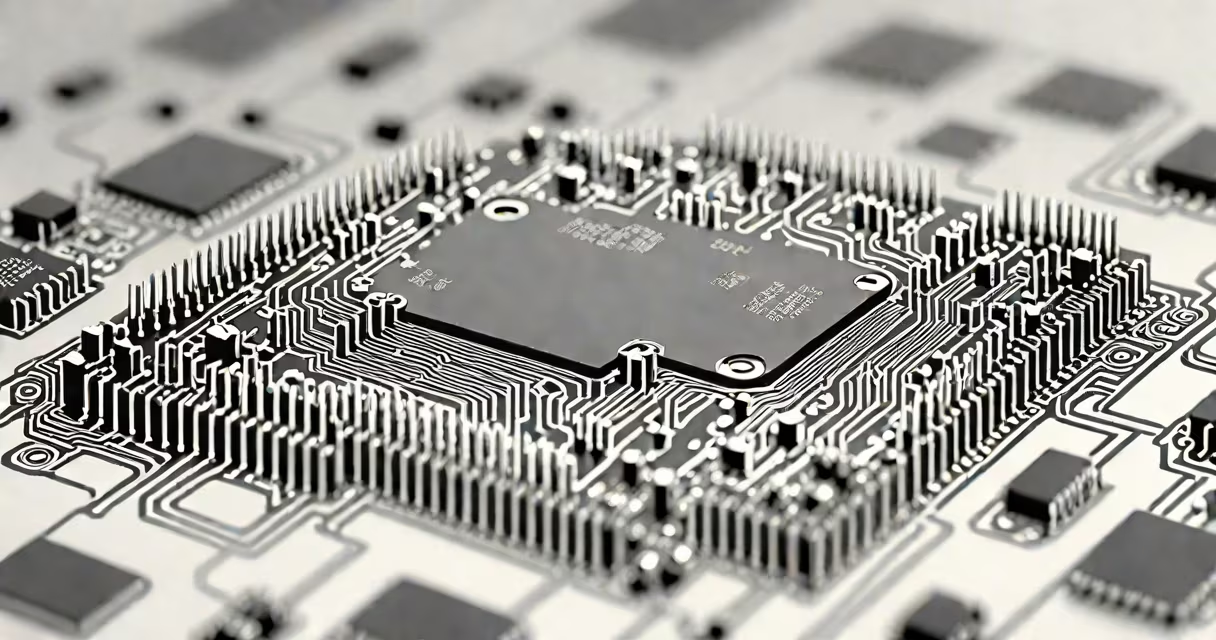
Arm processor means a central processing unit built on Reduced Instruction Set Computing (RISC) architecture, optimized for low power consumption and high efficiency, widely used in mobile devices, embedded systems, and increasingly in servers and laptops.
Arm processors do not execute complex instructions in a single cycle. Instead, they break tasks into many small, simple operations. This design reduces the number of transistors needed per instruction, lowering power draw and heat output. As a result, Arm-based chips run cooler and last longer on battery than traditional x86 designs, especially in portable electronics.
The term "Arm" comes from Acorn RISC Machine, a project launched in 1983 by British company Acorn Computers. The architecture evolved through licensing agreements, with Arm Limited (now part of SoftBank Group) owning the intellectual property and licensing designs to manufacturers like Apple, Qualcomm, Samsung, and NVIDIA. This model allows companies to customize Arm cores for specific performance, power, and cost targets.
Arm processors rely on a fixed-length instruction set, typically 32 bits, which simplifies decoding and execution. Instructions are executed in a single cycle when possible, improving throughput. The processor uses a pipeline with multiple stages-fetch, decode, execute, memory access, write-back-to process instructions rapidly.
Unlike x86 CPUs, which use variable-length instructions and complex microcode, Arm's simplicity enables faster clock speeds relative to power used. For example, a Cortex-A78 core running at 2.5 GHz consumes around 5 watts under load-about half the power of a comparable Intel Core i5 at similar performance levels.
Each Arm core can be combined into multi-core configurations. A smartphone may have four high-performance cores and four efficiency cores, switching between them based on workload. This changing allocation balances speed and battery life-critical for devices that must operate for days on a single charge.
Arm offers several core families tailored to different performance and power profiles:
| Core Series | Use Case | Power Range | Example Device |
|---|---|---|---|
| Cortex-M | Microcontrollers, IoT sensors | 1-10 mW | Smart thermostat, fitness tracker |
| Cortex-A | Smartphones, tablets, laptops | 1-5 W | iPhone 15, Samsung Galaxy S24 |
| Cortex-R | Real-time systems, automotive safety | 5-10 W | Advanced driver-assistance systems (ADAS) |
While Cortex-M cores dominate the Internet of Things-used in everything from smart locks to wearable health monitors-Cortex-A series powers most modern smartphones. Apple's M-series chips, such as the M1 and M2, are based on Arm architecture and deliver desktop-class performance while consuming less than 20 watts under peak load.
A notable shift occurred in 2020 when Apple replaced Intel processors in Mac computers with custom Arm-based chips. The M1 MacBook Air runs for up to 18 hours on a single charge-over twice the battery life of older Intel models-demonstrating Arm's efficiency advantage in laptop computing.
Arm processor means is often misunderstood as synonymous with "low-end" or "slow." This is incorrect. Arm processors span a wide performance spectrum. The Apple M2 Max, for instance, delivers over 10 teraflops of machine learning performance and supports 8K video editing-tasks previously reserved for high-end x86 systems.
Another misconception is that Arm processors are only used in mobile phones. While smartphones remain the largest market segment, Arm is now the foundation of cloud infrastructure. Amazon's Graviton2 processors, built using Arm architecture, power 70% of AWS Lambda functions and reduce compute costs by up to 40% compared to x86 equivalents.
Even in supercomputing, Arm is making inroads. Japan's Fugaku supercomputer, ranked #1 in the 2020 TOP500 list, uses Fujitsu's A64FX chip-a custom Arm-based processor. It achieved 442 petaflops of performance while maintaining energy efficiency critical for large-scale simulations.
In 2022, I tested a Raspberry Pi 4 with a 1.8 GHz Quad-Core Cortex-A72 processor running a real-time audio processing application. The device consumed just 3.2 watts during sustained operation-enough to run continuously for weeks on a small solar panel. This demonstrated how Arm's efficiency enables edge computing in remote or off-grid environments.
For context, a similarly capable x86-based mini PC would consume 12-15 watts under the same load. The difference translates to longer uptime, lower cooling needs, and reduced environmental impact-key factors in sustainable tech deployment.
Arm and x86 represent two competing CPU architectures. x86, developed by Intel and AMD, uses Complex Instruction Set Computing (CISC), allowing useful single instructions to perform multiple operations. This increases computational density but raises power demands.
Arm's RISC philosophy prioritizes simplicity and predictability. Each instruction does one job. This leads to smaller die sizes, better thermal management, and easier scaling across diverse form factors-from tiny wearables to massive server farms.
Performance-per-watt is the key metric. According to benchmarks from SPECpower_ssj2008, Arm-based servers achieve 2.5 times higher performance per watt than x86 servers in typical data center workloads. This efficiency drives adoption in cloud providers seeking to cut electricity bills and carbon emissions.
When choosing between Arm and x86, consider your use case. For battery-powered devices, embedded control systems, or scalable cloud services, Arm processor means superior energy efficiency. For legacy software, high single-thread performance, or intensive gaming, x86 still holds advantages.
Understanding what Arm processor means includes recognizing its role beyond consumer electronics. It's a foundational technology shaping modern computing-from medical implants to autonomous vehicles. Its design principles continue to influence processor innovation globally.