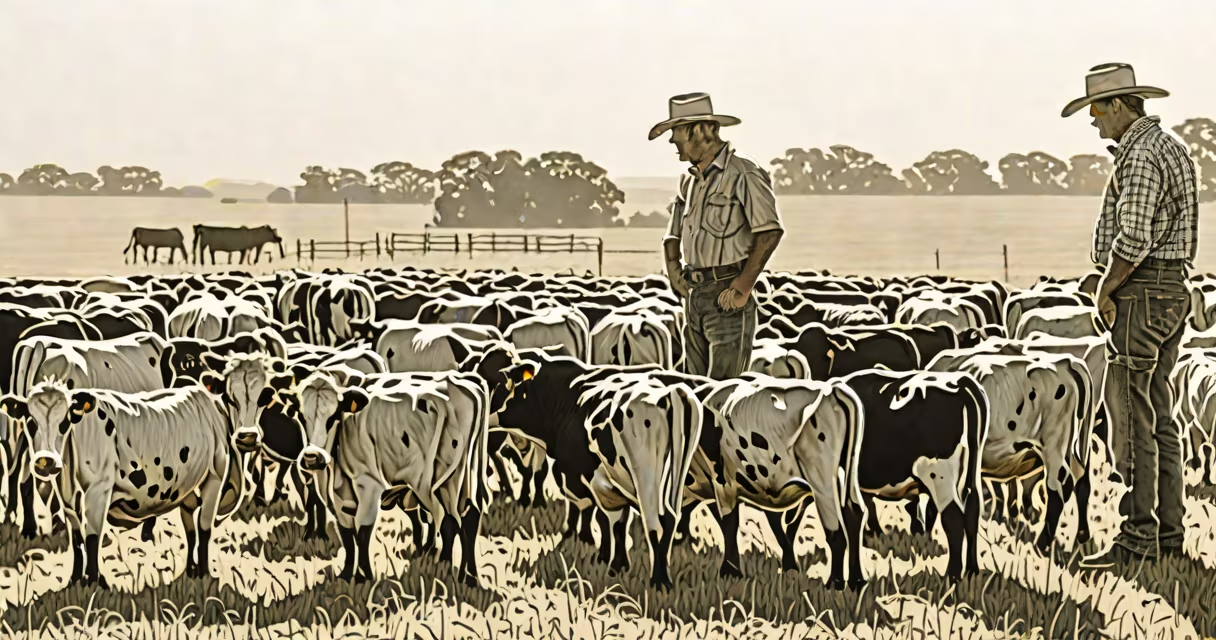
Living stock refers to live animals raised on farms for meat, milk, wool, hides, or labor. These animals form a core part of agricultural production systems worldwide.
Living stock includes cattle, sheep, goats, pigs, poultry, and sometimes horses or donkeys. They are not raw materials or finished goods-they are living biological entities managed for economic output over time. Unlike harvested crops, they grow, reproduce, and require ongoing care.
The term applies specifically to animals kept for commercial or subsistence farming. It excludes pets, zoo animals, or wild species. In accounting and agriculture, living stock is categorized as a tangible asset with fluctuating value based on weight, breed, health, and market demand.
Farmers raise living stock through breeding, feeding, medical treatment, and eventual sale or processing. Animals are tracked by age, weight, reproductive status, and health records. Their value increases over time until sold for slaughter, breeding, or resale.
For example, a dairy cow may cost $1,800 at purchase. Over 3 years, she produces 15,000 pounds of milk, generates calves, and incurs $600 in feed and veterinary costs. Her net contribution to farm income exceeds $10,000 before depreciation and taxes.
Animals are not consumed immediately. They serve as capital assets. A beef steer weighing 800 pounds at market may sell for $1.40 per pound, totaling $1,120. But its value at birth was only $600. The difference reflects growth, feed conversion efficiency, and market timing.
Major categories include ruminants (cattle, sheep, goats), swine, poultry, and equines. Each serves distinct roles in food systems and rural economies.
| Type | Primary Use | Typical Lifespan | Example Market Value (per animal) |
|---|---|---|---|
| Cattle (beef) | Meat, leather, manure | 2-4 years | $1,100-$1,600 |
| Dairy cows | Milk, cheese, yogurt | 5-7 years | $2,500-$4,000 |
| Pigs | Pork, bacon, lard | 1-2 years | $400-$600 |
| Chickens (broilers) | Meat | 6-8 weeks | $1.50-$2.50 |
| Sheep | Lamb, mutton, wool | 3-5 years | $200-$400 |
Some animals serve dual purposes. A dual-purpose goat may provide milk and meat. A working horse can plow fields and later be sold for meat. These multi-use animals increase farm resilience.
Not all living stock is raised for consumption. Heritage breeds like the Dexter cattle or Jacob sheep are kept for biodiversity, cultural preservation, or niche markets. Their value lies beyond immediate profit.
Living stock is often confused with "livestock" as a synonym. While synonymous in everyday speech, "living stock" emphasizes the biological and financial status of animals as assets in motion. "Livestock" is broader-it includes dead animals in transit, embryos, and even processed products in some regulatory contexts.
A key distinction: living stock is not inventory in the traditional sense. Inventory implies stored goods awaiting sale. Living stock changes daily-grows, gets sick, gives birth. Its value is changing and subject to market volatility, weather, disease outbreaks, and trade policy shifts.
For example, during the 2020 U.S. pandemic lockdowns, meatpacking plants closed. Demand for live cattle dropped. Prices fell 30% in six weeks. Farmers holding living stock faced losses despite healthy animals. This illustrates that value is not inherent-it depends on access to markets.
Another misconception: all living stock is profitable. In reality, many small-scale farmers operate at a loss due to high feed costs, poor infrastructure, or lack of access to credit. According to the USDA, nearly 40% of small U.S. farms report negative net income annually, even with living stock.
In 2022, a Nebraska rancher bought 50 heifers at $1,200 each. He spent $35,000 on feed, vaccinations, and pasture maintenance over 18 months. After fattening, he sold them at 1,200 lbs live weight for $1.35 per pound. Total revenue: $810,000.
Net profit: $810,000 - $35,000 - $60,000 (initial purchase) = $715,000. The living stock generated $14,300 profit per animal.
This outcome depended on accurate weight estimation, timely marketing, and disease control. Without proper management, the same herd could have lost money due to illness or low market prices.
When managing living stock, farmers must track daily gains, monitor feed conversion ratios, and respond quickly to signs of stress or disease. Tools like RFID tags, mobile apps, and AI-based health monitoring are increasingly used to improve accuracy and reduce losses.
According to the FAO, livestock provides 18% of global calories and 20% of protein intake. In sub-Saharan Africa, over 70% of rural households depend on living stock for income and nutrition.
These animals support food security, especially in regions with poor soil or unreliable rainfall. Pastoralists in Kenya and Ethiopia rely on camels and goats to sustain families during droughts. Their mobility allows access to water and grazing lands unavailable to crop farming.
However, living stock also contributes to environmental challenges. The UN Environment Programme reports that livestock accounts for 14.5% of global greenhouse gas emissions-more than all forms of transport combined. Methane from ruminants is particularly potent.
Efforts to reduce impact include improved feed formulations, rotational grazing, and selective breeding for lower methane output. Some farms now use wearable sensors to detect early signs of illness, reducing antibiotic use by up to 30%.
Recognizing the unique role of living stock helps avoid misapplication of financial models. An animal's value cannot be projected using standard DCF analysis because reproduction, mortality, and seasonal variation disrupt linear assumptions.
When evaluating farm performance, investors and analysts must account for biological variables. A calf born in spring may gain 2.5 pounds per day under optimal conditions. That rate drops during heat waves or droughts. Accurate modeling requires climate data, veterinary records, and local market intelligence.
Living stock meaning is not static. It evolves with technology, regulation, and consumer demand. As plant-based alternatives grow, the role of living stock shifts-from primary protein source to specialized, sustainable, or culturally significant product.