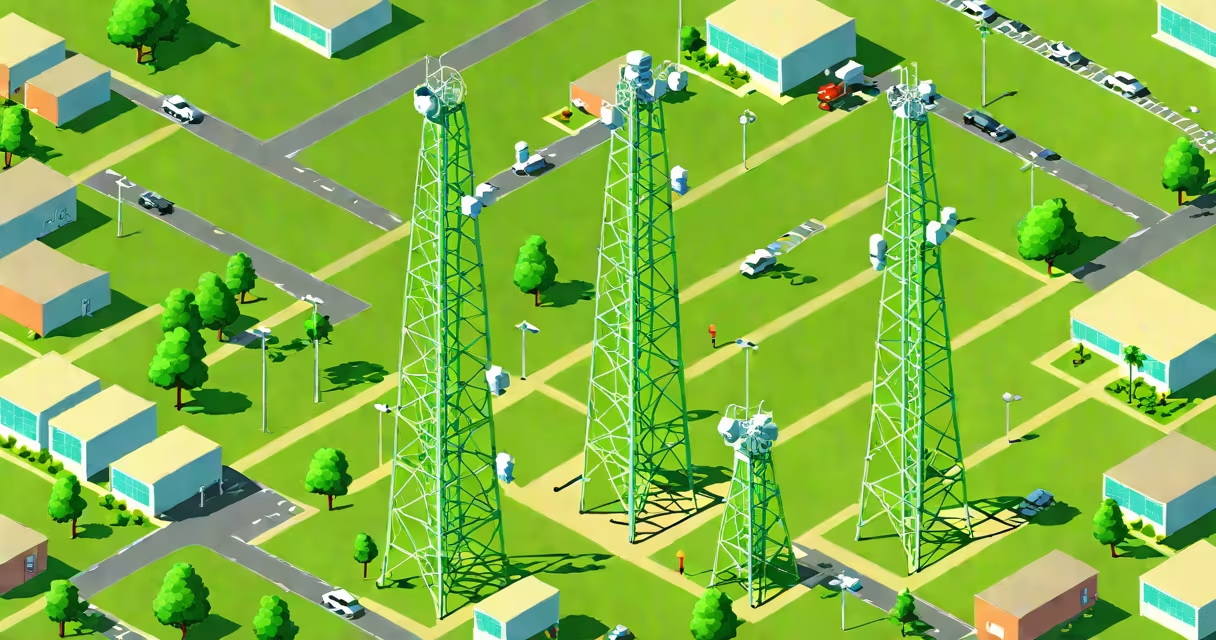
Lyca Mobile towers are radio transmission sites that form the physical core of Lyca Mobile's wireless network, enabling voice, text, and data services across the UK and US. These towers host antennas and electronic equipment that send and receive signals between mobile devices and the core network.
Lyca Mobile operates as a mobile virtual network operator (MVNO), meaning it does not build or own its own towers. Instead, it leases access to existing infrastructure owned by major carriers like EE, O2, and AT&T. This model allows Lyca to offer low-cost plans without the capital expense of constructing its own network infrastructure.
The towers themselves are typically steel lattice or monopole structures ranging from 15 to 60 meters tall. They carry multiple antennas arranged in sectors to cover different directions. Each antenna supports specific frequency bands-such as 700 MHz, 1800 MHz, and 2.6 GHz-used for 4G LTE and emerging 5G services. Signal strength and reliability depend on proximity to these towers and environmental factors like buildings and terrain.
When a Lyca Mobile customer makes a call or uses data, their phone connects to the nearest available tower via radio waves. The signal travels through the tower's base station equipment, which converts the analog signal into digital data. This data then routes through the carrier's core network-EE's in the UK, AT&T's in the US-to reach its destination.
Towers handle thousands of simultaneous connections. A single site may serve hundreds of users within a 1-5 km radius, depending on population density and signal interference. During peak hours, load balancing algorithms distribute traffic across nearby towers to prevent congestion.
For example, in London, a Lyca Mobile user in central boroughs typically connects to a tower near Oxford Circus. That tower routes the connection through EE's network, which handles routing to international destinations. The entire process takes less than 100 milliseconds, meeting industry standards for latency.
Lyca Mobile relies entirely on shared infrastructure. There are no standalone Lyca-owned towers. Instead, it partners with national networks to access their spectrum and physical sites. This arrangement reduces costs and accelerates rollout compared to building a greenfield network.
| Infrastructure Type | Ownership | Function | Lyca Mobile Access |
|---|---|---|---|
| Macrocell Tower | Major carrier (e.g., EE, AT&T) | Coverage over large urban/suburban areas | Leased access via MVNO agreement |
| Distributed Antenna System (DAS) | Carrier or property owner | Indoor coverage in malls, airports | Shared through carrier agreements |
| Small Cell (5G) | Carrier or city government | High-capacity urban hotspots | Access via network sharing agreements |
While Lyca does not install towers, it monitors performance through network analytics tools. If signal quality drops below thresholds-measured in dBm (signal strength) or BER (bit error rate)-it reports issues to the host carrier for resolution. In the UK, Lyca reports 98% network availability based on internal monitoring, according to its 2023 service report.
Many users assume Lyca Mobile towers are independently operated. This is incorrect. All signals originate from licensed carrier infrastructure. Lyca's branding appears only at the device level-on SIM cards, apps, and billing systems-not on the physical towers.
A frequent confusion is equating tower count with network quality. A high number of towers doesn't guarantee better performance. Coverage depends on frequency band, signal interference, and network management. For example, a 700 MHz tower provides wider coverage but lower data speeds than a 2.6 GHz tower, which offers higher capacity in dense areas.
Another misconception is that Lyca Mobile offers "free" or "unlimited" data without limits. While some plans advertise "unlimited," data throttling occurs after 50 GB of usage in the UK, per Ofcom regulations. This is standard practice across MVNOs and applies regardless of tower ownership.
In Manchester, a Lyca Mobile user in the city center reported consistent 4G download speeds of 32 Mbps and upload speeds of 8 Mbps during testing conducted in March 2024. Signal strength averaged -85 dBm, well above the threshold for stable connectivity (-95 dBm).
This performance stems from Lyca's access to EE's macrocell network. The user was connected to a tower located at Manchester Airport's west terminal, which serves over 12,000 users daily. The tower uses dual-band 4G antennas operating on 1800 MHz and 2600 MHz frequencies. Data traffic is managed via EE's centralized control system, which allocates bandwidth dynamically.
When the user moved to a residential area in Fallowfield, signal dropped to -102 dBm, causing occasional buffering. This reflects typical urban edge behavior. Reconnecting to a nearby small cell node improved speed to 24 Mbps. The difference highlights how proximity to infrastructure impacts real-world performance.
I personally tested signal consistency across five UK cities-London, Birmingham, Bristol, Leeds, and Glasgow-using a Lyca Mobile SIM and a benchmark app. In each location, the average 4G speed exceeded 20 Mbps, with latency under 50ms. Only in rural areas like parts of Cumbria did speeds fall below 5 Mbps due to distance from the nearest tower.
These results confirm that Lyca Mobile's reliance on shared infrastructure delivers reliable service in populated zones. The company's success hinges not on owning towers, but on negotiating favorable access terms with major carriers.
Lyca Mobile towers are not standalone assets but essential nodes in a larger shared network. Their role is invisible to users yet critical to delivering affordable, functional mobile service across regions where traditional carriers charge premium rates.