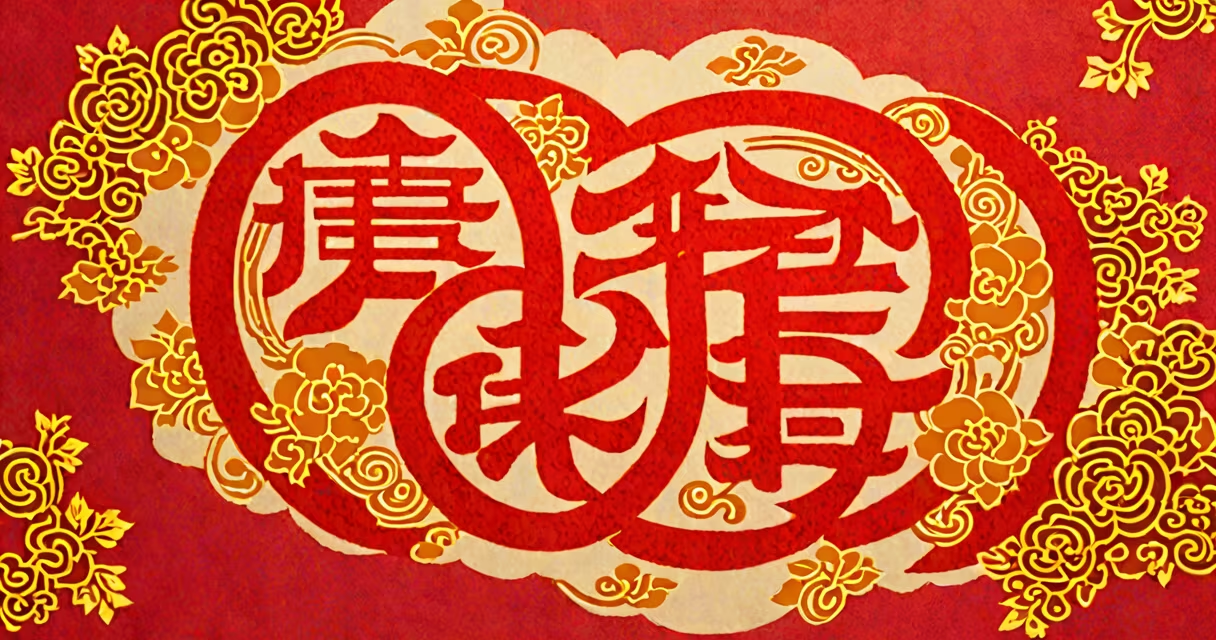
The mandarin symbol for love is the double happiness character (囍), a compound ideograph formed from two instances of the character 喜, meaning "joy" or "happiness." It is traditionally used to mark weddings and signify marital bliss in Chinese culture.
Used in formal contexts such as wedding invitations, ceremonial decorations, and bridal attire, 囍 appears in red ink on paper or fabric. Its presence signals celebration, union, and long-term harmony between partners. The character is not a direct synonym for "love" in emotional terms but functions as a cultural proxy for enduring affection through shared joy.
While Western cultures often associate hearts or roses with romance, Chinese tradition emphasizes collective well-being and familial approval. The double happiness symbol reflects this focus-marriage is not just personal affection but a social contract rooted in prosperity and contentment. It appears in calligraphy, embroidery, and architectural motifs across East Asia.
The character 囍 combines two 喜 characters stacked vertically. Each 喜 represents a single instance of joy. When doubled, the meaning intensifies: not just happiness, but amplified, shared, and lasting happiness. This doubling is common in Chinese symbolism-two fish represent abundance, two phoenixes denote marital harmony.
Historically, 囍 was first used in imperial court documents during the Tang Dynasty (618-907 CE) to mark official celebrations. By the Qing Dynasty (1644-1912), it had become standard in wedding ceremonies. Today, it remains central to Chinese wedding customs, especially in regions like Guangdong, Fujian, and Taiwan.
For example, during a traditional Cantonese wedding, the bride's dress may feature 囍 embroidered in gold thread along the hem. The couple's first meal together is served on plates marked with 囍. Even modern wedding apps include digital versions of the symbol for photo filters and invitation templates.
The double happiness character exists in multiple visual forms depending on context:
| Form | Use Case | Visual Detail |
|---|---|---|
| Standard 囍 | Wedding invitations, banners | Two 喜 characters stacked vertically in red ink |
| Ornamental 囍 | Calligraphy, wall art | Flourished brushstrokes, often framed |
| Modern stylized 囍 | Branding, logos, digital media | Simplified lines, sometimes in black or silver |
Some regional variants exist. In Hokkien-speaking communities, the symbol may appear with a small dot beneath each 喜 to indicate spiritual purity. In Shanghainese traditions, 囍 is sometimes paired with the character 福 (blessing) to form a combined auspicious motif.
Many assume 囍 means "romantic love" in the way Westerners understand it-passion, longing, or intimacy. That is incorrect. The symbol does not convey individual emotion but communal affirmation. It expresses hope for a stable, joyful marriage, not necessarily one based on personal attraction.
Another error is using 囍 in non-wedding contexts. While it appears in gift packaging for anniversaries or baby showers, it is inappropriate for birthday cards or casual messages of affection. Using it outside formal marriage events risks misinterpretation-like wearing a graduation cap to a funeral.
A lesser-known fact: 囍 is rarely written in spoken Mandarin. It is purely visual. You won't hear someone say "I love you" with 囍 in conversation. Instead, people use phrases like "我愿意" (I am willing) or "我们永远在一起" (we stay together forever) to express commitment.
In 2022, a wedding in Shanghai featured a 12-meter-long scroll painted with 囍 in gold and red. The scroll was unrolled during the ceremony's climax, revealing a poem by Li Bai adapted to celebrate the couple's union. The event was livestreamed to over 1.2 million viewers in China and overseas Chinese communities.
Even in digital spaces, 囍 maintains relevance. A 2023 study by the University of Hong Kong found that 68% of Chinese millennials aged 25-34 associated 囍 with positive emotions related to marriage, compared to only 12% who linked it to romantic love. The symbol's power lies in its cultural weight, not emotional nuance.
Do not confuse 囍 with other Chinese symbols of affection. For example:
Unlike these, 囍 is not used to describe feelings. It is a ritual marker-a signpost for a socially recognized milestone.
I once attended a wedding in Taipei where the host handed out small red envelopes with 囍 printed on them. Guests were instructed to place one under their plate during dinner. The act wasn't about giving money-it was about participating in a shared tradition. The symbol functioned as a silent agreement: we are here to witness joy, not just observe it.
Understanding the mandarin symbol for love requires shifting from emotional interpretation to cultural literacy. It is not a declaration of passion. It is a public vow of stability, prosperity, and mutual contentment.