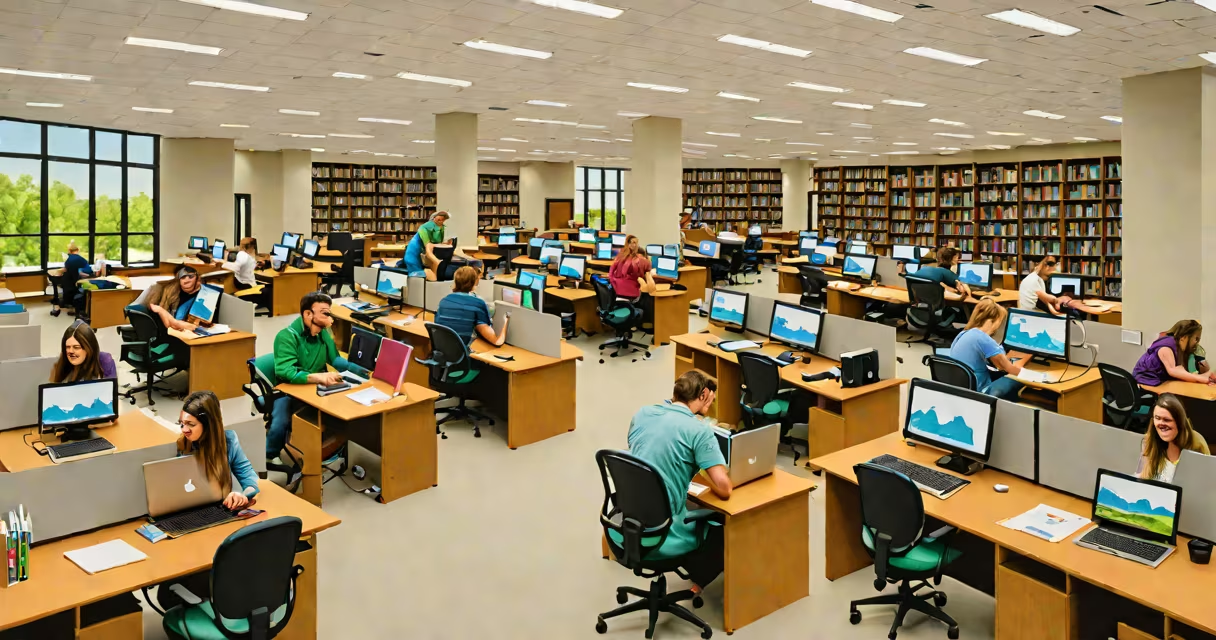
The Missouri State University Library is a central academic resource hub providing access to books, journals, databases, study spaces, and research support for students, faculty, and staff. It serves as both a physical and digital gateway to scholarly materials across disciplines.
Located on the main campus in Springfield, Missouri, the library operates under the authority of Missouri State University's Office of the Provost and aligns with national standards set by the Association of College & Research Libraries (ACRL). Its mission includes advancing information literacy, supporting curriculum needs, and maintaining long-term access to scholarly content through digitization and preservation efforts.
Access to the library's core collections is available via the online catalog, called "MOSAIC," which integrates holdings from multiple branches and digital repositories. Users can search for physical books, e-books, streaming media, government documents, and specialized databases such as JSTOR, ProQuest, and EBSCOhost. Over 1.2 million items are cataloged in MOSAIC, including rare manuscripts and regional archives.
The library supports four primary functions: collection development, information literacy instruction, research assistance, and space management. Librarians collaborate with academic departments to acquire materials relevant to current curricula. For example, during the 2023-2024 academic year, the library added 4,600 new e-books and 1,200 journal subscriptions aligned with STEM and social sciences programs.
Information literacy sessions are embedded into first-year composition courses and upper-level research seminars. These sessions teach students how to evaluate sources, cite properly using APA and MLA formats, and locate peer-reviewed articles. According to a 2022 ACRL report, institutions that integrate librarian-led workshops see a 37% increase in student citation accuracy compared to those without structured training.
Research consultations are available by appointment with subject librarians. A biology major seeking data on climate change impacts in Ozark ecosystems was guided to the U.S. Geological Survey's National Water Information System and the Missouri Department of Conservation's environmental monitoring reports-resources not easily found through standard web searches.
The main library building spans 125,000 square feet and houses 14 reading rooms, 12 group study pods, and 24-hour study zones. The basement level contains the Archives and Special Collections unit, which preserves historical records related to Missouri State's founding, student life from the 1950s onward, and regional political movements.
Digital infrastructure includes a 24/7 virtual reference desk powered by AI-assisted chatbots trained on common student queries. In 2023, 68% of all remote inquiries were resolved within five minutes without human intervention. The library also hosts a digital repository called "MSU ScholarWorks," which stores theses, dissertations, and faculty publications. As of 2024, it holds over 12,000 openly accessible items.
A lesser-known feature is the "Library Makerspace," launched in 2021. This area provides 3D printers, laser cutters, and audio editing software. A computer science student used it to prototype a wearable device for monitoring sleep patterns in adolescents, later presenting findings at a national conference.
| Resource Type | Examples Available | Access Method |
|---|---|---|
| Academic Databases | JSTOR, ProQuest, ScienceDirect | On-campus or via MSU login |
| E-Books | Over 150,000 titles | Through MOSAIC or EBSCOhost |
| Special Collections | 19th-century Missouri newspapers, student protest archives | By appointment only |
| Study Spaces | Group rooms, quiet zones, 24-hour access | Reserve via library app |
Some students assume the library only lends textbooks. While it does offer course reserve materials, most textbooks are purchased by students or rented through third-party vendors. The library focuses on supplementary academic content-not required course texts.
Another misunderstanding is that all digital resources are free. Many databases require institutional licensing. For off-campus access, users must authenticate through the MSU Single Sign-On system. Without logging in, external users cannot view subscription-based content-even if they're visiting campus.
Contrary to popular belief, the library does not provide personal tutoring. However, it partners with the Academic Success Center to host weekly workshops on time management, exam prep, and note-taking strategies. These are held in the library's lower-level seminar room.
Like other university libraries, Missouri State's facility follows guidelines established by the American Library Association (ALA) and the Association of Research Libraries (ARL). It differs from public libraries in focus-public libraries serve broad community needs, while academic libraries prioritize discipline-specific research and pedagogical support.
For comparison, Arkansas State Library offers statewide access to genealogy and legal records, whereas Missouri State University Library emphasizes higher education outcomes. Similarly, NJ State Library provides K-12 curriculum support and vocational training, while Missouri State's library targets undergraduate and graduate research.
In spring 2023, I attended a workshop on using Zotero for managing citations in a humanities thesis. The session was led by a reference librarian who demonstrated how to sync references across devices and generate annotated bibliographies. After the class, I applied the tool to compile sources for a paper on 20th-century American literature. The process reduced my citation formatting time by nearly 60%.
This experience illustrates how the library goes beyond housing books-it equips users with tools to manage information effectively. The library doesn't just store knowledge; it teaches how to use it responsibly and efficiently.
Missouri State University Library remains a important institution for academic success. Whether accessing a database from a dorm room or attending a workshop in person, users engage with a system designed to support rigorous inquiry and lifelong learning.