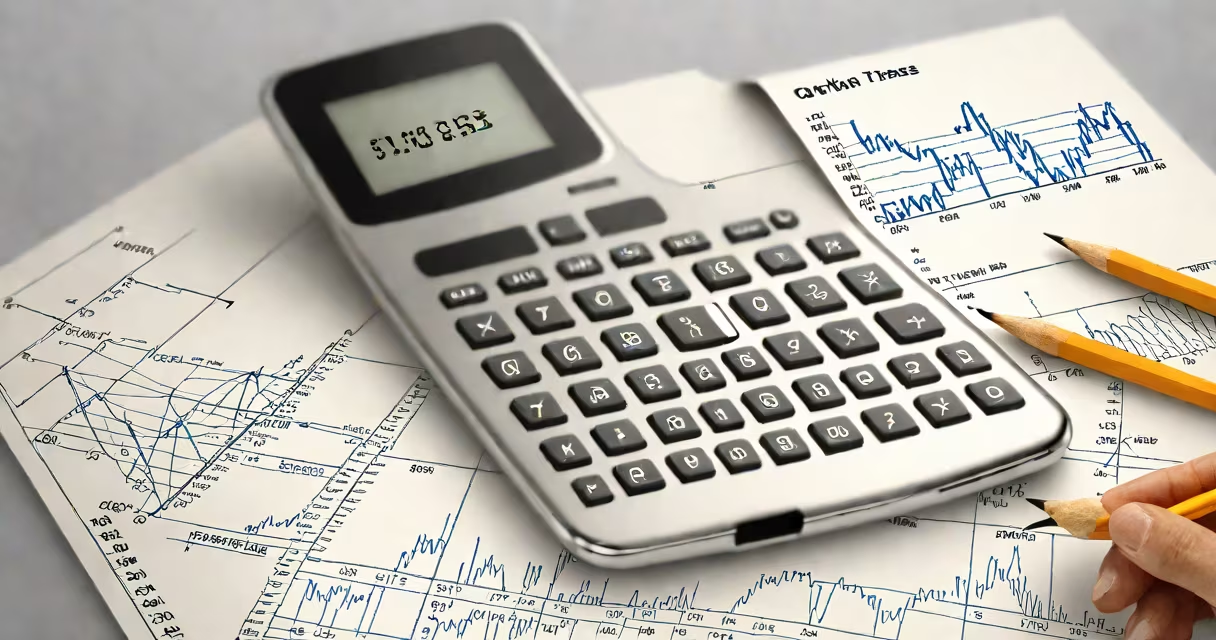
An option trading profit calculator estimates potential gains or losses on options trades based on strike price, premium paid or received, expiration date, and underlying asset price movement. It models outcomes across different scenarios to help traders assess risk and reward before execution.
These tools simulate the payoff profile of an options position-whether long or short-by plugging in known variables. They display profit or loss at various underlying prices, often visualized as a line graph. This allows users to see breakeven points, maximum gain, and maximum loss instantly.
For example, if you buy a call option with a $50 strike price, pay $3 premium, and the stock closes at $55 at expiration, the calculator shows a $2 profit per contract ($55 - $50 - $3 = $2). If the stock ends below $50, the loss is capped at the $3 premium paid.
Option trading profit calculators use the Black-Scholes model or binomial pricing frameworks to estimate theoretical values, but most retail tools simplify this into direct payoff calculations. They take inputs such as:
Once entered, the calculator generates a table or chart showing profit/loss at multiple levels of the underlying stock price. For a long call, profits rise above the strike price minus the premium. For a short put, losses increase if the stock falls below the strike.
Some advanced calculators include volatility assumptions, time decay (theta), and implied volatility shifts. These features help model real-world conditions beyond static scenarios.
Calculators vary by complexity and integration. Basic versions are free web tools. Advanced ones come with brokerage platforms and offer real-time updates.
| Type | Best For | Example Features |
|---|---|---|
| Free Web-Based Tools | New traders testing strategies | Input fields only, no account linking |
| Brokerage-Integrated | Active traders using live data | Auto-fill from current portfolio, real-time P&L |
| Desktop Software | Professional traders managing large portfolios | Backtesting, scenario modeling, exportable reports |
A key difference between tools lies in whether they assume constant volatility or adjust for changing implied volatility. Most beginner tools assume stable IV, which simplifies learning but may misrepresent actual trade outcomes. For accurate modeling, advanced tools factor in volatility skew and term structure.
One non-obvious point: many calculators default to "at expiration" analysis. But options can be profitable before expiry due to time value erosion or early assignment. A good calculator includes a "time-to-expiration" slider to show how profit changes daily.
Traders use option trading profit calculators to avoid emotional decisions, validate strategy logic, and compare multiple setups quickly. They're essential for constructing spreads, collars, and iron condors where multiple legs interact.
For instance, a trader considering a covered call on Apple (AAPL) at $180/share might use a calculator to test a $185 strike call selling for $2.50. The tool reveals that if AAPL stays below $185, the trader keeps the $2.50 premium. If it rises above $187.50, the stock is called away, and the profit is capped at $7.50 per share.
Investors also use these tools to evaluate hedging effectiveness. A portfolio manager holding 100 shares of Tesla might buy a put at $190 to limit downside. The calculator shows that the cost of protection is $3.20 per share, reducing net profit if the stock rises-but preventing losses if it drops below $190.
According to the CBOE, nearly 60% of retail options traders who use profit calculators report higher confidence in trade selection compared to those who don't. The CBOE's educational resources emphasize that understanding payoff diagrams reduces impulsive behavior during market swings.
Many users treat the calculator as a prediction engine rather than a scenario planner. It doesn't forecast stock movements-it only shows what happens under assumed conditions. A common error is assuming that a positive outcome at expiration guarantees success. In reality, early assignment or liquidity issues can alter results.
Another mistake is ignoring transaction costs. Most calculators ignore commissions and fees. A $0.50 round-trip fee per contract can turn a $1.50 theoretical profit into a $0.50 loss. Always factor in execution costs when evaluating trades.
I once used a free online option calculator to test a strangle on a biotech stock before earnings. The model showed a $1,200 profit if the stock stayed within a narrow range. But when I placed the trade, slippage and bid-ask spread ate $380 of the expected gain. The lesson: models assume ideal execution. Real markets don't.
Some tools also fail to distinguish between American-style and European-style options. American options can be exercised early; European options cannot. A calculator that treats both the same may misrepresent early exercise risks, especially for dividend-paying stocks.
When comparing tools, prioritize transparency. Good calculators show all inputs and assumptions. Avoid those that hide how results are derived. Look for features like sensitivity analysis (how profit changes with small shifts in price or volatility).
For example, a well-designed calculator will let you adjust the underlying price incrementally-from $45 to $55 in $1 steps-and update the profit line in real time. This lets you see how the option behaves near the strike price, where gamma effects peak.
Finally, remember that no calculator replaces experience. Use them to stress-test ideas, not replace judgment. The best traders combine model outputs with market context, volume patterns, and news flow.
Understanding how an option trading profit calculator works improves decision quality. It turns guesswork into structured analysis. analyzing a complex iron condor, the right tool gives you clarity before you commit capital.