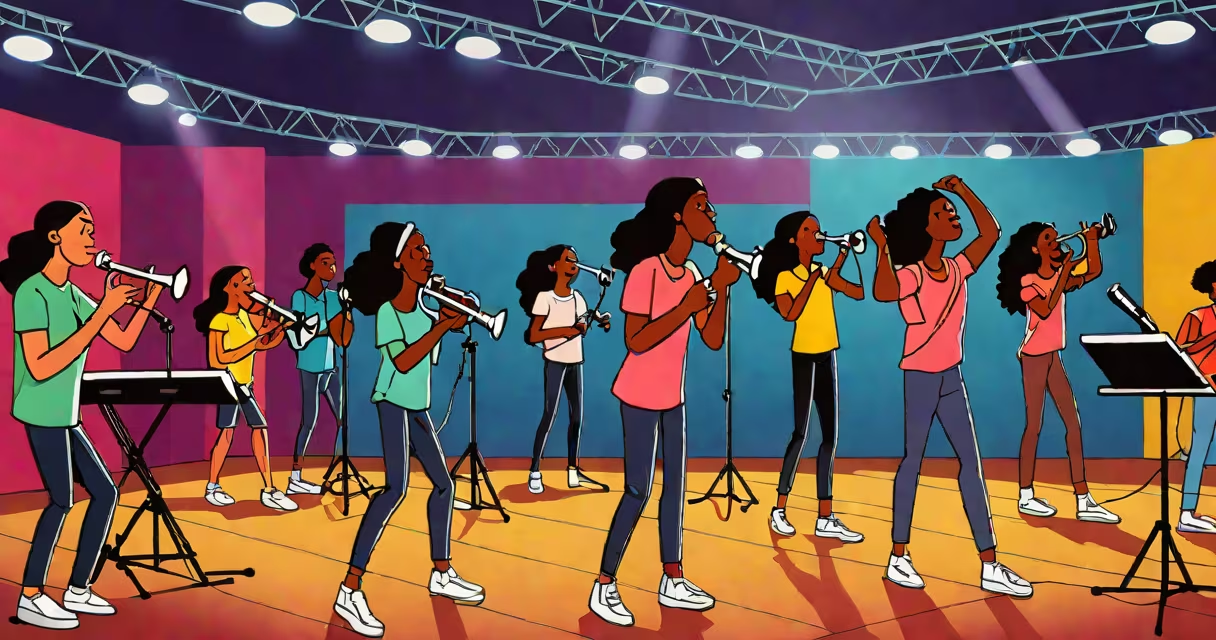
A performing arts school is an educational institution focused exclusively on training students in live performance disciplines such as acting, dance, and music. These schools emphasize technical mastery, stage presence, and professional readiness through daily rehearsals, performances, and mentorship.
Unlike general arts programs in public or private high schools, performing arts schools operate with a specialized curriculum designed around performance outcomes. Students typically begin training in early adolescence and progress through structured levels of study that culminate in formal assessments, showcases, and career placement support.
These schools often require auditions or portfolios for admission. They may be independent, charter, or part of a larger university system. Graduates frequently pursue careers in professional theater, dance companies, orchestras, or film and television.
Instruction at a performing arts school follows a model of daily practice, performance, and feedback. Students spend 6 to 8 hours per day in classes and rehearsals, with schedules divided between technique work, repertoire development, and performance theory.
For example, a student in a ballet program might start the day with barre exercises, move to center combinations, then rehearse a section of *Swan Lake* under a choreographer's supervision. After lunch, they attend acting class and vocal training, followed by a technical rehearsal for an upcoming production.
Each program includes regular evaluations by faculty and guest artists. A student's progress is measured not just by grades but by physical precision, emotional authenticity, and stage awareness. According to the National Association of Schools of Music (NASM), accredited performing arts programs must meet specific benchmarks in faculty qualifications, curriculum depth, and student outcomes.
Performing arts schools specialize in three primary areas: theater, dance, and music. Some institutions offer integrated programs; others focus on a single discipline.
| Discipline | Typical Training Focus | Common Performance Formats |
|---|---|---|
| Theater | Acting techniques (Meisner, Stanislavski), voice projection, stage combat | Full-length plays, monologues, improvisation |
| Dance | Ballet fundamentals, contemporary movement, choreography | Repertory pieces, solos, ensemble works |
| Music | Instrumental proficiency, sight-reading, ensemble playing | Orchestral concerts, recitals, chamber music |
Some schools blend disciplines. The Juilliard School in New York offers joint programs in drama and music, allowing students to explore roles that require both singing and acting. Others, like the American Musical Theatre Academy in Los Angeles, integrate dance, music, and acting into a single track leading to Broadway auditions.
Students in these programs often train under professionals who have performed on national stages or in major productions. For instance, a dance instructor at a conservatory might have danced with the Alvin Ailey American Dance Theater or performed in a West End revival of *Les Misérables*.
Performing arts schools serve distinct populations: pre-professional youth, college-bound students, and adult learners seeking career shifts. They are most common in urban centers with established cultural infrastructure.
In cities like New York, Chicago, and London, performing arts schools are embedded within larger cultural districts. The Lincoln Center for the Performing Arts hosts several affiliated training programs, including the Juilliard Pre-College Division and the New York City Ballet's School of American Ballet. These institutions provide access to rehearsal spaces, professional casting directors, and performance venues.
At the Wharton Center for Performing Arts in Michigan, students from rural communities travel weekly to attend workshops led by regional theater professionals. This model expands access to elite training beyond metropolitan hubs. According to a 2022 report by the National Endowment for the Arts, students from low-income backgrounds who attend performing arts schools are 3.2 times more likely to pursue higher education in the arts than peers in general education settings.
These schools also prepare students for industry-specific demands. A student trained in musical theater learns how to read a score, audition with a cold reading, and maintain vocal health during long runs.
Many people assume that attending a performing arts school guarantees a career in entertainment. That is incorrect. Admission to a performing arts school does not ensure employment. Success depends on talent, persistence, networking, and luck.
Another misconception is that these schools only accept "naturally gifted" students. In reality, many programs admit students based on potential and work ethic. A 2021 study published in *The Journal of Research in Music Education* found that 68% of students admitted to conservatories had average test scores but demonstrated strong improvement over four years of training.
Some confuse performing arts schools with weekend workshops or summer camps. While those offer exposure, they lack the sustained, structured curriculum required for professional development. A typical camp might run for two weeks with a single performance at the end. A performing arts school operates year-round with daily classes, ongoing assessments, and graduation requirements.
One non-obvious fact: many performing arts schools do not grant traditional academic degrees. Instead, they issue certificates or diplomas in performance. Students must enroll in separate academic programs to earn high school or college credits. This dual-path structure allows intensive training without compromising core academics.
Consider Maya, a 14-year-old from suburban Atlanta. She auditioned for the Atlanta School of the Performing Arts after studying dance for five years. Her application included a video of her dancing a variation from *The Nutcracker*, a written statement on her artistic goals, and a recommendation from her local dance studio.
She was accepted into the classical ballet track. Over the next two years, she trained six days a week: morning technique class, afternoon rehearsal, evening theory and anatomy lectures. She performed in three full-length productions, including *Giselle* and *Cinderella*. By age 16, she had been invited to join the Youth Company of the Atlanta Ballet.
Her training included vocal warm-ups, injury prevention sessions, and mock auditions with guest choreographers. She also took math and science courses at a nearby public high school to fulfill state graduation requirements. After completing her program, she applied to the School of American Ballet's summer intensive and was accepted.
This path reflects the standard trajectory: rigorous daily training, performance milestones, and integration with academic education. It is not a shortcut to fame but a disciplined foundation for a sustainable career.