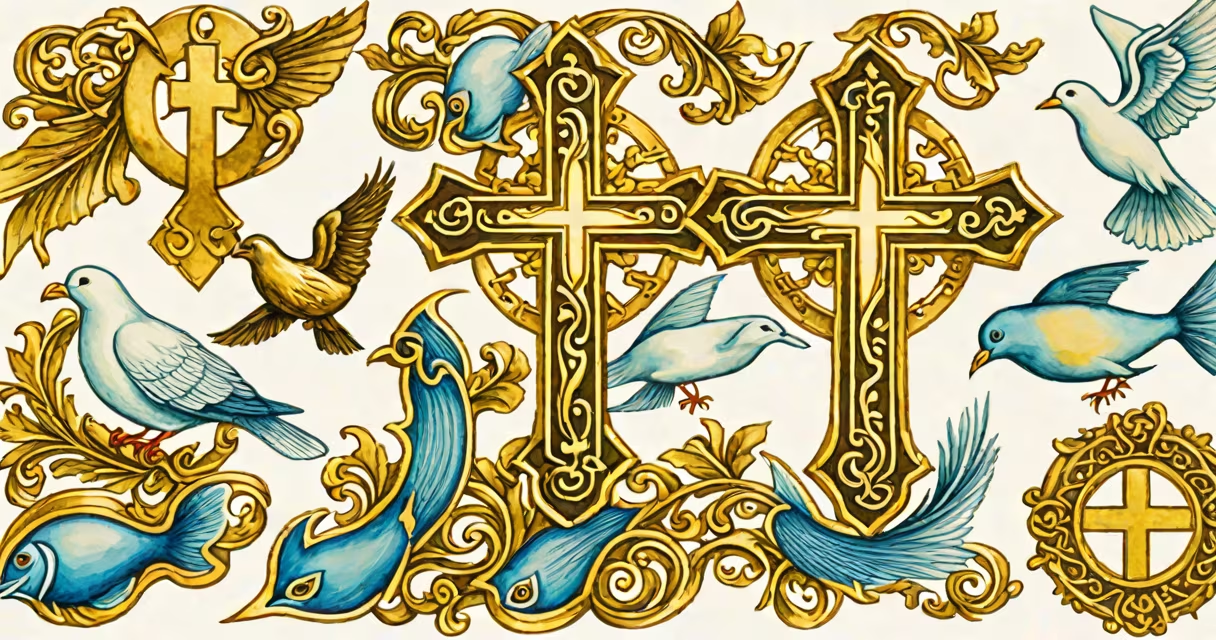
The principal symbols of Christianity are visual representations rooted in scripture, tradition, and early church practice. They convey core theological concepts such as sacrifice, resurrection, divine presence, and spiritual rebirth. These symbols appear in art, liturgy, architecture, and personal devotion worldwide.
Christian symbolism emerged from Jewish roots and early Greco-Roman culture. The cross, for example, began as a Roman execution device but was transformed into a central emblem of victory through Christ's resurrection. Early Christians used subtle signs like the ichthys (fish) to identify themselves during periods of persecution. Over time, these images became standardized across denominations, though interpretations vary.
According to the Catholic Church's Catechism, symbols are essential tools for teaching faith. "The Church uses sacred signs... to express mysteries of faith" (CCC 1146). The United States Conference of Catholic Bishops notes that "symbols are not mere decoration-they are vehicles of grace" (USCCB, 2023). This functional role explains why certain images endure across centuries and cultures.
The cross is the most recognizable symbol of Christianity. It represents Jesus' crucifixion and resurrection. While the Latin cross (with a longer vertical beam) dominates Western imagery, the Greek cross (equal arms) appears frequently in Eastern Orthodox traditions. A crucifix-depicting Christ on the cross-is especially common in Catholic and Lutheran contexts, emphasizing sacrifice.
The ichthys, or fish symbol, dates to the 2nd century. Early Christians used it as a covert identifier. The Greek word "ichthys" stands for "Jesus Christ, Son of God, Savior." When drawn in sand or carved on walls, it signaled belonging without drawing attention. Today, it appears on jewelry, car decals, and church banners.
The dove symbolizes the Holy Spirit. In the Gospels, the Spirit descended like a dove at Jesus' baptism (Matthew 3:16). This image became widespread in medieval art and remains central in Pentecost celebrations. The dove also appears in Christian peace movements, though its original context is theological, not political.
The lamb represents Jesus as the sacrificial Lamb of God. John the Baptist called him "the Lamb of God who takes away the sin of the world" (John 1:29). In art, the lamb often holds a banner with a cross or stands beside a chalice. The image draws from Old Proof Passover rituals and Isaiah's prophecy of a suffering servant.
| Symbol | Primary Meaning | Origin/Textual Basis | Common Usage |
|---|---|---|---|
| Cross | Sacrifice and resurrection | Crucifixion narratives (Gospels) | Churches, jewelry, liturgical vestments |
| Ichthys | Identification and faith | Early Christian secret code (2nd c.) | Car stickers, necklaces, graffiti |
| Dove | Presence of the Holy Spirit | Baptism of Jesus (Matthew 3:16) | Pentecost art, baptismal fonts, icons |
| Lamb | Christ as sacrificial victim | John 1:29; Revelation 5:6 | Altar decorations, stained glass, liturgical art |
These symbols appear in churches, homes, public spaces, and digital media. In Catholic cathedrals, the cross dominates altars and stained-glass windows. The dove may adorn baptismal fonts, while the lamb appears in depictions of the Last Supper. In Protestant churches, the cross is often plain-a reminder of humility and endurance.
In Japan, Christianity has a small but growing presence. According to the Japan Christian Association, there are approximately 1.5 million Christians in Japan, mostly in Protestant and Catholic communities. Despite cultural resistance to overt religious expression, symbols like the cross and ichthys appear in private homes and schools. During the Meiji period, Christian missionaries faced persecution, and the ichthys was used discreetly to mark safe houses. Today, a small Christian community in Nagasaki still honors this history through annual memorial services.
Personal use of symbols is equally significant. A friend in Kyoto once told me he wears a silver cross under his shirt-not for show, but as a daily reminder of accountability. He said, "When I'm stressed, touching it grounds me." This reflects a broader pattern: symbols serve both communal and individual functions.
Many assume the cross is exclusively Catholic or Western. That's incorrect. The Eastern Orthodox Church uses the Greek cross and emphasizes the Resurrection over the Crucifixion in iconography. In Ethiopia, the cross is worn as a protective amulet, often with geometric patterns reflecting ancient Ge'ez script traditions.
Another misconception is that the ichthys is a modern invention. Archaeological evidence from the 2nd-century catacombs of Rome shows the fish symbol inscribed on tombstones and walls. The earliest known example is from the cemetery of Praetextatus, dated around 180 CE. This predates Constantine's legalization of Christianity in 313 CE.
Some confuse the dove with secular peace symbols. While both feature wings and white feathers, the Christian dove is linked to divine action, not human diplomacy. The Peace Movement in Northern Ireland adopted the dove in the 1970s, but that usage is distinct from ecclesiastical tradition.
One overlooked point is that symbols evolve through cultural adaptation. The cross in West Africa often incorporates local materials-wood, beads, or woven textiles-reflecting indigenous aesthetics. In Nigeria, crosses are sometimes shaped like trees or birds, blending Christian theology with animist symbolism. This fusion doesn't dilute meaning-it expands it.
A fully worked example: In 2018, a church in Kumamoto, Japan, installed a wooden cross in its garden. The design included a stylized cherry blossom branch integrated into the horizontal beam. The pastor explained the choice: "The cross is life, not death. Cherry blossoms fall quickly-like Christ's sacrifice-but they return each spring. We're not just remembering pain. We're celebrating renewal." This blend of Christian doctrine and Japanese seasonal awareness illustrates how symbols remain changing.
Understanding principal symbols of Christianity requires more than recognition. It demands historical literacy, theological awareness, and cultural sensitivity. These symbols are not static objects-they are living expressions of belief, identity, and memory. Whether carved in stone or worn on a necklace, they carry weight beyond form.