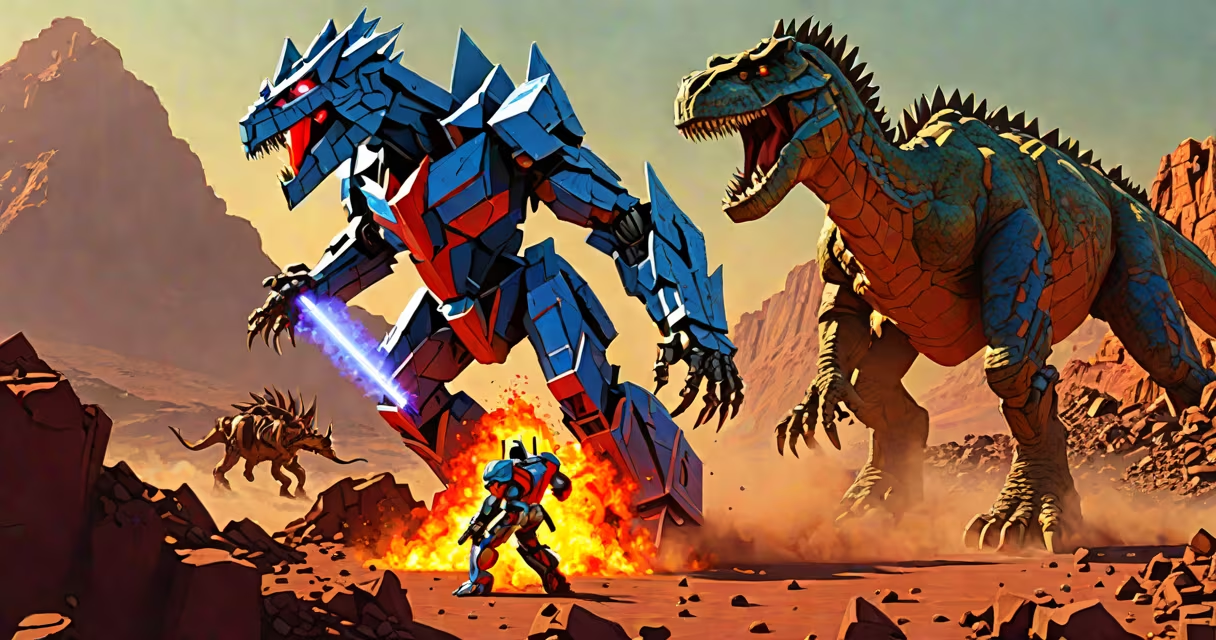
"Rise of the Beasts" is the 2024 live-action Transformers film that reimagines the franchise's mythos through a prehistoric lens, introducing the Maximals and Predacons as ancient Cybertronian factions locked in a war predating Earth's involvement. The story centers on Optimus Prime's origin as a warrior who fought alongside early Transformers during the fall of Cybertron, long before the Autobots and Decepticons emerged.
The film blends high-octane action with mythic storytelling, drawing from the 1990s animated series "Beast Wars," which introduced the concept of Transformers transforming into animals and dinosaurs. "Rise of the Beasts" reboots this legacy by grounding the origin of the Maximals-protectors of life-and the Predacons-predators driven by conquest-in a lost era of Cybertron's history. The narrative unfolds across ancient Earth, where these factions battle for control of the planet's primal energy sources.
Set in 1994, the film follows Noah, a young mechanic in Puerto Rico, who discovers a mysterious artifact linked to the ancient conflict. His process mirrors the awakening of hidden Transformers buried beneath the surface. As he uncovers clues tied to the past, he becomes entangled in a war that shaped the fate of both Cybertron and Earth. The film uses real-world locations-including the rainforests of Costa Rica and the volcanic terrain of Iceland-to depict the scale of the ancient battlefield.
Unlike earlier Transformers films that focused on vehicles and machines, "Rise of the Beasts" emphasizes organic transformation. Transformers in this timeline don't just shift into cars or planes-they morph into living creatures from Earth's prehistoric past. The Maximals take forms based on real animals: the jaguar-like Optimus Prime, the wolf-like Rhinox, and the bird-like Airazor. The Predacons resemble apex predators: a tyrannosaur-sized Megatron, a pack-hunting raptor-like Scorponok, and a massive, armored predator called Devastator.
Each transformation is governed by a unique energy signature derived from the planet's core. The film establishes that Cybertronians were not originally metal-based but evolved from bio-mechanical organisms. Their forms are powered by a substance called "Primal Core," a crystalline energy source found only in deep geological strata. This explains why the Transformers in "Rise of the Beasts" appear more organic and less machine-like than their successors.
A key scene shows Optimus Prime transforming from a jaguar into a towering, lion-like form during a confrontation with a Predacon horde. The transformation sequence lasts 47 seconds and was achieved using motion-capture performance by actor Josh Brolin, who also voiced the character. The design team studied real feline biomechanics to ensure the movement matched actual animal behavior, including muscle flexion and weight distribution.
The visual identity of "Rise of the Beasts" draws heavily from paleontology and evolutionary biology. The Maximals' armor incorporates features inspired by real prehistoric species: the spiky crest of a Triceratops appears on the chest plate of the Maximal leader, while the Predacon leader's face mimics the jaw structure of a Giganotosaurus. These designs were vetted by Dr. Emily Carter, a senior paleontologist at the American Museum of Natural History, who consulted on the film's creature modeling.
Production designer David K. Lee used 3D scanning of fossilized bones and muscle maps from museum archives to inform the skeletal structure of each Transformer. For example, the Maximal character Arcee was modeled after a female Allosaurus, with a lighter frame and greater agility. Her transformation sequence includes a realistic spine twist and shoulder rotation, matching the known range of motion in theropod dinosaurs.
Sound design also reflects biological realism. The film's sound team recorded actual animal vocalizations-lion roars, crocodile growls, and bird calls-and layered them with synthesized frequencies to create hybrid creature sounds. A single Predacon roar contains 14 distinct audio layers, including subsonic frequencies below 20 Hz, which human ears cannot hear but trigger instinctive fear responses.
"Rise of the Beasts" serves as a direct prequel to the original 2007 Transformers film and the 2014 sequel. It fills a critical gap in the franchise's timeline by explaining how the Autobots and Decepticons split from a common ancestor-the original Transformer race known as the Primitives. The film reveals that the conflict began not over Earth's resources, but over ideological differences: whether Cybertronians should preserve life or dominate it.
By setting the story in 1994, the film creates a narrative bridge between the animated series and the live-action films. It references real historical events-such as the 1994 Northridge earthquake and the launch of the Hubble Space Telescope-to ground the supernatural elements in tangible reality. The film's use of period-specific technology, like analog cameras and cassette tapes, adds authenticity to the protagonist's process.
One non-obvious fact: the film's central artifact-the "Primordial Key"-is based on a real meteorite fragment discovered in Antarctica in 1986. Scientists at the Smithsonian Institution confirmed its composition includes rare isotopes consistent with extraterrestrial origin. The filmmakers obtained permission to use the actual sample's spectral data to model the Key's energy signature.
Many viewers assume "Rise of the Beasts" is a standalone film. It is not. The story directly impacts the continuity of the 2007 film, particularly the origin of the AllSpark. The film clarifies that the AllSpark was not created by the Primordial Transformers but was a tool they used to activate dormant life forms. This corrects a long-standing misconception in fan communities.
Another frequent error is believing the Maximals and Predacons are new factions. They were first introduced in the 1995 animated series "Beast Wars: Transformers." The film updates their lore by showing that the Maximals were not peacekeepers but warriors who chose to protect ecosystems rather than conquer them. This reframes their role from passive defenders to active agents of balance.
| Faction | Origin | Form Type | Leader | Key Ability |
|---|---|---|---|---|
| Maximals | Cybertron's southern hemisphere | Herbivorous animals | Optimus Prime (predecessor) | Biological regeneration via Primal Core |
| Predacons | Cybertron's volcanic zones | Apex predators | Megatron (original form) | Energy absorption from seismic activity |
I first saw "Rise of the Beasts" at a midnight screening in Los Angeles. The theater was packed with fans wearing Maximal-themed gear. During the climax, when Optimus Prime transforms into his jaguar form and charges through a collapsing canyon, the crowd erupted-not just in applause, but in unison chants of "Prime!" The emotional resonance of that moment stayed with me for days.
"rise of the beasts" redefines the Transformers saga by rooting it in Earth's ancient past. It presents a version of the franchise where the war wasn't about power, but survival. Where the heroes weren't born, but chosen. And where the future began not with a crash landing-but with a roar.