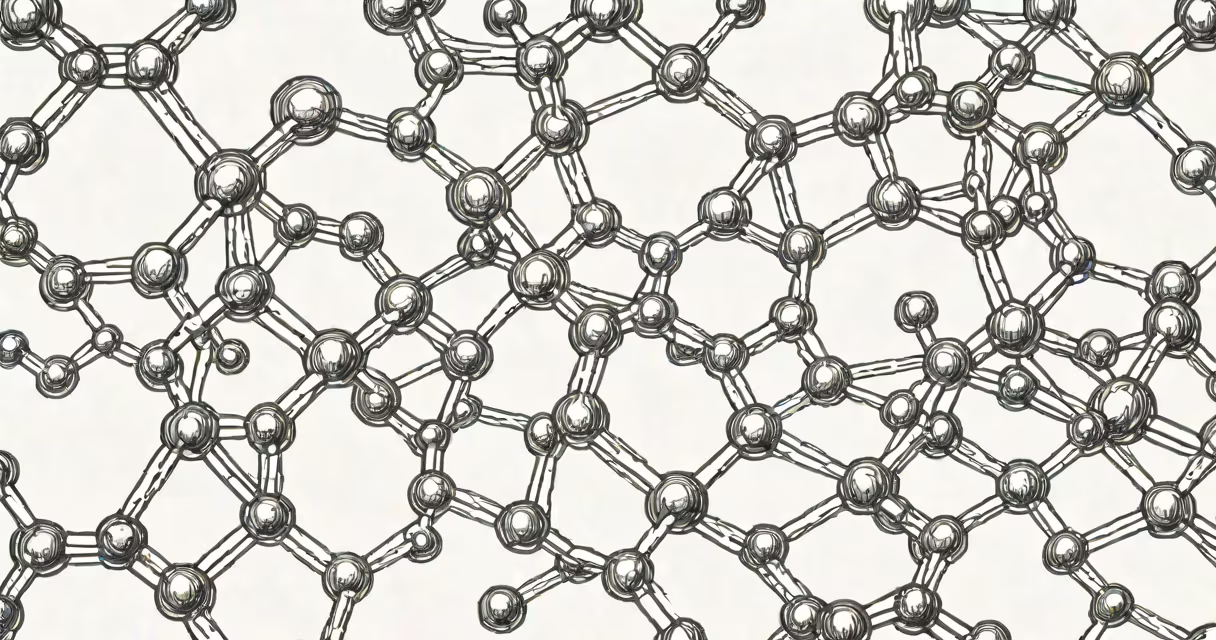
A monomer is a single molecule that serves as the building block for polymers. It typically contains reactive functional groups that allow it to bond with other monomers through covalent linkages. These units form long chains or networks seen in plastics, rubber, and biological macromolecules.
Monomers vary widely in appearance depending on their chemical composition. Small organic monomers like ethylene (C₂H₄) or styrene (C₈H₈) exist as colorless liquids or crystalline solids at room temperature. Larger ones such as amino acids or nucleotides appear as white powders or colorless crystals. Under a light microscope, individual monomer molecules are invisible due to their size-typically less than 1 nanometer in diameter.
At the atomic level, monomers display specific geometric arrangements. For example, ethylene features a planar structure with a carbon-carbon double bond and four hydrogen atoms symmetrically bonded around the two carbons. This geometry influences how monomers align during polymerization. In contrast, glucose (a sugar monomer) forms a ring-shaped structure with hydroxyl groups oriented in specific directions, enabling stereospecific bonding in cellulose or starch.
At the macroscopic scale, most monomers are odorless, transparent liquids or fine white powders. Ethylene gas is colorless and odorless, while vinyl chloride monomer is a volatile liquid with a faint sweet smell. These physical traits make handling them challenging in industrial settings, requiring sealed systems to prevent inhalation or explosion risks.
Under electron microscopy, individual monomer molecules cannot be resolved directly. Instead, scientists infer their arrangement by analyzing the resulting polymer's morphology. For instance, scanning electron microscopy (SEM) images of polyethylene show a granular texture formed from densely packed chains derived from ethylene monomers. The spacing between chains reflects the original monomer packing in the melt state.
Computational models provide the clearest visual representation. Software like Avogadro or PyMOL generates 3D renderings of monomers using ball-and-stick or space-filling formats. In these depictions, carbon atoms appear as black spheres, hydrogen as white, oxygen as red, and nitrogen as blue. A typical ethylene monomer shows two central black spheres connected by a double line, surrounded by four smaller white spheres.
Monomers fall into several categories based on their functional groups and polymerization mechanisms:
| Type | Example | Structure Feature | Polymer Formed |
|---|---|---|---|
| Alkenes | Ethylene | Double bond between two carbons | Polyethylene |
| Acrylates | Methyl acrylate | C=C bond with ester group | Poly(methyl acrylate) |
| Amino acids | Glycine | Carboxyl and amine groups on same carbon | Proteins |
| Nucleotides | Adenine deoxyribonucleotide | Phosphate group linked to sugar and base | DNA |
Each type undergoes distinct reactions. Alkene monomers like ethylene polymerize via addition reactions, where the double bond opens and connects to adjacent units. Amino acid monomers join through condensation reactions, releasing water as peptide bonds form. This difference affects both the appearance and properties of the final polymer.
Monomers are essential in manufacturing synthetic materials. Polyethylene, derived from ethylene monomers, makes up over 30% of global plastic production. Acrylic monomers form impact-resistant coatings used in automotive paint and safety goggles. In biotechnology, nucleotide monomers are synthesized to create DNA sequences for gene editing tools like CRISPR.
Many people assume monomers are visible to the naked eye because they see the products they form-plastic bottles, synthetic fabrics, or lab-grown tissues. But monomers themselves are too small to see without advanced imaging techniques. Even high-powered optical microscopes fail to resolve individual molecules. Only electron microscopes or atomic force microscopy can reveal surface details at the nanoscale.
A common error is equating monomer shape with polymer shape. For example, a linear ethylene monomer produces a flexible, branched polyethylene chain. The final material behaves like a soft plastic, despite the rigid, planar structure of the original monomer. This transformation occurs during polymerization, where chain entanglement and intermolecular forces dominate behavior.
Styrene (C₈H₈) is a clear, flammable liquid with a sweet, aromatic odor. Its monomer structure consists of a benzene ring attached to a vinyl group (CH=CH₂). In industrial reactors, styrene undergoes free-radical polymerization when heated with initiators like benzoyl peroxide.
During this process, the double bond in the vinyl group breaks and forms single bonds with neighboring styrene units. The result is polystyrene-a rigid, transparent plastic used in disposable cutlery, packaging foam, and laboratory culture dishes. Under SEM, polystyrene appears as a continuous matrix with occasional voids, reflecting the original monomer distribution during solidification.
When I worked in a polymer lab, we monitored styrene monomer purity using gas chromatography. Impurities above 0.1% led to uneven chain growth and brittle final products. This taught me that even tiny deviations in monomer structure affect performance-highlighting how sensitive polymer formation is to initial molecular quality.
Monomers differ from oligomers and polymers in both size and function. An oligomer contains 2-20 monomer units and often acts as an intermediate in synthesis. For example, dimers of acrylamide are used in gel electrophoresis to separate proteins. Unlike monomers, oligomers may exhibit measurable viscosity or solubility changes.
Another misconception is that all monomers are small. Some large monomers, like those in block copolymers, contain multiple functional groups. For instance, a monomer with both hydrophilic and hydrophobic segments can self-assemble into micelles in water-structures that resemble tiny bubbles. These behaviors emerge only after polymerization, not in the isolated monomer.
According to the National Institute of Standards and Technology (NIST), the average monomer size ranges from 50 to 300 daltons. Glucose (180 Da) and ethylene (28 Da) fall within this range. Larger monomers, such as certain amino acids or modified nucleotides, exceed 300 Da but still qualify as monomers if they participate in chain formation.
Understanding what a monomer looks like requires shifting focus from macroscopic observation to atomic-scale analysis. While no human eye can see a single monomer, computational models, spectroscopy, and polymer morphology offer accurate representations. Recognizing this distinction prevents confusion between raw materials and their engineered outcomes.