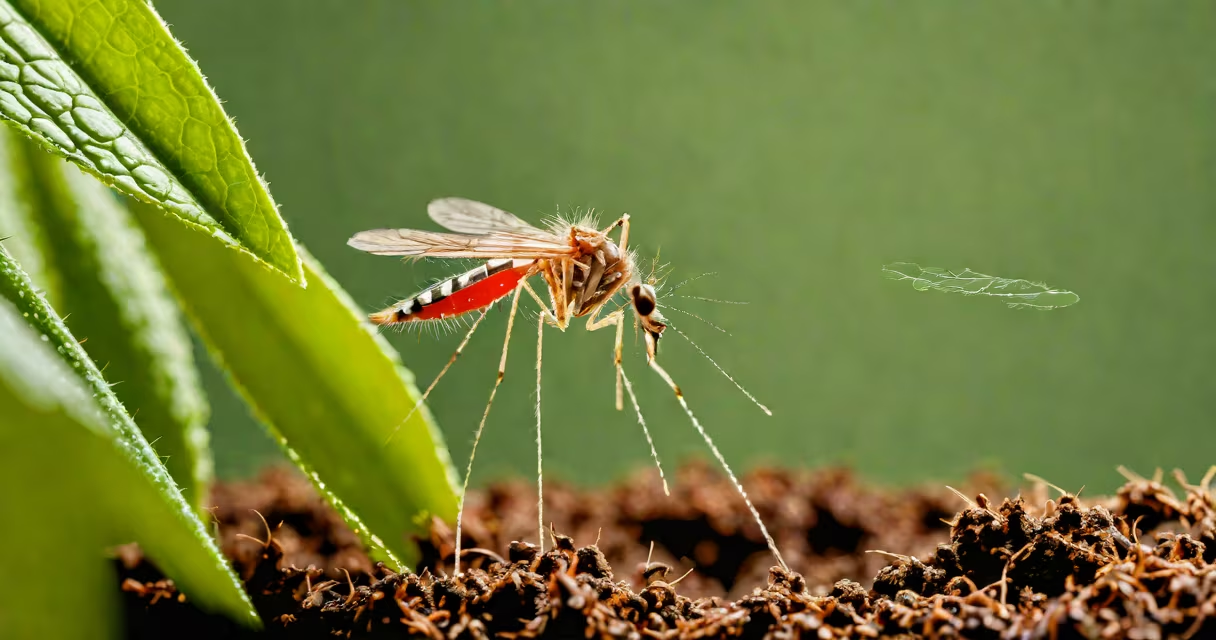
Small white mosquito-like bugs are typically fungus gnats-tiny flying insects that resemble miniature mosquitoes and breed in damp potting soil. They feed on organic matter and plant roots, especially in indoor plants, and can multiply rapidly under warm, humid conditions.
Fungus gnats are not true mosquitoes, though they share a similar appearance. Adults are 1-3 mm long, with slender bodies, long legs, and delicate wings. Their larvae live in soil, feeding on fungi and plant roots, which can stunt seedlings and weaken mature plants. These pests are common in homes, greenhouses, and nurseries where potted plants are kept.
They are most active during early morning and evening hours. While adults don't bite humans, their presence signals overwatering or poor drainage. Left unchecked, populations grow quickly-up to 100 eggs laid per female in warm environments-and can lead to root rot and plant decline.
Fungus gnats complete their life cycle in 14-21 days, depending on temperature and humidity. Eggs hatch in 4-6 days, larvae develop over 10-14 days, and pupation occurs in 3-5 days. Adults live 7-10 days but can lay hundreds of eggs in their short lifespan.
Larvae are translucent white with black heads and move through soil in search of fungal colonies and decaying roots. They can tunnel into young roots, reducing water and nutrient uptake. This weakens seedlings, causing stunted growth, yellowing leaves, and eventual death in severe cases.
Adults emerge from soil and fly weakly, often hovering near lights or plant bases. They do not transmit diseases to humans but are persistent nuisances. Their flight pattern resembles that of fruit flies, but they are smaller and more delicate.
Fungus gnats belong to the family Sciaridae, with over 100 species identified. The most common in homes is *Bradysia impatiens*, a species adapted to indoor environments with consistent moisture and warmth.
These insects have a segmented exoskeleton made of chitin, compound eyes, and mouthparts designed for sponging liquid food. Adults lack biting structures, so they cannot pierce skin. Larvae have chewing mouthparts suited for breaking down organic material in soil.
| Type | Size | Lifestyle | Damage Potential |
|---|---|---|---|
| Adult | 1-3 mm | Flying, feeds on nectar | Low (nuisance) |
| Larva | 2-5 mm | Soil-dwelling, feeds on roots and fungi | High (can kill seedlings) |
A key distinction often missed: adult fungus gnats do not harm plants directly. The damage comes entirely from larvae. Many people mistake the flying adults for a threat, but eliminating them doesn't stop root damage unless larval stages are targeted.
Fungus gnats are not used intentionally in agriculture or pest control. They are considered pests in horticulture and home gardening. However, their presence indicates underlying issues: overwatering, poor soil drainage, or contaminated potting mix.
They thrive in environments with high humidity and standing water. Common breeding sites include overwatered houseplants, saucers filled with runoff, and soil with excessive organic debris. A single potted fern or peace lily left in a bathroom with constant misting can host a full colony within weeks.
One non-obvious fact: fungus gnat larvae can survive in low-oxygen soil conditions. Unlike many insects, they tolerate anaerobic environments due to specialized respiratory adaptations. This allows them to persist even in poorly aerated pots.
Small white mosquito-like bugs are frequently mistaken for aphids, spider mites, or whiteflies. Aphids are larger, pear-shaped, and cluster on stems and leaf undersides. Spider mites produce fine webbing and cause stippling. Whiteflies are more active when disturbed and leave sticky honeydew.
Unlike fungus gnats, these pests are not soil-dwelling. Misidentifying them leads to ineffective treatments. Spraying insecticide on adult fungus gnats while ignoring larval development in soil results in recurring infestations.
A common error is treating only the visible adults. A study by the University of California Cooperative Extension found that targeting larvae with soil drenches reduced infestations by 90% within two weeks. Treating only adults had less than 30% success rate.
In March 2023, a houseplant owner in Portland reported a sudden increase in tiny white flies around a Peace Lily (*Spathiphyllum*). The plant was watered twice weekly and sat in a ceramic saucer with standing water. Soil was consistently damp.
Upon inspection, larvae were found in the top 2 cm of soil. Adult gnats flew erratically when the pot was moved. The owner applied a soil drench of 1% hydrogen peroxide mixed with water (1 part peroxide to 4 parts water), applied at 1 cup per 6-inch pot.
After seven days, adult activity dropped by 80%. After 14 days, no new adults emerged. The soil was allowed to dry between waterings. Within 21 days, the plant showed new growth and no further signs of pests.
This case shows that effective control requires addressing both life stages. Simply wiping flies off leaves or using sticky traps offers temporary relief but fails to eliminate the root cause.
I once monitored a greenhouse in Seattle where fungus gnats infested 40% of potted basil plants. Despite daily spraying with neem oil, populations grew. Switching to a combination of sand-top layering and predatory nematodes (*Steinernema feltiae*) reduced larvae by 95% in 10 days. The plants recovered within three weeks.
That experience confirmed: biological controls outperform chemical sprays in soil-based systems. Neem oil affects adults but does little against buried larvae.
Use a magnifier or smartphone macro lens to examine specimens. Fungus gnat larvae are thin, legless, and transparent with dark heads. Aphids are plump and have two tailpipes (cornicles). Spider mites are barely visible and leave fine webbing.
If you see tiny white insects flying near lights or soil, they are likely fungus gnats. If they stay on leaves and form clusters, consider aphids or scale insects. Sticky traps placed at soil level catch larvae; those above soil catch adults.
For accurate identification, submit samples to university extension labs. The University of Florida IFAS Extension provides free online diagnosis tools for common indoor pests.
If you notice a small white sore on the tip of your tongue, a short sore on the tongue tip may signal oral irritation or infection, unrelated to insect infestations.
Understanding small white mosquito-like bugs as fungus gnats-distinct from other pests-allows for precise treatment. Focus on drying soil, removing standing water, and applying larvicidal solutions. Preventive measures include using sterile potting mix and avoiding overwatering.