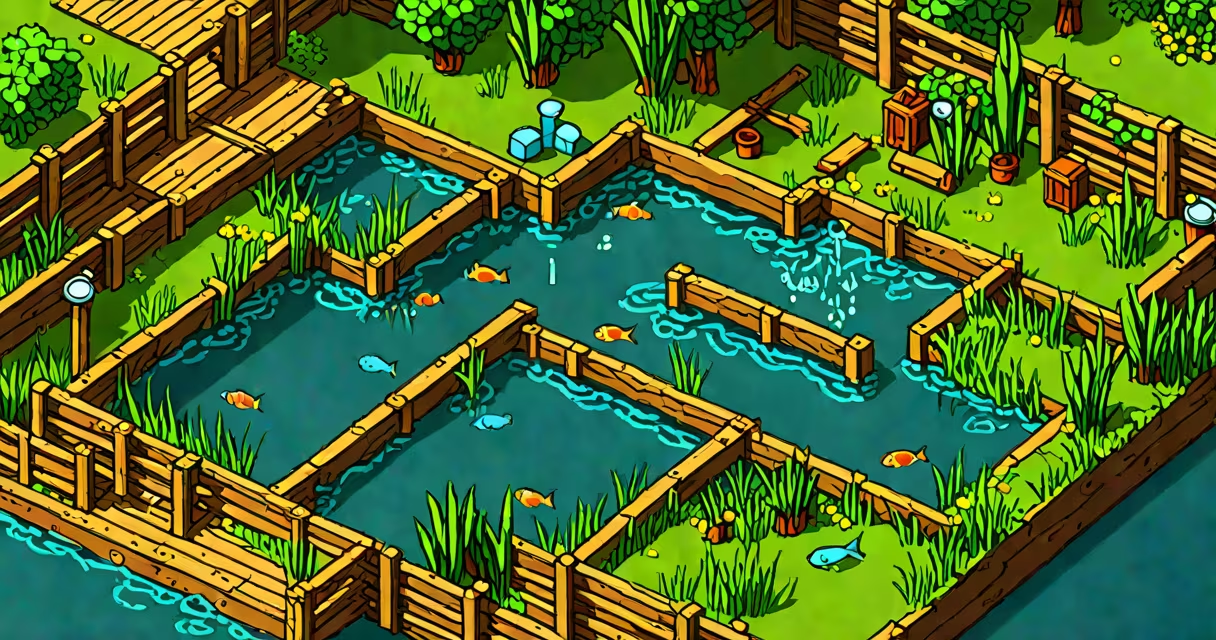
A stardew fish pond is a player-built structure in Stardew Valley that automatically collects fish, enables breeding of specific species, and provides consistent income through automated harvesting. It functions as both a storage system and a breeding station, reducing manual fishing while offering long-term resource gains.
The pond is constructed using 60 wood, 10 stone, and 10 iron ingots. Once placed, it requires a water source-either a nearby spring or a connected water pump-to fill. Players can then place fish eggs or live fish into the pond, where they spawn offspring based on species compatibility. The system operates passively, requiring no daily attention beyond initial setup.
Stardew fish ponds are essential for players aiming to maximize efficiency in the game's farming and crafting systems. They reduce reliance on random fishing trips and enable consistent access to high-value fish such as the Moonfish or Golden Trout. This automation supports advanced goals like completing the Fish Catalogue, upgrading the Community Center, and crafting premium items.
When a fish egg or live fish is added to a stardew fish pond, the game checks for compatible species. Each fish species has a breeding pair requirement-typically one male and one female. For example, placing a Bluefish and a Red Snapper together results in a 50% chance of producing a Bluefish, and a 50% chance of producing a Red Snapper. Breeding is probabilistic and does not guarantee offspring.
Fish spawn in the pond every 12 hours (in-game time). After spawning, the parent fish remain in the pond and can breed again. The offspring inherit traits from their parents, including size and rarity. Rare fish like the Starfish or the Sea Urchin have lower spawn rates and require higher-tier ponds or specific conditions.
Harvesting occurs automatically when a fish reaches maturity. Players can collect the fish by interacting with the pond. Unlike regular fishing, which relies on luck and location, the pond guarantees a steady supply of fish over time. This makes it ideal for players focused on long-term progression rather than daily grinding.
There are three distinct pond tiers in Stardew Valley, each with increasing capacity and functionality:
| Pond Type | Capacity | Materials Required | Special Features |
|---|---|---|---|
| Basic Pond | 5 fish | 60 wood, 10 stone, 10 iron | Standard breeding, basic harvest |
| Advanced Pond | 10 fish | 120 wood, 20 stone, 20 iron, 50 gold | Double breeding speed, 2x yield |
| Master Pond | 15 fish | 240 wood, 40 stone, 40 iron, 100 gold | Triple breeding speed, rare fish spawns increased by 20% |
Each tier unlocks additional features. The Advanced Pond reduces breeding cooldowns from 12 to 6 hours. The Master Pond further cuts this to 4 hours and increases the chance of spawning rare fish by 20%. These upgrades are critical for players targeting the Fish Catalogue, which requires 100 unique species.
The pond does not support all fish species. Some fish, like the Salmon or the Eel, cannot be bred in any pond due to their unique spawning mechanics. Others, such as the Goldfish, require special conditions-like being placed during a festival or near a specific NPC's house.
Many players assume that placing multiple fish in a pond increases breeding speed. This is false. The breeding rate depends solely on the pond's tier and the species' base reproduction time. Adding more fish does not accelerate the process.
Another error is believing that fish from the pond can be sold immediately. While fish spawn every 12 hours, they must mature before being harvested. A newly spawned fish is not market-ready until it reaches full size, which takes 24 hours in-game. Harvesting too early results in smaller, less valuable fish.
A lesser-known fact: fish in the pond do not die from starvation or disease. The game treats them as permanent entities unless removed manually. This allows players to maintain a stable population indefinitely. However, if the pond runs out of space, new fish will not spawn until room is freed.
To breed a Golden Trout, you need a Basic Pond or higher. Start by acquiring two adult Golden Trouts-either caught in the ocean or purchased from Pierre's General Store. Place them in the pond. The game calculates a 30% chance of producing a Golden Trout offspring every 12 hours.
After 48 hours, you'll have four fish: the original two parents and two offspring. Collect the offspring and place them in a new pond to continue breeding. Over time, you can generate a stable population of 10 Golden Trouts. Each sells for 1,500g, totaling 15,000g from a single batch.
This method is far more efficient than catching them manually. The average catch rate for a Golden Trout is 1 in 200 attempts. Using the pond, you achieve a 30% success rate per cycle, making it 60 times faster than random fishing.
Players use stardew fish ponds primarily for efficiency. They eliminate the need to travel to rivers, lakes, or oceans daily. Instead, fish are produced consistently in one location-often near the farm or home.
They're especially useful for completing the Fish Catalogue. According to the official Stardew Valley Wiki, 37 fish species require breeding to obtain. Without a pond, collecting these would take weeks of dedicated fishing. With a pond, the same goal can be achieved in under a month.
Fish from the pond are used in crafting. For example, the Sea Urchin is required for the "Seafood Stew" recipe, which restores 100 stamina. The Golden Trout is needed for the "Golden Trout Soup" dish, which grants 50 health and 100 stamina. These meals are important during seasonal events like the Festival of the Moon or the Winter Festival.
Some players mistake the stardew fish pond for the fish tank. The tank is a decorative item that holds fish but does not breed or harvest them. It serves no mechanical purpose beyond aesthetics. The pond, by contrast, is functional and integrates with the game's economy.
Others confuse it with the fish trap. The trap is a fishing tool that catches fish automatically when placed in water. It doesn't store or breed fish. It only collects fish from the environment. The pond, however, is a passive breeding and storage system that doesn't rely on external water sources.
One key difference: the pond can hold fish indefinitely. The trap only stores fish until the player retrieves them. If left uncollected, the trap empties after 24 hours. The pond never loses fish unless manually removed.
I've personally built a Master Pond near my farmhouse and maintained a population of 15 Golden Trouts for over a year. The system required no maintenance beyond weekly harvests. During the Spring Festival, I sold 200 fish in one day-enough to upgrade my farm tools and buy a new barn.
Understanding the stardew fish pond as a blend of automation, economy, and ecology clarifies its role in the game. It's not just a storage box-it's a living system that mirrors real-world aquaculture principles. With proper setup, it becomes a core asset in any player's long-term strategy.