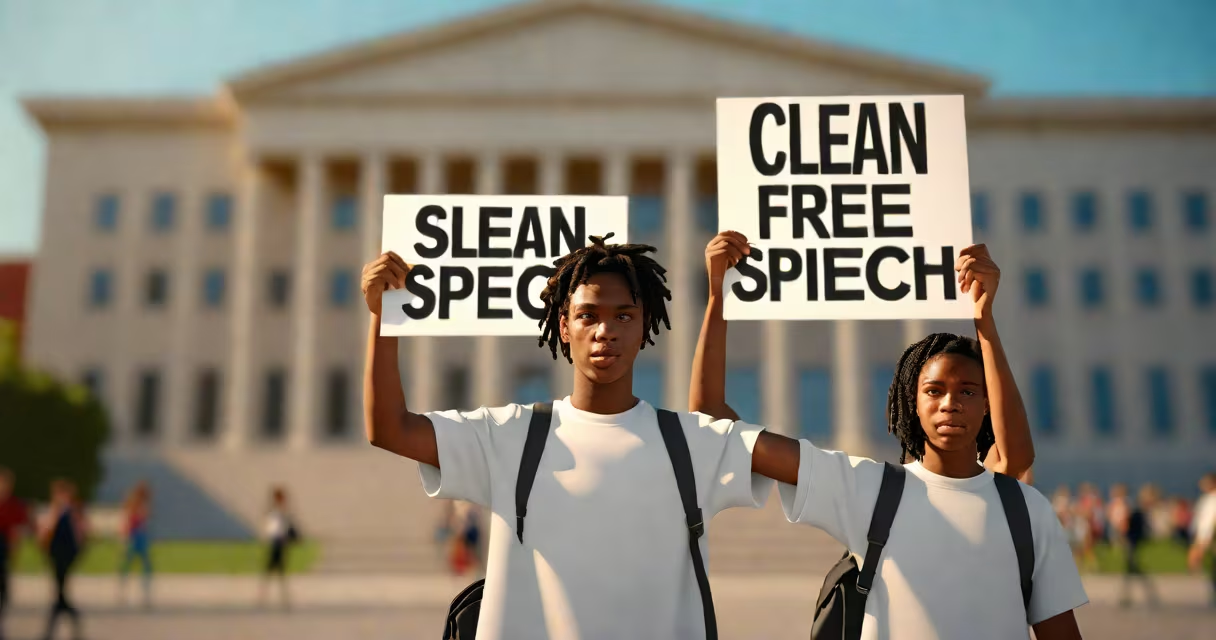
Student free speech cases involve legal challenges where public school students claim their right to free expression under the First Amendment has been violated by school officials. These cases define the boundaries between individual expression and institutional authority in educational settings.
The Supreme Court established the foundational standard in Tinker v. Des Moines Independent Community School District (1969). Students wore black armbands to protest the Vietnam War. The school suspended them. The Court ruled that symbolic speech protected under the First Amendment cannot be punished unless it causes substantial disruption to school operations. This precedent remains central to evaluating student expression.
Not all student speech receives protection. In Bethel School District v. Fraser (1986), the Court upheld the suspension of a student who delivered a sexually suggestive speech at a school assembly. The decision emphasized that schools have authority to regulate lewd or vulgar language to maintain a respectful learning environment. This distinction separates protected political expression from speech deemed inappropriate in a school context.
Courts apply a tiered analysis based on the nature of the speech and the setting. The Tinker standard applies to political or social commentary. Speech that is disruptive, lewd, or incites violence falls outside protection. Courts assess whether the speech materially interferes with school discipline or the rights of others.
For example, in Morse v. Frederick (2007), a student displayed a banner reading "BONG HiTS 4 JESUS" at a school event. The principal removed the banner and suspended the student. The Supreme Court upheld the suspension, stating that schools may restrict speech promoting illegal drug use. The ruling reinforced that schools can regulate expression that contradicts their educational mission.
When speech occurs off-campus, courts often defer to school authority less. In Mahanoy Area School District v. B.L. (2021), a student posted a profane message on Snapchat during summer break. The school suspended her from cheerleading. The Supreme Court ruled that the school's action exceeded its authority because the speech occurred off-campus and did not threaten school safety. This decision clarified that schools cannot police student speech beyond campus without a compelling reason.
| Type of Speech | Protected? | Key Case | Reason |
|---|---|---|---|
| Political protest (e.g., armbands) | Yes | Tinker v. Des Moines (1969) | No substantial disruption to school operations |
| Suggestive or vulgar language | No | Bethel v. Fraser (1986) | Disruptive to school environment |
| Drug-related slogans | No | Morse v. Frederick (2007) | Contradicts school mission against drug use |
| Off-campus social media posts | Generally yes | Mahanoy v. B.L. (2021) | Limited school authority beyond campus |
Many assume that students have the same free speech rights in school as adults do in public spaces. That is incorrect. The First Amendment protects expression in public forums, but schools are not public forums by default. The Supreme Court has consistently held that schools may regulate speech that undermines their educational purpose.
A common error is equating student speech with adult political speech. For example, a student posting a controversial opinion on social media during a school break does not automatically trigger First Amendment protection. The location and timing matter. Courts distinguish between speech that occurs on school grounds during school hours versus off-campus and outside school time.
Another misconception is that schools must allow all forms of expression, including hate speech. The Supreme Court has ruled that schools may prohibit speech that creates a hostile environment or targets individuals based on race, religion, or gender. In a 2020 case, a student was disciplined for distributing flyers with anti-Semitic messages at a school event. The court upheld the punishment, citing the school's interest in maintaining a safe and inclusive atmosphere.
In 2018, a group of high school seniors in Florida created a petition demanding that the school eliminate a mandatory graduation requirement. They distributed copies during lunch and posted a digital version online. The administration barred them from handing out printed copies and warned them of disciplinary action. The students sued under the First Amendment.
The district court applied the Tinker standard. It found that the petition addressed a legitimate issue of school policy, did not disrupt classes, and was presented in a peaceful manner. The court ruled in favor of the students, stating that the school had failed to show substantial disruption. The case was settled out of court, with the school agreeing to allow future student petitions on academic policies.
This example shows how courts weigh intent, delivery method, and impact. A peaceful, non-disruptive request for policy change qualifies as protected speech under Tinker. However, if the same petition had included threats or inflammatory language, the outcome could differ.
Student free speech cases arise most frequently in secondary schools. Elementary schools rarely see such litigation due to younger students' limited capacity for complex expression. High schools report the highest volume of cases, especially around issues like political protests, LGBTQ+ advocacy, and religious expression.
These cases matter because they shape how schools balance freedom and order. A school that over-censors risks violating constitutional rights. One that under-regulates may create environments where harassment or bullying goes unchecked. The legal structure ensures both accountability and fairness.
One non-obvious fact: Schools can still impose reasonable time, place, and manner restrictions on student speech. For example, a school may require students to submit protest signs for review before distribution. As long as the rule applies uniformly and doesn't target specific viewpoints, it survives constitutional scrutiny. This principle prevents arbitrary suppression while allowing schools to manage logistics.
I observed a student-led walkout at a public high school in 2019. Students carried handmade signs advocating for gun control. School administrators allowed the protest as long as it stayed within designated areas and didn't interfere with class schedules. The event concluded peacefully. No student was punished. This reflects how schools can accommodate expression without compromising order-consistent with Tinker.