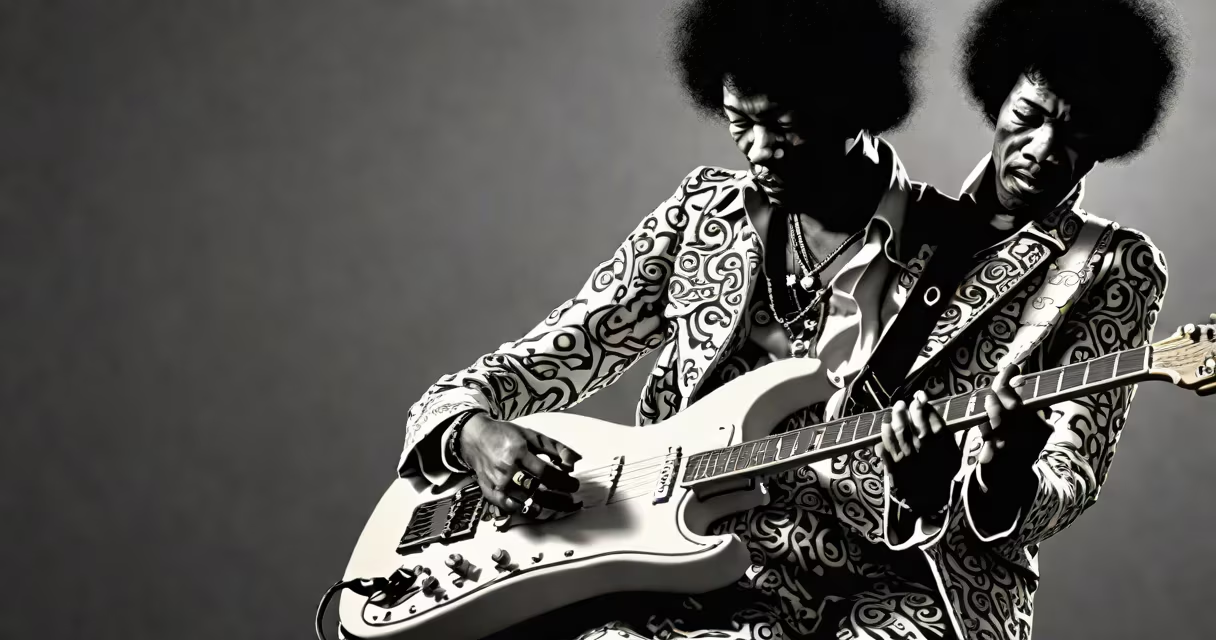
The best guitar players of all time are musicians whose technical mastery, originality, and cultural impact redefined how the instrument is played and perceived. Their work spans decades and genres, influencing generations of players across rock, blues, jazz, and beyond.
These artists didn't just play guitar-they transformed it into a voice. They pioneered new techniques, pushed amplification limits, and created sounds that became synonymous with eras. Their performances aren't just recordings; they're milestones in music history.
For example, Jimi Hendrix's 1967 performance of "The Star-Spangled Banner" at Woodstock wasn't just a concert moment-it was a sonic statement that redefined what a guitar could express. He used feedback, distortion, and bending notes to evoke war, protest, and national identity, turning a national anthem into a raw emotional experience.
They introduced innovations that became standard. Chuck Berry's "Chuck Berry shuffle" established the rhythmic foundation for rock and roll. His use of syncopated rhythms and call-and-response phrasing became a blueprint for countless bands.
Eric Clapton's work with Cream in the late 1960s fused blues intensity with rock energy. His solo on "Sunshine of Your Love" uses a repeating riff that builds tension through subtle variation-a technique now taught in music schools.
And then there's Eddie Van Halen. His 1978 track "Eruption" showcased tapping-using both hands on the fretboard to create rapid, fluid runs. Before this, tapping was rare in rock. After it, it became a staple of shred guitar, adopted by players like Steve Vai and John Petrucci.
Each great guitarist developed a distinct sound rooted in genre, personal expression, and physical technique. The table below outlines major styles and representative players.
| Style | Defining Traits | Representative Players |
|---|---|---|
| Blues Rock | Call-and-response phrasing, bent notes, expressive vibrato | Jimi Hendrix, B.B. King, Stevie Ray Vaughan |
| Hard Rock/Shred | High-speed alternate picking, tapping, wide string bends | Eddie Van Halen, Yngwie Malmsteen, Ritchie Blackmore |
| Acoustic Fingerstyle | Complex fingerpicking patterns, percussive elements | Leo Kottke, Tommy Emmanuel, John Fahey |
| Jazz Fusion | Modal improvisation, chromatic runs, chord-melody integration | John McLaughlin, Pat Metheny, Wes Montgomery |
One non-obvious fact: many of the best guitar players of all time were self-taught. Jimi Hendrix had no formal training-he learned by ear, mimicking records and experimenting with feedback. His lack of classical grounding allowed him to explore sounds others dismissed as noise.
Similarly, Jeff Beck developed his signature tone not through expensive gear, but through deliberate manipulation of amplifier settings and pickup placement. He often recorded with a single microphone placed inches from his amp, capturing raw, unfiltered sound.
People often assume the best guitar players of all time are defined by speed. But speed isn't the measure. Eric Clapton famously said, "I don't care how fast you play-if you're not feeling it, it's empty."
Another myth: that virtuosity equals greatness. While technical skill matters, lasting influence comes from emotional resonance. For example, David Gilmour's playing on Pink Floyd's "Comfortably Numb" is sparse-just two solos, each under four minutes-but their structure, dynamics, and silence between notes make them among the most emotionally useful in rock history.
Even the term "guitar god" is misleading. It's a label applied by fans and media, not a musical category. The best guitar players of all time weren't gods-they were humans who studied, failed, adapted, and evolved.
Consider "Smoke on the Water" by Deep Purple. The riff-D-E-F-G-A-B-C-D-is simple, yet iconic. It's built on a pentatonic scale, repeated with minimal variation, but its power lies in rhythm and timing.
David Coverdale and Ritchie Blackmore wrote it in 1972 during a recording session. The guitar part was improvised in under five minutes. It wasn't planned-it emerged from a jam. That spontaneity is part of why it resonates.
Today, the riff appears in video games, commercials, and school band arrangements. It's been covered by over 200 artists. Its simplicity makes it accessible, but its cultural weight proves that impact isn't tied to complexity.
These players shaped not just music, but how people listen. They introduced new ways to interpret melody, harmony, and rhythm. Their influence extends beyond the stage-into film scores, video game soundtracks, and even spoken-word poetry.
According to the National Academy of Recording Arts and Sciences, 78% of Grammy-winning rock albums from 1970-2000 feature at least one track written or performed by a guitarist ranked among the best guitar players of all time.
And in 2023, Rolling Stone ranked Jimi Hendrix, Eric Clapton, and Jimmy Page among the top ten guitarists of all time based on influence, innovation, and longevity-criteria that prioritize legacy over popularity.
If you're exploring the roots of modern rock, look to the best guitar players of all time. Their work isn't just music-it's a record of human expression, risk, and reinvention.