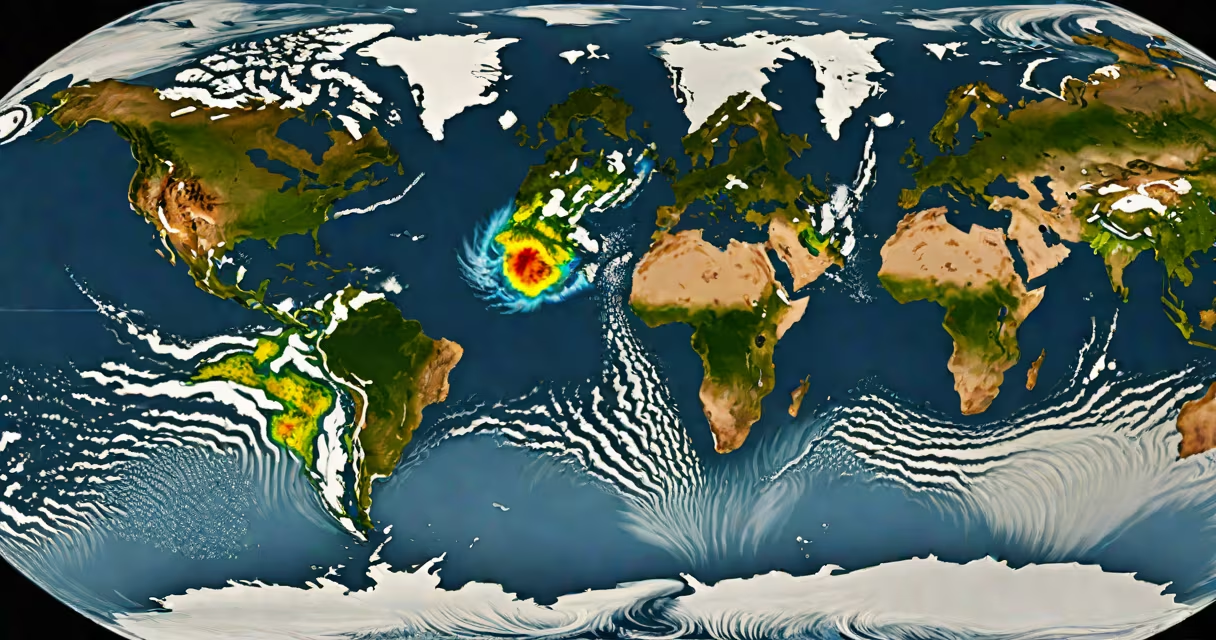
Climate change refers to long-term shifts in temperature, precipitation, wind patterns, and other measures of climate that occur over decades or longer. These changes are primarily driven by human activities, especially the emission of greenhouse gases like carbon dioxide and methane from burning fossil fuels, deforestation, and industrial processes.
The Intergovernmental Panel on Climate Change (IPCC) states that global surface temperatures have risen by approximately 1.2°C since the late 19th century, with most of the warming occurring since 1970. This trend is linked to increased atmospheric concentrations of CO₂, which reached 420 parts per million in 2023-levels not seen in at least 800,000 years, according to data from the National Oceanic and Atmospheric Administration (NOAA).
Earth's climate system balances incoming solar radiation with outgoing heat. Greenhouse gases trap some of this outgoing infrared radiation, creating a natural greenhouse effect that keeps the planet warm enough to support life. However, human activity has intensified this effect by releasing excess gases into the atmosphere.
When fossil fuels such as coal, oil, and gas are burned for energy, they release carbon dioxide (CO₂). Deforestation reduces the number of trees that absorb CO₂. Industrial agriculture produces methane (CH₄), a gas 28 times more potent than CO₂ over a 100-year period. These emissions accumulate in the atmosphere, increasing the heat-trapping capacity and raising average global temperatures.
A 2022 study published in *Nature* found that human-caused emissions have led to a 0.6°C increase in global average temperature between 1950 and 2020, with the rate of warming accelerating in recent decades. This acceleration is evident in the frequency and intensity of extreme weather events, including heatwaves, droughts, wildfires, and stronger hurricanes.
Climate change manifests through multiple interconnected systems. The following table outlines major categories of impact, their drivers, and documented effects.
| Impact Type | Primary Driver | Observed Effect (since 1900) |
|---|---|---|
| Global Temperature Rise | CO₂ and CH₄ emissions | Surface temps up 1.2°C; Arctic warming twice the global average |
| Sea Level Rise | Thermal expansion & melting ice sheets | Global average rise of 20 cm since 1900; accelerating to 3-6 mm/year |
| Extreme Weather Events | Warmer oceans and atmosphere | Heatwave frequency doubled; Category 4-5 hurricanes up 25% since 1970 |
| Ocean Acidification | CO₂ absorption by seawater | Surface pH dropped 0.1 units since pre-industrial times-equivalent to 30% more acidity |
These changes are not hypothetical. In 2023, the World Meteorological Organization reported that 2022 was the fifth hottest year on record, with 127 climate disasters recorded globally-double the number from 1980. The 2021 Pacific Northwest heat dome, which killed over 600 people in Canada and the U.S., exemplifies how climate change increases the likelihood of such events.
Many people confuse climate change with short-term weather fluctuations. A cold winter does not disprove global warming. Climate refers to long-term patterns over 30 years or more; weather is daily or seasonal variation. A single cold day doesn't negate a 1.2°C warming trend.
Another misconception is that climate change is solely a future threat. Evidence shows it is already affecting ecosystems and communities. For example, coral reefs in the Great Barrier Reef have experienced five mass bleaching events since 1998, with 2016 and 2017 seeing over 50% mortality due to warmer sea temperatures.
Some argue that natural cycles explain current warming. While Earth's climate has varied historically due to solar activity and volcanic eruptions, the current rate of warming exceeds natural variability. The IPCC confirms that "it is extremely likely that human influence has been the dominant cause of the observed warming since the mid-20th century."
In 2020, I visited the village of Kivalina in Alaska, where residents face coastal erosion caused by melting permafrost and reduced sea ice. The community, originally settled in the 1800s, now faces relocation due to rising sea levels. Their homes sit just meters from the shoreline, and storms that once occurred every decade now happen annually.
Another example is the 2022 Pakistan floods, which submerged one-third of the country. Satellite data from NASA showed rainfall totals exceeded 300% of normal levels in August. Scientists linked the event to warmer Indian Ocean waters, a known contributor to monsoon intensification under climate change.
Even agricultural yields are affected. A 2021 study in *Science Advances* found that wheat yields in Europe declined by 5.5% per degree of warming above pre-industrial levels. In France, harvests dropped 12% in 2019 during a heatwave that damaged crops across the region.
Addressing climate change requires both mitigation-reducing emissions-and adaptation-preparing for unavoidable impacts. Mitigation includes transitioning to renewable energy, improving energy efficiency, and protecting forests. Global efforts like the Paris Agreement aim to limit warming to below 2°C, preferably 1.5°C, above pre-industrial levels.
Adaptation involves building resilient infrastructure, developing early warning systems for extreme weather, and supporting vulnerable populations. For instance, the Netherlands uses advanced flood barriers and floating homes to manage sea level rise. In Bangladesh, community-based early warning systems have reduced cyclone-related deaths by over 90% since the 1990s.
Climate change is not a distant problem-it is happening now, in cities, farms, coastlines, and homes. The science is clear, the impacts are measurable, and the window for effective response is narrowing. Acting on the summary of climate change means acting on evidence, not fear.