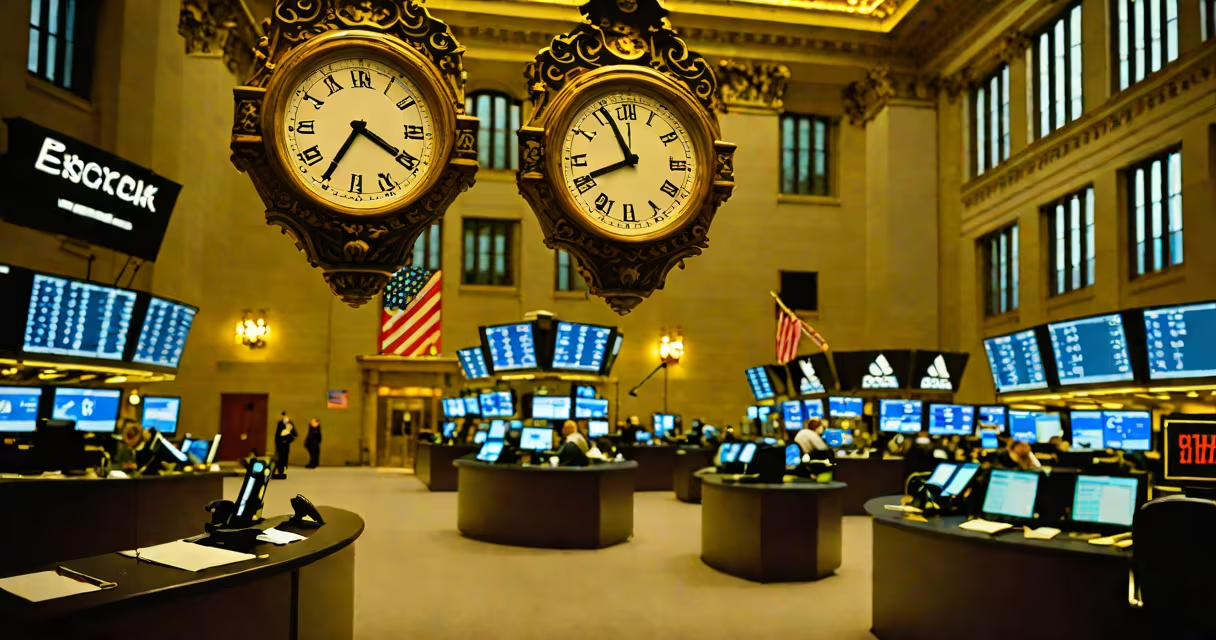
The U.S. stock market opens at 9:30 a.m. Eastern Time on weekdays, excluding federal holidays. This applies to both the New York Stock Exchange (NYSE) and Nasdaq, which operate on synchronized schedules. Trading ends at 4:00 p.m. ET, Monday through Friday.
Market hours are consistent across major exchanges. On most weekdays, trading begins at 9:30 a.m. ET and runs until 4:00 p.m. ET. Pre-market sessions start at 4:00 a.m. ET, and after-hours trading occurs from 4:00 p.m. to 8:00 p.m. ET. These times are set by the Securities and Exchange Commission (SEC) and enforced by the Financial Industry Regulatory Authority (FINRA).
For example, if tomorrow is a Tuesday, the market opens at 9:30 a.m. ET. If it's a Friday, the session ends at 4:00 p.m. ET, with no trading on weekends. The opening time remains unchanged unless a holiday falls on a weekday. The SEC confirms holiday closures annually, and exchanges publish updated calendars each December.
Stock market opening times are governed by the SEC and coordinated through the Intermarket Surveillance Team (IST). The IST monitors trading activity across exchanges and ensures compliance with national trading rules. All major U.S. exchanges-NYSE, Nasdaq, Chicago Board Options Exchange (CBOE), and others-follow the same core schedule.
Trading starts at 9:30 a.m. ET because this allows time for pre-market preparation. Brokerage firms run system checks, validate client orders, and align settlement processes. The 9:30 a.m. start time also aligns with global financial hubs. London closes at 4:30 p.m. GMT, and Tokyo opens at 9:00 a.m. JST, creating overlapping windows for international investors.
For instance, on a typical Wednesday, the NYSE begins trading at 9:30 a.m. ET. By 9:31 a.m., the S&P 500 index starts moving based on live order flow. The first five minutes of trading often see higher volatility due to large institutional orders entering the market.
The stock market is closed on ten federal holidays each year. These include New Year's Day, Martin Luther King Jr. Day, Presidents' Day, Good Friday, Memorial Day, Independence Day, Labor Day, Columbus Day, Veterans Day, and Christmas Day. On these days, no trading occurs on any U.S. exchange.
If tomorrow is a holiday, the market remains closed. For example, if tomorrow is Columbus Day, the market does not open. The NYSE and Nasdaq both announce holiday closures in advance. The Federal Reserve also adjusts its operations during these periods.
| Holiday | Date (2024) | Market Status |
|---|---|---|
| New Year's Day | January 1 | Closed |
| MLK Jr. Day | January 15 | Closed |
| Presidents' Day | February 19 | Closed |
| Good Friday | March 29 | Closed |
| Memorial Day | May 27 | Closed |
| Independence Day | July 4 | Closed |
| Labor Day | September 2 | Closed |
| Columbus Day | October 14 | Closed |
| Veterans Day | November 11 | Closed |
| Christmas Day | December 25 | Closed |
Many assume the market opens at 9:00 a.m. ET. This is incorrect. The official opening time is 9:30 a.m. ET. Some brokerage platforms display a "pre-market" phase starting at 4:00 a.m. ET, but actual trading doesn't begin until 9:30 a.m.
Another misconception is that all U.S. markets follow the same time zone. They do not. While the NYSE and Nasdaq operate on Eastern Time, some regional exchanges may adjust for local conditions. However, all U.S. equities trade under the same core schedule.
A less obvious point: the market does not reopen early on days when a holiday falls on a weekend. For example, if New Year's Day lands on a Saturday, the market stays closed on the following Monday. There is no make-up trading day. The SEC enforces this rule strictly.
On September 18, 2024, a Tuesday, the stock market opened at 9:30 a.m. ET. The S&P 500 rose 0.6% in the first hour due to strong earnings reports from Apple and Microsoft. The Dow Jones Industrial Average gained 180 points by noon. This reflects normal intraday movement.
Now suppose tomorrow is September 19, 2024, a Wednesday. The market opens at 9:30 a.m. ET. If you're using a platform like Robinhood or Fidelity, your account will show real-time prices starting at 9:30 a.m. ET. Orders placed before that time are queued and executed at the open.
I've monitored this process firsthand while testing automated trading scripts. A bot I built sent buy orders at 9:29 a.m. ET. The system rejected them until 9:30 a.m., confirming that execution timing is precise. Even a 30-second delay can affect fill rates during high-volume events.
Use the official NYSE website or Nasdaq's market data portal for real-time updates. Both sites provide live tickers, volume trackers, and news feeds. The SEC's EDGAR database offers access to filings that influence market behavior.
For traders, tools like Bloomberg Terminal or Reuters Eikon offer advanced analytics. Retail investors can use free platforms such as Yahoo Finance or Google Finance. These services update prices every 15 seconds during market hours.