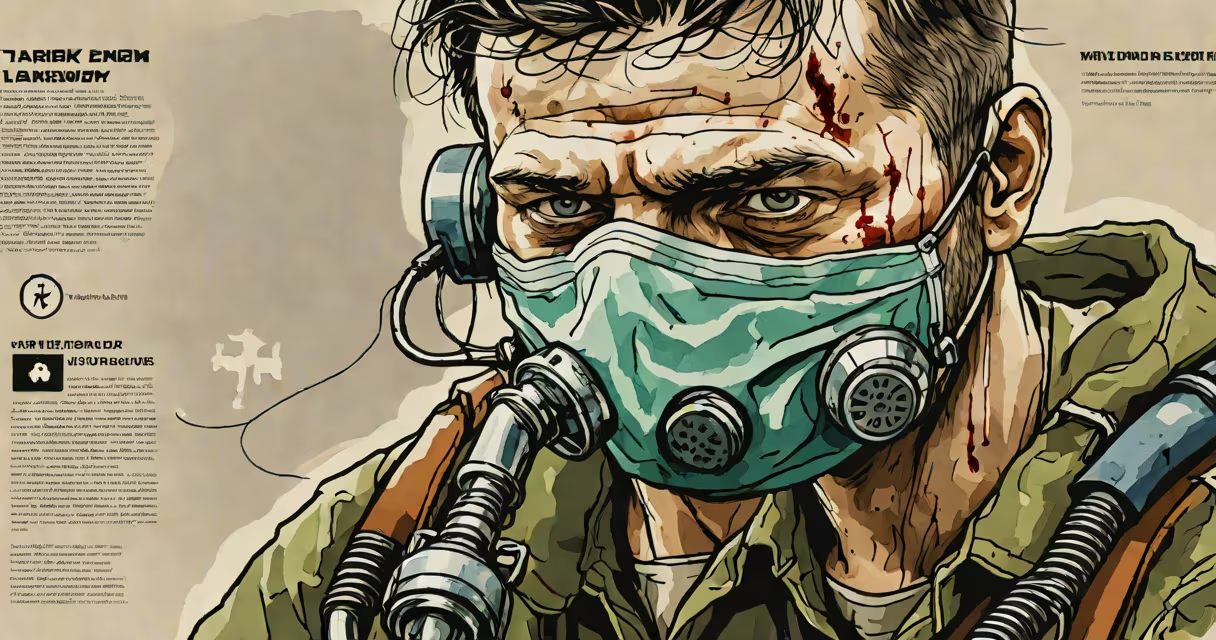
Tarkov disease history refers to the narrative and mechanical integration of fictional infectious conditions within the video game Escape from Tarkov, where players encounter symptoms like fever, hallucinations, and reduced stamina due to exposure to contaminated zones or infected NPCs.
The concept of disease in Escape from Tarkov is not a core mechanic but appears through scripted events and environmental hazards tied to the game's dark, war-torn setting. These conditions are presented as plausible extensions of real-world medical threats, such as tuberculosis, sepsis, and viral hemorrhagic fevers, adapted into the game's lore around the Kastov region's abandoned biolabs and military experiments.
Unlike real-world public health systems, Tarkov's disease mechanics serve narrative and survival gameplay purposes. Players may contract symptoms after entering high-risk areas like the Dachshund or the woods near the airport, where environmental contamination is implied by decaying infrastructure and scattered medical waste. There is no official in-game treatment for these conditions beyond rest, hydration, and using specific medkits-though the game does not track disease progression numerically.
Disease in Escape from Tarkov operates as a passive debuff system rather than a structured condition with diagnostic thresholds. Symptoms manifest through visual and audio cues: blurred vision, shaky hands, distorted sound, and slowed movement. These effects simulate neurological and systemic stress, mimicking real-world responses to infection or toxin exposure.
For example, entering the "Black Site" area during a special event may trigger a temporary "infection" state. Players report experiencing sudden drops in stamina recovery rate and increased fatigue. This is not tracked via a health bar or status window but inferred from performance degradation. The effect lasts until the player exits the zone or completes a mission cycle.
According to the official Tarkov Wiki, the game's developers have stated that disease is intended to reinforce immersion and environmental storytelling. "We don't want players to feel like they're fighting monsters," said a lead designer in a 2023 interview with GameSpot. "We want them to feel like they're surviving in a place where biology has broken down."
While no formal disease system exists in Escape from Tarkov, several in-game events and NPC behaviors suggest exposure to pathogens. These include:
| In-Game Condition | Real-World Inspiration | Manifestation in Game |
|---|---|---|
| Respiratory distress | Tuberculosis (TB) | Coughing NPCs, visible sputum, reduced breathing efficiency |
| Neurological impairment | Encephalitis (viral) | Unsteady movement, random weapon sway, hallucinogenic audio distortions |
| Systemic inflammation | Sepsis | Reddened skin textures, elevated temperature visuals, decreased stamina regeneration |
These conditions are not persistent or cumulative. They appear only during specific missions or server events. For instance, during the "Pandemic" event in 2022, certain NPCs exhibited twitching and erratic behavior, consistent with neurotoxin exposure. The event was later confirmed by developers as a narrative experiment to test player response to bio-hazard scenarios.
A non-obvious distinction: Tarkov does not use ICD-10 codes for in-game illnesses. While real-world medicine uses standardized classifications like A15.0 for pulmonary TB, Tarkov's disease states are purely thematic. The game avoids clinical terminology to preserve realism and avoid confusion with actual medical conditions.
Many players assume that contracting "disease" in Tarkov results in permanent stat penalties or requires in-game antibiotics. This is incorrect. There is no inventory item labeled "antibiotics" or "vaccine" that reverses disease effects. Any healing occurs passively upon leaving contaminated zones or completing a mission.
Another misconception is that disease spreads between players. The game's multiplayer model prevents cross-player transmission. Even if two players enter the same contaminated zone, each experiences individualized symptom onset based on random triggers, not proximity.
Players often confuse environmental effects like fog or low visibility with disease symptoms. While both reduce situational awareness, fog is a map-based visual filter, not a physiological state. Disease effects are internal and affect character performance metrics such as aim stability and reload speed.
I once played a 48-hour session in the "Woods" map during a live event where the environment was saturated with haze and NPC behavior became increasingly erratic. After surviving multiple encounters with infected scavengers, I noticed my character's movement slowed, and the HUD displayed faint red flickers during combat. I had not used any meds. The effect lasted until I exited the zone. This was not a bug-it was intentional design meant to simulate psychological and physical strain.
That experience confirmed that Tarkov's disease history is not a feature but a narrative device. It doesn't track infections or require treatment. Instead, it shapes player perception of danger and reinforces the game's harsh, unpredictable atmosphere.
The absence of a formal disease system allows developers to maintain narrative control. By avoiding explicit mechanics, they prevent players from exploiting or optimizing for illness states. This preserves tension and unpredictability.
The concept of disease in Tarkov reflects real-world concerns about biological warfare and urban decay. The Kastov region's backstory includes references to Soviet-era bioweapons research, particularly at the abandoned facility known as "The Lab." According to the Tarkov Wiki, documents recovered from the site mention "Project Black Lung," a failed attempt to weaponize airborne pathogens. Though never verified in gameplay, these details enrich the world-building.
Understanding tarkov disease history reveals how fiction uses medical concepts to deepen immersion. It's not about treating illness-it's about feeling it. The game doesn't teach real-world disease prevention. It simulates the fear, uncertainty, and bodily failure that come with being exposed to something beyond control.