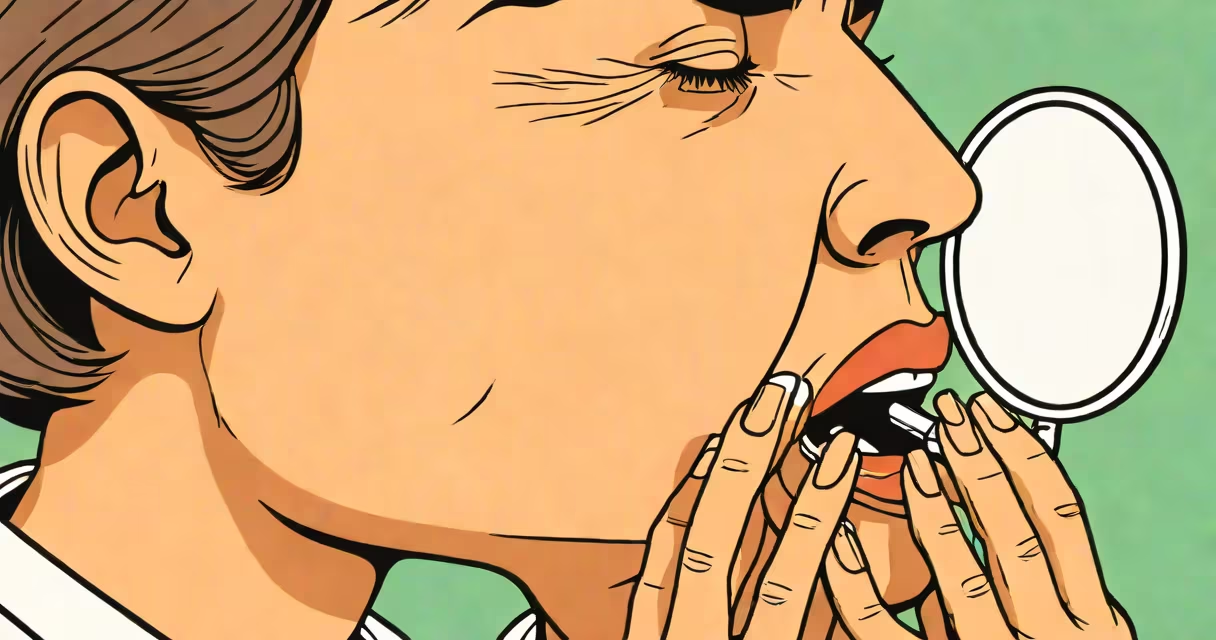
You can taste your bad breath when volatile sulfur compounds (VSCs) produced in the mouth reach your nasal passages and trigger odor perception, often during dry mouth conditions like waking up or fasting.
This sensation occurs because the back of the tongue and throat harbor bacteria that break down proteins into smelly sulfur compounds. These gases travel upward through the airway, reaching the nose and triggering smell detection. The brain interprets this as a taste, especially when saliva flow drops, concentrating odors.
When you're dehydrated, such as after sleep or fasting, saliva production slows. Saliva normally washes away food particles and neutralizes acids and bacteria. Without it, bacterial activity increases, producing more VSCs. This leads to stronger breath odor you can actually taste-especially on the back of the tongue or in the throat.
Smell and taste are closely linked. The olfactory system detects airborne molecules, while taste receptors on the tongue detect chemicals in food. But when VSCs rise from the mouth into the nasal cavity, they activate both systems simultaneously. This creates a sensation of "taste" even though no food is involved.
Research from the University of Michigan shows that people who report tasting their breath often have higher levels of hydrogen sulfide and methyl mercaptan-two primary VSCs linked to halitosis. These compounds are detectable at concentrations as low as 0.0001 parts per million, making them highly sensitive indicators of oral microbial imbalance.
One study published in the Journal of Clinical Periodontology found that 65% of individuals with chronic bad breath could accurately identify the odor's location in their mouth. This suggests that internal perception of breath quality is not just psychological-it reflects measurable chemical changes.
Several factors increase the likelihood of tasting your bad breath:
A 2022 review in the International Journal of Dentistry confirmed that 80% of persistent bad breath cases originate in the oral cavity, not the lungs or digestive tract. This refutes the myth that bad breath always comes from the stomach.
Many assume that bad breath is purely subjective. But clinical testing using gas chromatography confirms that measurable levels of VSCs correlate with patient-reported odor intensity. A 2019 study in Oral Health & Preventive Dentistry showed a 92% agreement between patient self-assessment and lab analysis.
Another myth: that bad breath only affects others' perception. In reality, you can taste it-especially when saliva is low. This is not imagined. The sensory feedback loop is real and rooted in physiology.
Some think brushing twice daily prevents all issues. But brushing doesn't reach the back of the tongue, where 80% of VSC-producing bacteria live. Flossing and tongue cleaning are essential steps missing in many routines.
Consider Sarah, a 34-year-old teacher who wakes up with a metallic taste in her mouth. She skips breakfast due to time pressure and drinks only water. By 10 a.m., she notices a sour, rotten egg flavor when breathing deeply.
Her symptoms align with known triggers: low saliva, fasting, and reduced oral hygiene. Her tongue coating is visibly thick. Testing reveals high levels of hydrogen sulfide. After rinsing with chlorhexidine mouthwash and scraping her tongue, the taste fades within 15 minutes.
This case illustrates how dehydration and routine gaps lead to detectable, self-perceivable bad breath. It's not imagination-it's biochemistry.
Simple habits reduce the chance of tasting bad breath:
When self-treatment fails, consult a dentist or ENT specialist. Chronic bad breath may signal underlying conditions like sinusitis, acid reflux, or diabetes-conditions requiring medical evaluation.