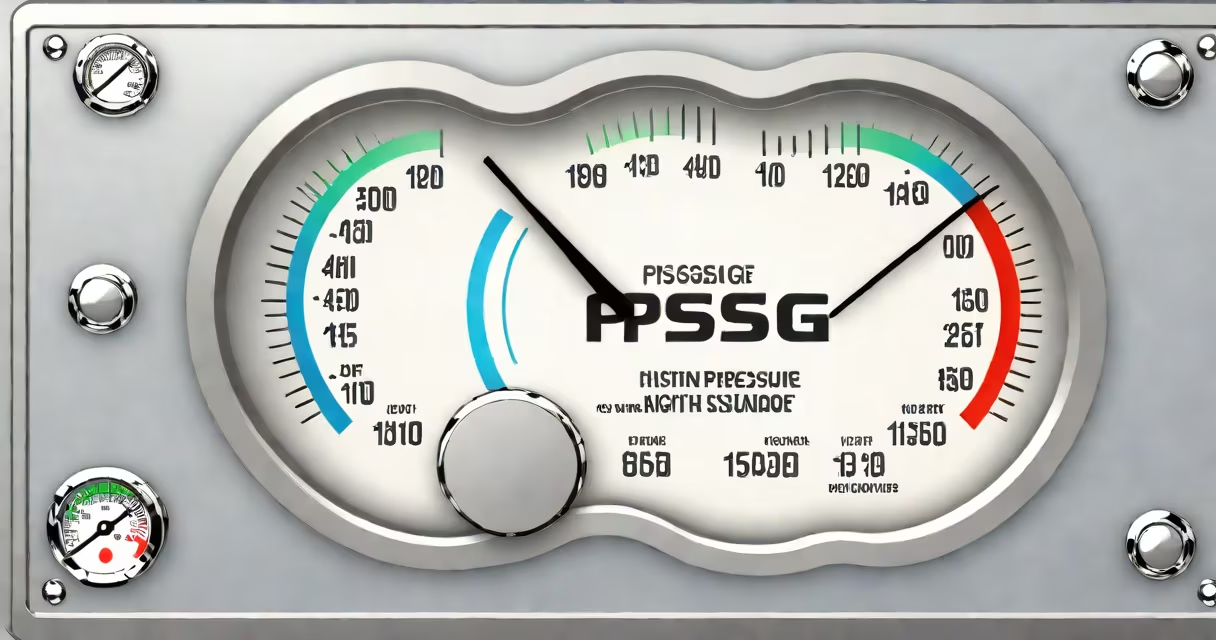
Psig stands for pounds per square inch gauge, a unit measuring pressure relative to ambient atmospheric pressure. It indicates how much pressure exists above or below the surrounding air pressure at sea level, typically 14.7 psi.
When a system shows 0 psig, it means internal pressure equals atmospheric pressure. A reading of 50 psig means the pressure inside is 50 psi higher than the outside air. This distinction is critical in engineering, plumbing, and mechanical systems where absolute pressure differences affect performance and safety.
For example, a car tire inflated to 32 psig has an internal pressure 32 psi greater than the surrounding atmosphere. The actual absolute pressure inside the tire is 32 + 14.7 = 46.7 psia (pounds per square inch absolute).
Psig uses a reference point: atmospheric pressure at sea level. Instruments calibrated to psig measure the difference between the system's pressure and that baseline. This makes psig ideal for applications where the environment's air pressure fluctuates but the system's performance depends on internal pressure relative to surroundings.
Most pressure gauges in industrial settings, HVAC systems, and hydraulic equipment display psig because operators need to know how much force the system exerts beyond normal air pressure. For instance, a boiler operating at 100 psig delivers steam under significant excess pressure compared to the atmosphere, which enables efficient heat transfer.
Pressure sensors use diaphragms or strain gauges to detect deformation caused by fluid or gas pressure. The sensor compares this deformation to atmospheric pressure via a vented reference chamber. The result is a direct psig output. This design ensures readings remain consistent regardless of altitude changes, unlike absolute pressure measurements.
Understanding psig requires knowing how it compares to other pressure units. The most common are psia (absolute), psi (general), and kPa (kilopascals).
| Unit | Definition | Use Case |
|---|---|---|
| psig | Pressure relative to atmospheric pressure | Industrial tools, HVAC, tires |
| psia | Pressure relative to a perfect vacuum (zero pressure) | Scientific calculations, thermodynamics |
| psi | General term for pounds per square inch; context-dependent | Everyday usage; ambiguous without clarification |
| kPa | Kilopascals (1 kPa = 0.145 psi); metric equivalent | International standards, medical devices |
A key distinction: psig values can be negative. If a system is under vacuum, such as a sealed container with reduced internal pressure, the gauge reads below zero. A reading of -5 psig means the pressure inside is 5 psi less than atmospheric pressure.
For example, a vacuum pump reducing pressure in a chamber to 10 psi absolute (psia) results in a psig value of 10 - 14.7 = -4.7 psig. This negative reading reflects suction force, essential in processes like degassing liquids or sealing packages.
Many assume psig and psi are interchangeable. They are not. Saying "the system runs at 100 psi" without specifying gauge or absolute leads to errors. In a piping system, 100 psig means the working pressure exceeds ambient by 100 psi, while 100 psia includes atmospheric pressure.
Another mistake is treating psig as absolute. In aerospace or high-altitude environments, atmospheric pressure drops. A gauge showing 0 psig at 10,000 feet still reads zero, but the actual pressure is lower than at sea level. This affects system design-especially in aircraft fuel systems or weather balloons.
One non-obvious fact: psig readings change with weather. Barometric pressure varies daily. A pressure vessel showing 50 psig on a sunny day may read slightly different on a stormy day due to atmospheric shifts. While the instrument accounts for local conditions, long-term monitoring requires adjusting for barometric fluctuations.
In HVAC systems, refrigerant pressures are measured in psig. A typical residential AC unit operates with refrigerant at around 70 psig during cooling mode. Technicians use this value to diagnose low charge or blocked lines. If the reading drops below 50 psig, they suspect a leak or insufficient refrigerant.
Consider a water heater set to maintain 150°F. The pressure relief valve opens at 150 psig to prevent tank rupture. If the temperature rises too high, thermal expansion increases pressure. At 150 psig, the valve releases excess pressure safely. Without accurate psig monitoring, the tank could fail catastrophically.
During my time installing commercial boilers, I once encountered a system that failed repeatedly. The pressure gauge showed 120 psig, within specification. But upon checking the actual pressure using a calibrated digital sensor, we found it was 120 psia. That meant the gauge was actually reading absolute pressure, not gauge. The error stemmed from mislabeling the gauge. Correcting the calibration restored safe operation.
Understanding psig enhances comprehension of related terms. For instance, "h x w x d meaning" refers to dimensions-height, width, depth-used in packaging and equipment specs. A compressor rated at 24 in × 18 in × 36 in has a footprint of 24×18 inches and a height of 36 inches. Knowing these dimensions ensures proper installation space, especially when paired with pressure ratings like 150 psig.
Similarly, "has been meaning" describes past actions completed in the past tense. "The system has been running at 80 psig for six hours" confirms continuous operation. This helps track performance trends. Monitoring psig over time identifies gradual pressure loss, indicating wear or leaks.
"G up meaning" relates to informal slang for getting ready or preparing. "I'm g up for the shift" means "I'm preparing." This contrasts sharply with technical terms like psig, which demand precision. In contrast, a technician cannot say "I'm g up for the pressure test"-the intended meaning would be lost.
For accurate pressure analysis, always verify whether a reading is psig or psia. Many manuals list both. A pressure switch rated for 50-100 psig must not be exposed to 100 psia unless designed for it. Overpressure risks damage or failure.
When troubleshooting, cross-reference psig values with manufacturer specifications. Always calibrate instruments annually. Use a known reference standard-like a deadweight tester-to validate accuracy. Even small deviations compound in closed-loop systems.