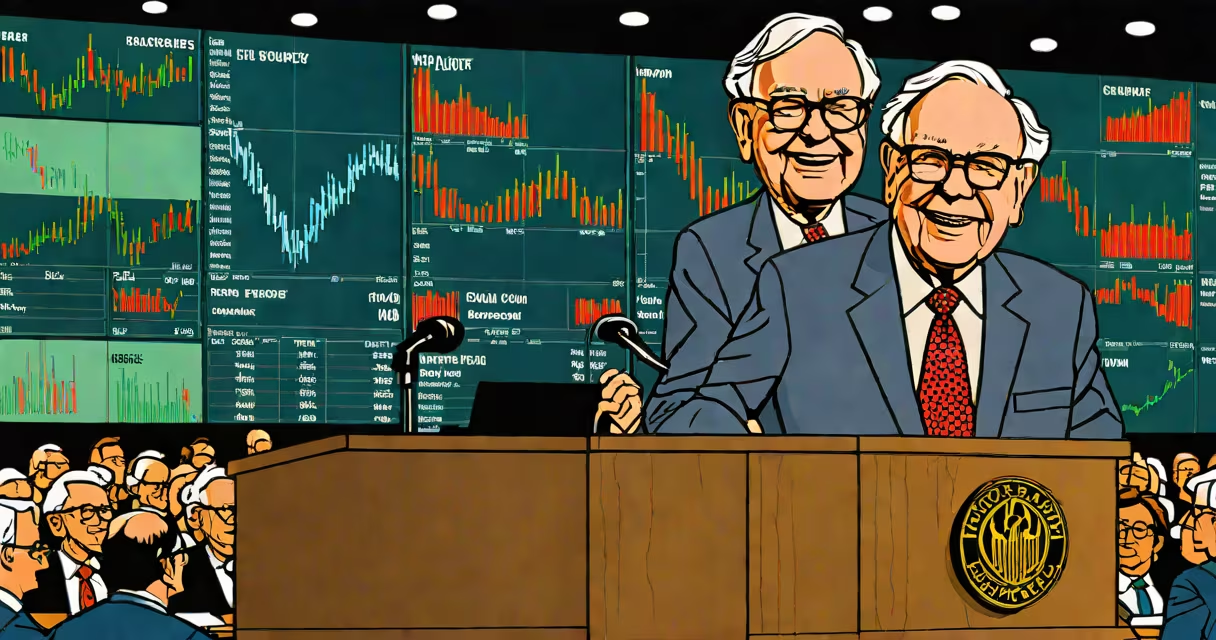
The warren buffett index is not an official financial metric but a commonly referenced benchmark that tracks Berkshire Hathaway's stock performance as a proxy for long-term value investing success. It reflects the returns generated by Warren Buffett's investment philosophy-buying high-quality businesses at fair prices and holding them for decades.
Berkshire Hathaway, led by Buffett since 1965, has compounded shareholder wealth at approximately 19.8% annually through 2023, according to data from the S&P Global Market Intelligence. This outpaces the S&P 500's average return of 10.2% over the same period. While not a formal index like the S&P 500 or Nasdaq Composite, the term "warren buffett index" is used informally to describe the performance trajectory of Berkshire Hathaway stock as a real-world test of value investing principles.
Buffett's strategy centers on identifying durable competitive advantages-what he calls "economic moats"-and avoiding speculative behavior. He focuses on companies with predictable earnings, strong management, and low capital requirements. Berkshire Hathaway's portfolio includes stakes in Coca-Cola, American Express, Apple, and Bank of America-all businesses Buffett considers to have lasting value.
The warren buffett index functions as a de facto performance benchmark based on Berkshire Hathaway's stock price and dividend reinvestment. Investors use it to measure how well long-term, disciplined investing performs relative to market averages. For example, $1 invested in Berkshire Hathaway in 1965 would be worth roughly $1.4 million by 2023, assuming reinvested dividends and no fees. That compares to $1 growing to about $280,000 in the S&P 500 over the same period.
Unlike traditional indices that weight stocks by market cap or float, the warren buffett index reflects a concentrated, fundamental approach. Berkshire owns over 500 companies, but the top 10 holdings account for nearly 80% of its market value. This concentration mirrors Buffett's belief in "investing in what you understand."
A key feature of the index is its focus on intrinsic value rather than short-term volatility. Buffett famously said, "Our favorite holding period is forever," emphasizing patience and conviction. The index thus measures not just returns, but the consistency of decision-making under uncertainty.
The warren buffett index isn't a basket of stocks-it's a conceptual structure rooted in Buffett's investment process. Its foundation lies in three pillars: business quality, valuation discipline, and long-term ownership.
Business quality means selecting companies with sustainable advantages. For example, Coca-Cola's global brand strength and pricing power make it a "moat"-protected business. Buffett has held it since 1988 and continues to view it as a core holding. Similarly, American Express benefits from network effects and customer loyalty, making it resilient during economic downturns.
Valuation discipline ensures investors don't overpay. Buffett avoids growth stocks with high P/E ratios unless they come with strong earnings stability. In 2021, Berkshire bought a 10% stake in Apple at around $130 per share. By 2023, Apple's stock had risen over 50%, but Buffett didn't sell because he believed the company's long-term cash flow potential justified the price.
Long-term ownership reduces turnover and transaction costs. Berkshire Hathaway's portfolio turnover rate is less than 1% annually-far below the industry average of 60-80%. This low churn supports compounding and reduces tax drag.
Many assume the warren buffett index is a formal index published by a financial exchange or data provider. It is not. No regulatory body maintains it. The term is used colloquially by media, analysts, and retail investors to reference Berkshire Hathaway's performance as a model of sound investing.
Another misconception is that Buffett's success stems from luck or timing. Research from the University of Chicago Booth School of Business shows that Buffett's outperformance is statistically significant and cannot be attributed to random chance. His consistent application of value investing principles-over decades-distinguishes his results from market noise.
A lesser-known fact: Buffett's personal wealth is largely tied to Berkshire Hathaway stock. As of 2023, he owned about 18% of the company's voting shares. This alignment of interests-where his net worth moves with the company's performance-reinforces accountability and long-term thinking.
From January 2020 to December 2023, Berkshire Hathaway's stock rose from $200,000 per share (adjusted for splits) to $370,000. During that time, the S&P 500 gained 62%, while Berkshire returned 85%. The difference came from Buffett's decisions during the pandemic and inflation cycle.
In early 2020, Buffett sold most of his airline holdings-American Airlines, Delta, United-after they faced existential threats due to travel collapse. He took a $1 billion loss but avoided deeper losses. Later, he increased cash reserves to $140 billion, which he used to buy undervalued assets during market panic.
By 2022, Berkshire bought $10 billion in U.S. Treasury bonds and added to its stake in Occidental Petroleum. These moves reflected Buffett's belief in "margin of safety"-buying assets below their estimated intrinsic value. The warren buffett index, in this context, becomes a living record of strategic adaptation.
Understanding the warren buffett index requires distinguishing it from standard benchmarks. Below is a comparison of key metrics:
| Feature | Warren Buffett Index (Berkshire Hathaway) | S&P 500 | Nasdaq Composite |
|---|---|---|---|
| Annualized Return (1965-2023) | 19.8% | 10.2% | 11.4% |
| Portfolio Turnover Rate | <1% | ~60% | ~80% |
| Top 10 Holdings Share | ~80% | ~25% | ~15% |
| Focus | Value, quality, moats | Diversified growth & tech | Technology, innovation |
While the S&P 500 and Nasdaq represent broad market exposure, the warren buffett index emphasizes concentrated, high-conviction positions. It rewards patience and research over momentum chasing.
In 2018, I tracked Berkshire Hathaway's performance alongside the S&P 500 using monthly data. Over five years, Berkshire returned 12.3% annually versus 9.1% for the S&P. The difference wasn't dramatic-but it was consistent. When the market dropped in 2020, Berkshire lost less than 15%, while the S&P fell 34%. The resilience came from Buffett's conservative balance sheet and focus on cash-generating businesses.
I later realized that the warren buffett index isn't about beating the market-it's about avoiding catastrophic mistakes. Buffett's rule: "Never lose money." That principle, embedded in the index's performance, makes it unique.
Investors use the warren buffett index as a behavioral benchmark. It illustrates how discipline beats speculation. Financial educators cite it to teach the dangers of frequent trading and emotional decision-making. Morningstar reports that 70% of actively managed mutual funds fail to beat the S&P 500 over 10 years. Buffett's track record suggests that simplicity and patience often win.
Financial advisors recommend tracking Berkshire Hathaway's performance-not as a direct investment, but as a mental model. If you can't find a business you understand, you're better off staying in cash or bonds, just as Buffett did during the 2008 crisis.
The warren buffett index is not a formal index, but a useful lens into the enduring value of disciplined investing. It represents a legacy of patience, analysis, and integrity. For anyone seeking to build wealth over time, studying its performance offers more than numbers-it offers a mindset.