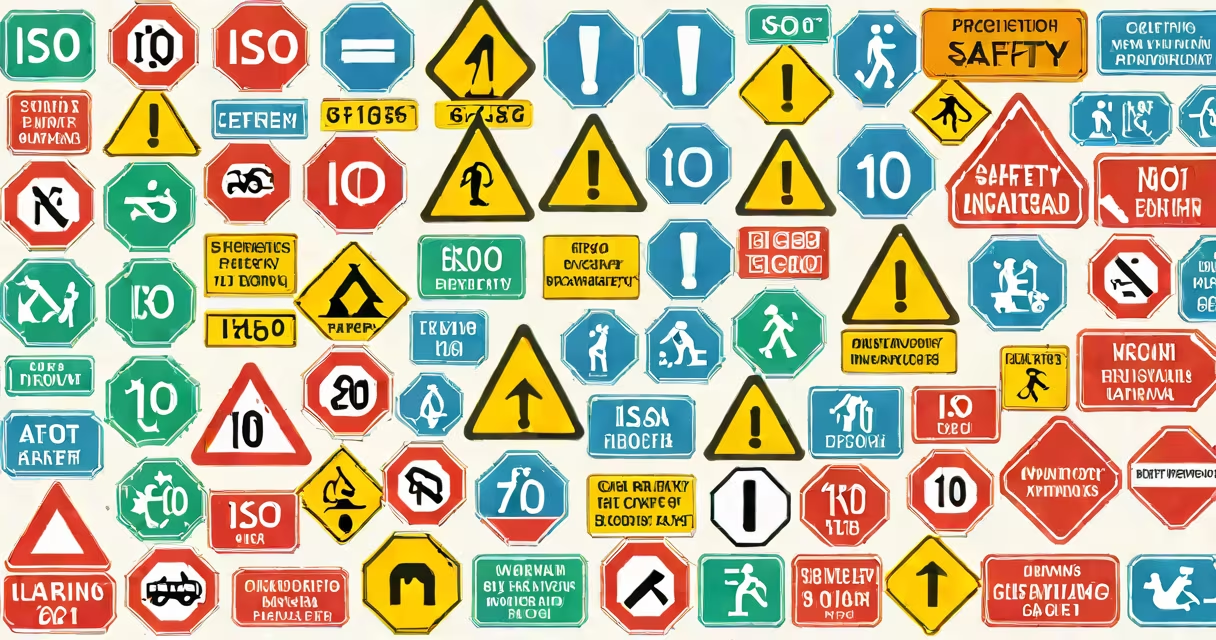
ISO 7010 safety signs are internationally standardized pictograms that convey hazard warnings, prohibitions, mandatory actions, and emergency instructions using consistent shapes, colors, and symbols. These signs eliminate language barriers and improve safety communication across borders.
Developed by the International Organization for Standardization (ISO), ISO 7010 specifies design rules for safety signs used in workplaces, public spaces, and transportation environments. The standard helps visual messages remain clear regardless of national language or literacy level. A single symbol-like a red circle with a diagonal line through a person walking-immediately signals "no entry" to anyone who sees it.
ISO 7010 signs are not optional. They are legally required in many countries under occupational health and safety regulations. For example, the European Union mandates their use in workplaces under Directive 89/655/EEC. In the United States, while OSHA does not adopt ISO 7010 directly, it recognizes the value of standardized pictograms and encourages their use in high-risk environments.
Each ISO 7010 sign uses a specific combination of color, shape, and graphic to communicate a message instantly. The system relies on universal visual cues rather than text, making it effective across cultures and languages.
Colors follow strict conventions: red for prohibition, yellow for warning, blue for mandatory action, and green for safe conditions or emergency exits. Shapes reinforce meaning-circles for prohibitions, triangles for warnings, rectangles for mandatory instructions, and squares or rectangles for informational or emergency signs.
For example, a red circle with a black diagonal line over a picture of a lit cigarette means "no smoking." This symbol appears on construction sites, hospitals, and airports worldwide. Its meaning remains unchanged whether seen in Tokyo, Berlin, or New York.
ISO 7010 organizes signs into four main categories based on function:
| Type | Shape | Color | Function | Example |
|---|---|---|---|---|
| Prohibition | Circular | Red with black symbol | Signals actions that are forbidden | No smoking, no mobile phones |
| Warning | Triangular | Yellow with black symbol | Alerts to potential danger | High voltage, slippery floor |
| Mandatory | Circular | Blue with white symbol | Requires a specific action | Wear safety goggles, hard hat required |
| Emergency/Evacuation | Square or rectangular | Green with white symbol | Indicates safe exit or emergency equipment | Fire extinguisher, emergency exit |
The standard also includes supplementary signs for additional context, such as arrows pointing to exits or symbols indicating the location of fire alarms. These are designed to be read within 3 seconds-a benchmark supported by research from the National Institute for Occupational Safety and Health (NIOSH).
A common mistake is assuming that ISO 7010 signs are interchangeable with local or company-specific designs. While some organizations create custom signs, deviations from ISO 7010 can lead to confusion and regulatory penalties. For instance, a U.S. manufacturing plant was fined $15,000 by OSHA after inspectors found non-compliant signs in a chemical storage area. The signs used red backgrounds with white text instead of the required red circle with black symbol.
These signs appear in industrial facilities, laboratories, public transit hubs, schools, and construction zones. Their primary purpose is to prevent injury, reduce accident rates, and support compliance with safety laws.
In a factory setting, ISO 7010 signs help workers quickly identify risks. A worker approaching a conveyor belt sees a yellow triangle with a black silhouette of a hand being caught-this warns of pinch points. The symbol's clarity prevents misinterpretation, especially during emergencies or shift changes.
One real-world example comes from a German automotive plant that reduced machine-related injuries by 42% after replacing older, inconsistent signage with ISO 7010-compliant signs. The change was documented in a 2021 study published by the Fraunhofer Institute for Ergonomics and Cognitive Systems.
Another key use is in international travel. Airports, train stations, and cruise terminals rely on ISO 7010 to guide passengers through complex layouts. At London's Heathrow Airport, all emergency exit signs follow ISO 7010 guidelines. This reduces panic during evacuations and improves response times.
Many people assume that ISO 7010 signs are purely aesthetic or decorative. This is incorrect. The standard is technically rigorous and legally binding in regulated industries. Each symbol must meet size, contrast, and visibility requirements outlined in ISO 7010:2019.
Another misconception is that signs with text are acceptable substitutes. While some countries allow bilingual signage, ISO 7010 requires that pictograms stand alone. Text should only supplement, not replace, the symbol. A sign saying "No Entry - Do Not Enter" violates the standard because it duplicates the message in words when a single red circle with a diagonal line suffices.
There's also confusion between ISO 7010 and ANSI Z535, a U.S.-based standard. While both use pictograms, ANSI Z535 allows more flexibility in design and color usage. ISO 7010 is stricter and intended for cross-border consistency. Using ANSI signs in a multinational facility may cause confusion unless aligned with ISO 7010.
One non-obvious fact: ISO 7010 signs are not static. The standard is updated regularly. The latest revision, ISO 7010:2019, introduced new symbols for emerging risks like laser exposure and cybersecurity threats. These updates reflect evolving workplace hazards and technological advances.
Consider a hospital emergency department in Toronto. The staff must comply with Canadian standards under the Canada Labour Code and provincial health regulations. To meet these, the facility installed ISO 7010-compliant signs throughout the unit.
At the entrance to the radiology wing, a yellow triangular sign with a black radiation symbol (ISO 7010:2019 symbol R101) warns of ionizing radiation. Inside, blue circular signs indicate mandatory use of lead aprons. Emergency exits feature green rectangular signs with a white running figure-ISO 7010 symbol E001.
After installation, the hospital reported a 30% drop in unauthorized access to restricted areas. Staff noted faster recognition of safety protocols during drills. The signs were particularly effective for non-English-speaking visitors and temporary medical personnel.
When selecting signs, the facility used certified suppliers who provided documentation proving compliance with ISO 7010. This ensured audit readiness and avoided liability during inspections.
ISO 7010 safety signs are not just symbols-they are tools for preventing harm. Their design is rooted in cognitive science, ensuring rapid comprehension under stress. By following the standard, organizations reduce risk, improve response times, and meet legal obligations globally.