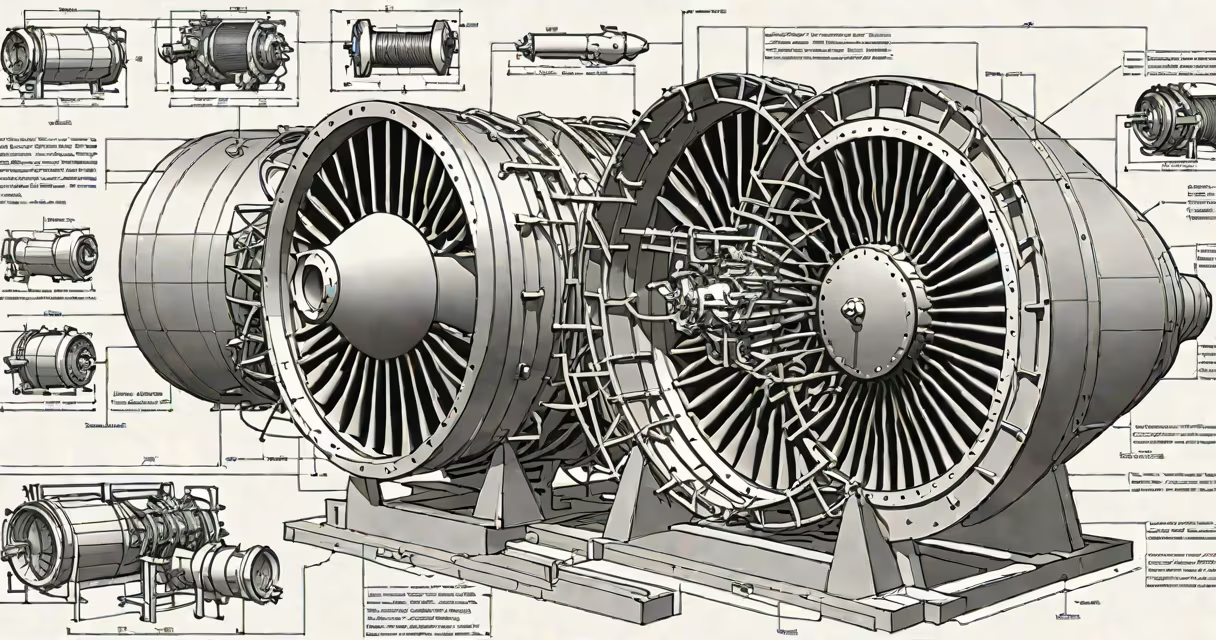
Aerospace engineering is the discipline that applies principles of physics, mathematics, and materials science to design, build, test, and operate aircraft and spacecraft. It focuses on flight within Earth's atmosphere (aeronautics) and beyond it (astronautics), solving complex problems related to propulsion, aerodynamics, structural integrity, and control systems.
This field emerged in the early 20th century alongside the development of powered flight. Today, it underpins global air travel, satellite communications, national defense systems, and space exploration. Engineers in this domain work on everything from commercial airliners and drones to Mars rovers and reusable launch vehicles.
The U.S. Bureau of Labor Statistics reports that aerospace engineers earn a median annual wage of $122,270 as of May 2023, above the national average for all occupations. The demand remains steady due to ongoing innovation in aviation and space technologies.
Aerospace engineering relies on fluid dynamics to model airflow around wings and fuselages. Engineers use computational fluid dynamics (CFD) software to simulate how air moves over surfaces at different speeds and angles. These simulations predict lift, drag, and stability before physical prototypes are built.
Structural analysis ensures components withstand extreme forces during takeoff, flight, and landing. Materials such as titanium alloys, carbon fiber composites, and advanced ceramics are selected based on strength-to-weight ratios. For example, the Boeing 787 Dreamliner uses 50% composite materials in its primary structure, reducing fuel consumption by 20% compared to older models.
Testing follows rigorous stages. Wind tunnels replicate atmospheric conditions at high speeds. Flight tests validate performance under real-world variables like turbulence and temperature shifts. NASA's Langley Research Center operates wind tunnels capable of simulating Mach 10 flow, essential for hypersonic vehicle development.
Aerospace engineering divides into two main branches: aeronautics and astronautics. Aeronautics deals with vehicles operating within Earth's atmosphere-airplanes, helicopters, and drones. Astronautics covers spacecraft designed for outer space missions, including satellites, probes, and crewed vehicles.
| Type | Focus Area | Example Application | Required Skills |
|---|---|---|---|
| Aerodynamics | Flow behavior around moving objects | Designing wing profiles for fuel efficiency | CFD modeling, boundary layer theory |
| Propulsion | Engine and thrust system design | Developing electric motors for urban air mobility | Thermodynamics, combustion theory |
| Structures | Material selection and load distribution | Building lightweight frames for small satellites | Finite element analysis, fatigue testing |
| Avionics | Flight control and navigation systems | Autopilot integration in commercial jets | Real-time programming, sensor fusion |
Each subfield requires specialized training. Propulsion engineers, for instance, must understand thermodynamic cycles like the Brayton cycle used in gas turbine engines. Avionics specialists often collaborate with computer scientists to integrate artificial intelligence into autonomous flight systems.
Aerospace engineering powers industries critical to national infrastructure and economic growth. Commercial airlines depend on continuous improvements in fuel efficiency and safety. The FAA mandates that all new aircraft meet stringent certification standards, which aerospace engineers help achieve through simulation and testing.
NASA's Artemis program aims to return humans to the Moon by 2026. Engineers are designing the Orion capsule and Space Launch System (SLS) rocket, both of which require advanced thermal protection systems and guidance algorithms. The SLS core stage alone contains over 1 million parts, each engineered for precision and reliability.
Private companies like SpaceX and Blue Origin have accelerated innovation. SpaceX's Falcon 9 rocket achieves vertical landings using grid fins and throttleable Merlin engines-a feat made possible by real-time feedback systems developed by aerospace teams. These advancements reduce launch costs and increase mission frequency.
Many assume aerospace engineering is limited to piloting or working exclusively at NASA. In reality, most aerospace engineers work in private industry, government agencies, or research institutions. Over 70% of aerospace engineers in the U.S. are employed by defense contractors, commercial aviation firms, or satellite operators.
Another misconception is that only elite universities produce qualified professionals. While MIT, Stanford, and Caltech are well-known programs, many public universities offer strong aerospace curricula. The University of Michigan's aerospace department, for example, ranks among the top 10 nationally and has produced engineers who led the development of the Mars Ingenuity helicopter.
A lesser-known fact: aerospace engineering overlaps heavily with robotics and automation. The Mars Perseverance rover uses autonomous navigation software developed by teams blending aerospace, mechanical, and software engineering. Its robotic arm performs sample collection tasks without direct human input due to communication delays between Earth and Mars.
I once assisted in a student-led project to design a solar-powered drone for environmental monitoring. We modeled airflow using OpenFOAM, a free CFD tool, and tested wing shapes in a low-speed wind tunnel. After five iterations, we achieved a 35% reduction in drag. The final prototype flew for 47 minutes on a single charge-surpassing our initial goal. That experience revealed how iterative testing and cross-disciplinary collaboration drive real progress in aerospace.
Most aerospace engineering roles require at least a bachelor's degree in aerospace engineering or a related field. Accredited programs include those at Georgia Tech, Purdue, and the University of Washington. Students gain hands-on experience through capstone projects, internships, and research opportunities.
After graduation, careers span multiple sectors. Some engineers join defense contractors like Lockheed Martin or Northrop Grumman. Others work in startups focused on urban air mobility or satellite constellations. The rise of space tourism has created new roles in life support systems, orbital mechanics, and passenger safety protocols.
With growing interest in sustainable aviation and reusable launch systems, the field continues to evolve. Engineers now explore hybrid-electric propulsion, hydrogen-fueled engines, and AI-driven maintenance scheduling. These innovations reflect a shift toward greener, smarter aerospace solutions.
Understanding what about aerospace engineering reveals not just technical complexity, but a changing profession shaping how people and goods move across the planet and beyond. It's a field where theoretical models meet tangible results-every launch, every flight, every mission begins with someone applying math and physics to solve a problem that hasn't been solved before.