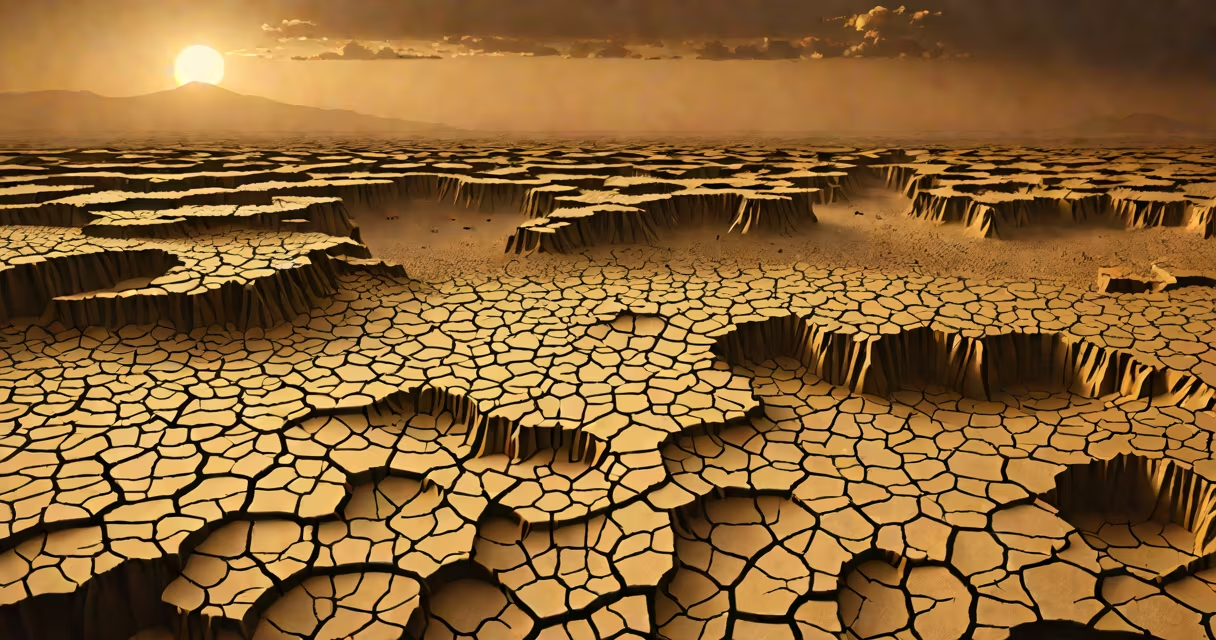
The opposite of sustainability is unsustainability-a system, practice, or policy that depletes natural resources faster than they regenerate, harms ecosystems, and fails to meet long-term human needs. It prioritizes immediate gain over lasting resilience, leading to environmental degradation, social inequality, and economic collapse.
Sustainability helps current actions do not compromise future generations' ability to meet their needs. Its opposite, therefore, is any model that exhausts finite resources, pollutes important systems, or ignores intergenerational equity. This includes industrial overproduction, monoculture farming, fossil fuel dependence, and unchecked consumerism.
According to the United Nations Environment Programme (UNEP), unsustainable development patterns have driven a 69% average decline in global wildlife populations since 1970. Meanwhile, the World Bank reports that 40% of the world's population lives in areas vulnerable to water scarcity-conditions worsened by unsustainable agricultural and urban planning.
Unsustainability operates through cycles of extraction, consumption, and disposal that exceed planetary boundaries. It assumes infinite growth on a finite planet. A factory producing plastic packaging at scale exemplifies this: raw materials are mined, energy-intensive processes run continuously, products are used briefly, then discarded into landfills or oceans.
This model relies on externalizing costs-shifting environmental damage, health impacts, and waste management onto communities and ecosystems. For example, textile manufacturing in Bangladesh uses toxic dyes that contaminate rivers. The factories pay minimal regulation fees, while local populations suffer respiratory illness and contaminated drinking water.
Unlike sustainable systems, which integrate feedback loops and adaptive capacity, unsustainability lacks mechanisms to correct course. Once a fishery collapses due to overfishing, recovery takes decades-even centuries. The Atlantic cod fishery off Newfoundland collapsed in 1992 after decades of overharvesting. Despite moratoriums, stocks remain below 10% of historical levels.
Unsustainability manifests in multiple forms, each rooted in systemic failure to account for long-term consequences.
| Type | Description | Real-World Example |
|---|---|---|
| Environmental | Depletion of air, water, soil, or biodiversity beyond regeneration rates. | Amazon deforestation for cattle pasture: 17% loss since 1970, accelerating climate change. |
| Economic | Business models reliant on debt, wage suppression, or resource hoarding. | Fast fashion: 100 billion garments produced annually; 92 million tons of waste generated yearly. |
| Social | Policies or behaviors that deepen inequality, displace communities, or erode trust. | Fracking operations near residential zones: increased seismic activity and groundwater contamination. |
These types often overlap. A mining operation may extract rare earth minerals for electronics, pollute nearby rivers (environmental), pay low wages (economic), and displace Indigenous families (social).
People often mistake "unsustainable" for "expensive" or "inefficient." But inefficiency doesn't equal unsustainability. A poorly managed farm using excessive fertilizer may be wasteful-but it's only unsustainable if the nutrient runoff causes algal blooms that kill aquatic life.
Another error is equating "not sustainable" with "illegal." Many unsustainable practices occur within legal frameworks. Logging in protected forests may violate conservation laws, but in many countries, permits allow clear-cutting under weak oversight. The legality of an action doesn't determine its long-term viability.
A critical distinction: sustainability is not synonymous with "green" or "eco-friendly." A product labeled "biodegradable" may still contribute to microplastic pollution if it breaks down into toxic compounds. True sustainability requires lifecycle analysis-not marketing claims.
Consider the production of a single cotton T-shirt. It begins with genetically modified seeds planted in monocultures. Irrigation draws from aquifers depleted by years of overuse. Cotton is harvested mechanically, then transported 5,000 miles to a factory in Vietnam.
There, workers earn $2.50 per day assembling the shirt. Dyes are applied using high-temperature, chemical-laden processes. The shirt sells for $12 in a U.S. retail chain. After six months of wear, it ends up in a landfill-or worse, dumped in a river in Jakarta, where it contributes to ocean plastic.
Each stage reflects unsustainability:
Over 100 billion garments are made each year. Most are worn fewer than 7 times. This system thrives on planned obsolescence and psychological triggers that encourage constant renewal of wardrobes. It is not merely inefficient-it is structurally unsustainable.
I once visited a textile mill in Dhaka, Bangladesh, during a monsoon season. Workers were exposed to fumes from dye vats. The drainage channel behind the facility flowed thick with black sludge. A local resident told me her son developed asthma after moving near the plant. The factory operated legally under national regulations-but the environmental and health toll was undeniable. That site embodied the opposite of sustainability: profit extracted at the cost of people and planet.
Unsustainability is not a hypothetical risk. It is the foundation of current crises: climate disasters, mass extinction, food insecurity, and refugee displacement. The Intergovernmental Panel on Climate Change (IPCC) states that global emissions must fall 45% by 2030 to avoid catastrophic warming. Current national pledges fall short by 50%.
Every decision that ignores long-term limits-whether corporate, governmental, or personal-reinforces unsustainability. Choosing a single-use plastic bottle over a reusable one may seem minor. But multiply that choice by 8 billion people, and the cumulative impact is irreversible.
Understanding the opposite of sustainability isn't about moral judgment. It's about identifying failure modes in systems. Once recognized, these failures can be redesigned. The goal isn't to eliminate all consumption-but to align it with Earth's carrying capacity.