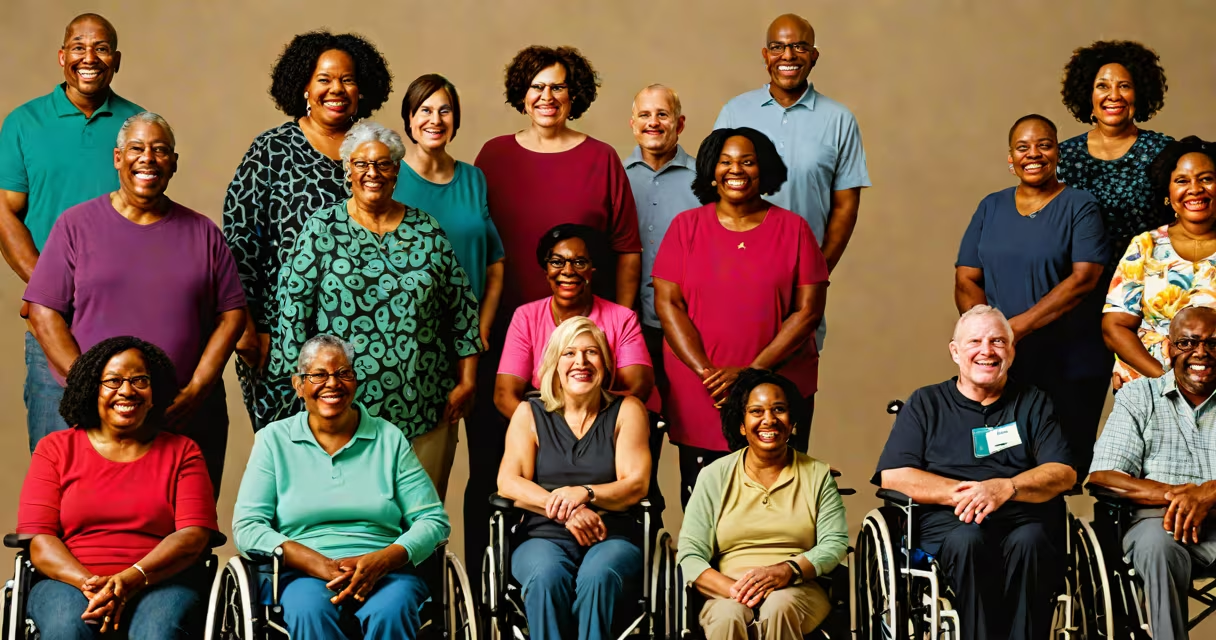
The term "people with disabilities" refers to individuals who have long-term physical, mental, sensory, or developmental conditions that may limit their ability to perform certain tasks independently. This phrase emphasizes the person first, placing the individual before the condition.
Language around disability has evolved. Historically, terms like "handicapped" or "invalid" were common, but they carry outdated and often dehumanizing connotations. Today, the preferred approach centers on dignity, autonomy, and respect for personal identity.
According to the World Health Organization (WHO), disability is not a medical condition alone-it results from the interaction between a person's health condition and environmental barriers. This structure shifts focus from individual deficit to societal inclusion. The United Nations Convention on the Rights of Persons with Disabilities (UNCRPD) reinforces this view, affirming that persons with disabilities have equal rights and should be addressed with respect and accuracy.
Two primary styles of terminology exist: person-first and identity-first. Person-first language places the person before the disability-e.g., "a person with autism." This approach aims to avoid defining someone solely by their condition.
Identity-first language, such as "autistic person," is increasingly accepted, especially within the autistic community itself. Many autistic individuals see autism as central to their identity, not something to be separated from them. The National Autistic Society in the UK states that many autistic people prefer identity-first language because it affirms their identity rather than implying they are "less than" due to neurodivergence.
There is no universal rule. Some people prefer one form, others another. The safest practice is to ask individuals which term they use for themselves. For example, a person with cerebral palsy may say, "I'm a wheelchair user," while another might say, "I live with spastic diplegia." Both are accurate; neither is inherently better.
Use specific, precise language. Avoid vague or euphemistic terms like "differently abled" or "special needs." These phrases dilute the lived reality of disability and can feel patronizing. The American Psychological Association (APA) guidelines state that such terms lack clarity and contribute to stigma.
Instead, use direct, accurate descriptions. Examples:
When referring to cognitive or developmental conditions, use the condition as a descriptor, not a label. Say "a student with dyslexia" rather than "a dyslexic student," unless the individual identifies with that phrasing.
Language shapes perception. Research published in the journal *Disability & Society* shows that media portrayals using respectful, accurate language lead to higher public support for disability rights policies. Conversely, stigmatizing language correlates with lower empathy and reduced political engagement.
In healthcare, mislabeling can impact care quality. A 2021 study in *The Lancet* found that patients described with dehumanizing terms (e.g., "confused elderly") received less thorough evaluations and were less likely to be offered treatment options. Accurate language ensures equitable access to services.
Workplaces benefit too. A 2022 report by the U.S. Equal Employment Opportunity Commission (EEOC) noted that inclusive language in job postings and internal communications improves employee retention among disabled staff. Using "qualified candidate with mobility limitations" signals openness and fairness.
Many well-intentioned phrases unintentionally erase agency or reduce identity to a condition. Avoid:
These terms reinforce the idea that disabled lives are only valuable when they meet able-bodied expectations. Instead, recognize people for their skills, contributions, and presence-not their struggle.
A non-obvious fact: The term "disabled" is not inherently negative. In the UK, the Equality Act 2010 defines disability as a protected characteristic. Using the term openly supports legal protections and visibility. The Disability Rights Education and Defense Fund (DREDF) notes that reclaiming the word is a form of empowerment.
Consider a university course syllabus. One version says: "Students with learning differences must request accommodations early." Another says: "All students, including those with learning disabilities, are welcome to request accommodations."
The second version normalizes disability as part of the academic field. It avoids framing accommodation as a favor. A 2020 survey by the National Center for Learning Disabilities found that students who saw inclusive language in course materials reported higher confidence in seeking help and greater sense of belonging.
Similarly, a company's job posting that reads "We welcome applicants with disabilities" is more effective than "We encourage people with disabilities to apply." The former assumes inclusion; the latter treats it as an exception.
There is no single correct way to refer to all people with disabilities. Individual preference varies widely. The most respectful approach is to follow the person's lead.
I once facilitated a workshop with a group of deaf and hard-of-hearing professionals. During a presentation, I used "hearing-impaired" until a participant corrected me. She said, "I am Deaf. I use capital D. My culture is not a deficit." That moment reshaped my understanding: language isn't about correctness-it's about listening.
When unsure, use the phrase "person with [condition]" as a neutral default. But always be open to correction and willing to adjust.
| Term | Preferred Use | Why It Matters |
|---|---|---|
| Person with a disability | General, safe default | Centers the individual, not the condition |
| Autistic person | When the individual prefers identity-first | Respects neurodiversity and self-identification |
| Deaf person (capital D) | For members of Deaf culture | Distinguishes cultural identity from medical condition |
| Wheelchair user | Descriptive, respectful | Focuses on function, not limitation |
Using accurate, respectful language isn't about perfection. It's about intention. Words shape how people see themselves and how society treats them. The goal is not to avoid all mistakes-but to learn, adapt, and listen.