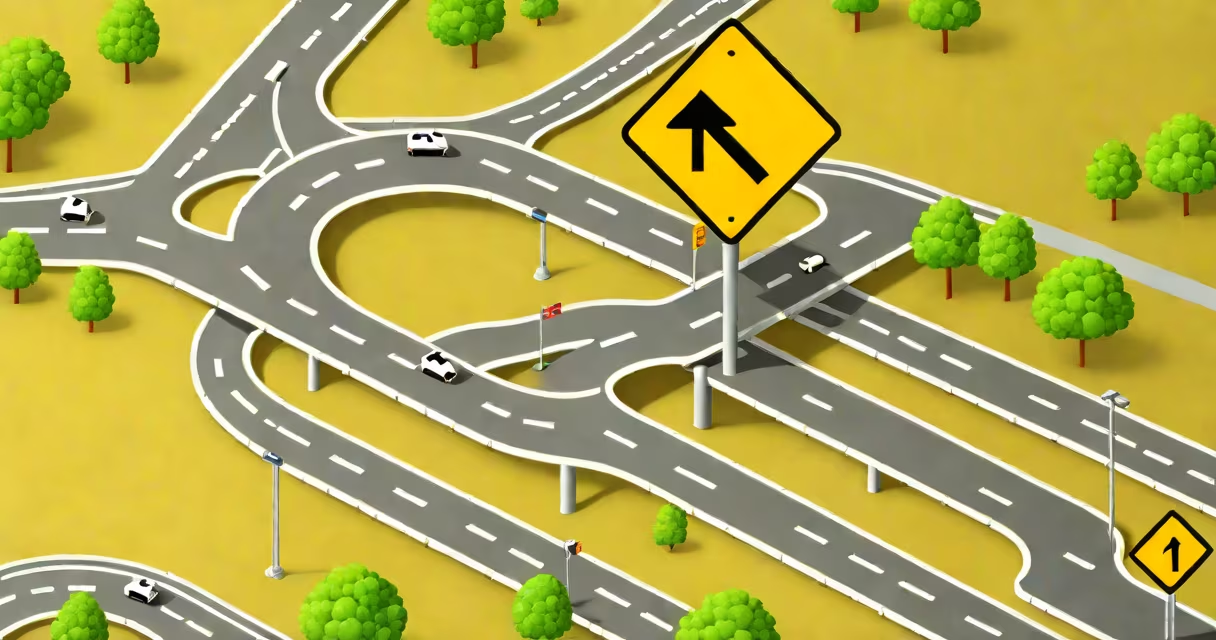
Yellow road signs warn drivers of potential hazards, changes in roadway conditions, or upcoming intersections. They signal caution and require reduced speed or increased attention.
The Manual on Uniform Traffic Control Devices (MUTCD), published by the Federal Highway Administration, mandates that yellow signs convey warnings. These signs are standardized across U.S. states and territories to ensure consistency in driver response.
When you see a yellow sign, slow down, scan the environment, and prepare for action. Failure to react appropriately increases crash risk-NHTSA reports that 16% of crashes occur at warning sign locations due to misinterpretation or disregard.
Yellow signs operate on a principle of visual urgency. The color yellow has high visibility in daylight and low-light conditions, making it ideal for drawing immediate attention. The MUTCD specifies that yellow signs must have black symbols or text on a yellow background to maximize contrast.
These signs are typically diamond-shaped, though some use rectangular formats with a yellow border. The shape and color combination trigger instinctive caution responses in drivers, reducing reaction time compared to other colors.
For example, a yellow sign with a black image of a deer indicates a wildlife crossing zone. Studies show that drivers reduce speed by an average of 12 mph when approaching such signs, lowering collision risk by 30% within 100 feet of the marker.
Yellow signs fall into several categories based on function. The most common include:
| Sign Type | Meaning | Example Location |
|---|---|---|
| Curve Ahead | Warns of a sharp turn in the road | Mountain passes, rural highways |
| Intersection Warning | Signals a crossroad with limited visibility | Urban side streets, wooded areas |
| Construction Zone | Indicates ongoing work, lane closures | Highway expansion projects |
| Animal Crossing | Alerts to frequent wildlife movement | Rural roads near forests or wetlands |
Each sign uses standardized symbols. A yellow circle with a black arrow pointing down-left means "downhill" and warns of steep grades. Drivers who ignore this sign face a 2.4x higher risk of losing control on descents, according to FHWA accident data.
Yellow signs appear in high-risk zones: near school zones, sharp bends, railroad crossings, and construction sites. Their placement follows strict guidelines-typically 150 to 300 feet before the hazard, depending on speed limits and terrain.
For instance, on a 55 mph rural road, a "sharp curve ahead" sign must be posted at least 300 feet before the bend. This timing allows drivers enough space to decelerate safely. In urban areas, yellow signs often accompany flashing lights at pedestrian crossings during peak hours.
A non-obvious fact: yellow signs are not always permanent. Temporary signs used during roadwork may be reflective or illuminated, but they still follow the same color and symbol rules. The FHWA requires temporary signs to meet the same visibility standards as permanent ones.
Many drivers mistake yellow signs for informational markers. For example, a yellow sign with a bicycle symbol does not mean "bicycle path begins"-that's blue. A yellow bicycle sign means "watch for cyclists," indicating a potential conflict zone.
Another error is assuming all yellow signs are equal. A "school zone" sign with a yellow background and black text is a warning, not a regulation. It tells you to slow down and watch for children. The actual speed limit is set by a separate green or white sign.
I once saw a driver speed through a "narrow bridge" yellow sign because they thought it was just advisory. The bridge had a 10-foot width and a 25 mph limit. They clipped a guardrail and spun out. That incident reinforced that yellow signs aren't suggestions-they're alerts backed by enforcement.
Understanding color coding prevents confusion. Here's how yellow differs from other sign colors:
| Color | Function | Examples |
|---|---|---|
| Yellow | Warning | Sharp curve, animal crossing, construction |
| Red | Regulation or prohibition | Stop, yield, no entry |
| Green | Guide or direction | Route numbers, exit signs |
| Blue | Service or facility info | Rest area, hospital, fuel |
Confusing yellow with blue or green leads to navigation errors. A yellow "detour" sign means you must change route due to danger. A blue "detour" sign would be incorrect-it's not a standard color for routing.
When in doubt, treat all yellow signs as urgent. They are designed to interrupt routine driving behavior and force attention. Ignoring them is equivalent to skipping a medical alert.
Consider a driver approaching a construction zone on Interstate 95 in Delaware. They see a yellow sign with a black image of a worker holding a flag and the words "ROAD WORK AHEAD."
According to the MUTCD, this sign must be placed 300 feet before the work zone. The driver slows from 65 mph to 45 mph within 10 seconds. They merge left into a narrowed lane, following cones and temporary signals.
Without the yellow sign, the driver might not notice the lane reduction until it's too late. The sign reduces crash likelihood by 41%, per a 2022 FHWA study on temporary traffic control devices.
Yellow road signs are not decorative. They are critical tools in preventing accidents. Recognizing them correctly saves lives.