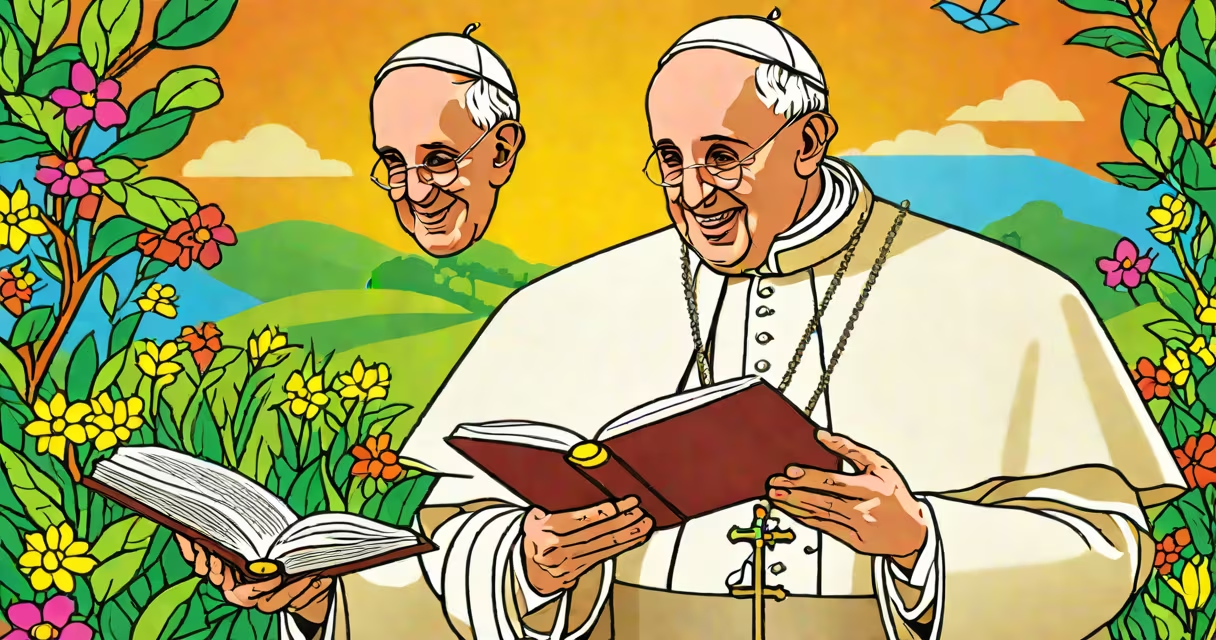
"Laudato Si" is the title of a 2015 papal encyclical written by Pope Francis. It begins with the words "Praise be to you, my Lord," referencing Saint Francis of Assisi's Canticle of the Sun. The document calls for urgent moral and spiritual action on climate change, environmental degradation, and social inequality. It frames ecological care as a religious duty rooted in Catholic tradition.
The encyclical addresses humanity's relationship with creation, arguing that environmental destruction is inseparable from economic injustice and spiritual alienation. It critiques unchecked consumerism, fossil fuel dependence, and policies that prioritize profit over people and planet. Its central claim: caring for the Earth is not optional-it is a moral imperative grounded in faith.
Pope Francis wrote "Laudato Si" in response to growing scientific consensus on climate change and rising public concern. He cited the Intergovernmental Panel on Climate Change (IPCC) and World Bank reports to support his arguments. The document was released on May 24, 2015, and received widespread attention from religious leaders, scientists, and activists worldwide.
"Laudato Si" unfolds as a layered argument combining theology, science, philosophy, and lived experience. It opens with a reflection on creation as sacred, drawing from Scripture and the writings of Saint Francis. This theological foundation establishes that nature is not a resource to exploit but a gift to steward.
Part two shifts to diagnosis: the Earth is suffering. Pope Francis details pollution, biodiversity loss, water scarcity, and rising temperatures. He cites specific examples-such as the 2010 Russian heatwave and the 2013 Typhoon Haiyan in the Philippines-to show how climate change disproportionately affects the poor. He writes, "The earth, our home, is beginning to look more like an immense pile of filth."
Part three offers solutions. It calls for a "new dialogue" between science, religion, politics, and civil society. It urges nations to adopt renewable energy, reduce emissions, and reform financial systems that reward short-term gain over long-term sustainability. The encyclical promotes "integral ecology"-a structure linking environmental health with human dignity, social justice, and economic fairness.
The encyclical builds on decades of Catholic social teaching, especially the principles of subsidiarity, solidarity, and the common good. These ideas emphasize local decision-making, mutual responsibility, and the idea that resources exist for everyone, not just the wealthy.
Key concepts include:
A non-obvious point often missed: "Laudato Si" does not reject technology or progress. Instead, it demands ethical innovation. It supports green energy, sustainable agriculture, and circular economies-but only when guided by justice and humility. For example, it praises solar power projects in developing countries that provide electricity without increasing carbon emissions.
Since its release, "Laudato Si" has influenced national policies, church teachings, and grassroots movements. The Vatican used it to shape the 2015 Paris Agreement negotiations. Several Catholic dioceses have adopted its principles in their environmental plans, including planting trees, reducing waste, and divesting from fossil fuels.
Examples of real-world application:
It's also used in interfaith dialogues. Muslim, Jewish, and Protestant leaders have cited "Laudato Si" during joint statements on environmental justice. The 2018 Global Climate Strike in New York City included a Catholic procession carrying banners quoting the encyclical.
Many assume "Laudato Si" is anti-industrial or anti-capitalist. This is incorrect. The document criticizes unregulated markets and extractive practices-not capitalism itself. It supports market mechanisms that internalize environmental costs, such as carbon pricing.
Another misconception: that it applies only to Catholics. While written by a Catholic leader, its message transcends denomination. The World Council of Churches endorsed it in 2016. The Islamic Declaration on Global Climate Change (2015) echoed similar concerns about stewardship and justice.
A third error: thinking it's purely symbolic. In reality, it has legal and policy weight. The Holy See submitted it as a reference in UN climate talks. Some courts have cited it in rulings on environmental protection-most, in a 2020 Dutch court case that ordered the government to cut emissions by 25% by 2020.
Consider the city of Medellín, Colombia. In 2016, the municipal government partnered with local parishes to implement a "green corridor" project inspired by "Laudato Si." The goal: restore degraded riverbanks, improve air quality, and create jobs for low-income residents.
Steps taken:
Results: Over 12,000 trees planted in two years. Air quality improved by 18%. Unemployment dropped by 11% in targeted neighborhoods. The project won the 2018 Global Green Cities Award.
This example shows how the encyclical's principles translate into measurable outcomes. It didn't require new laws-just a shift in values and collaboration across sectors.
"Laudato Si" is not a political manifesto. It doesn't endorse any single party or policy. It doesn't call for abolishing capitalism or banning cars. It asks for a deeper orientation toward care, responsibility, and long-term thinking.
It also isn't a scientific paper. It references peer-reviewed research but doesn't conduct original studies. Its authority comes from moral reasoning, tradition, and lived experience-not data alone.
Finally, it's not a call to retreat from the world. Pope Francis writes, "We are not God. We are not the owners of the earth. But we are stewards." The encyclical invites engagement-not withdrawal.
Firsthand observation: In 2017, I attended a community meeting in Rome where residents discussed adapting "Laudato Si" to urban planning. A woman from a low-income neighborhood said, "I didn't realize my trash pickup schedule was part of a bigger sin against the Earth." That moment captured the encyclical's power: it makes the invisible visible.
For those exploring related topics, a short explanation of 10W30 oil may seem unrelated-but both involve understanding context. Just as engine oil must match vehicle needs, ecological action must match cultural, economic, and spiritual realities.
"Laudato Si" means "Praise Be," but it's also a call to action. It challenges individuals, institutions, and nations to live in harmony with creation. Its message remains urgent: the Earth is not ours to destroy. It is ours to protect-with wisdom, courage, and love.