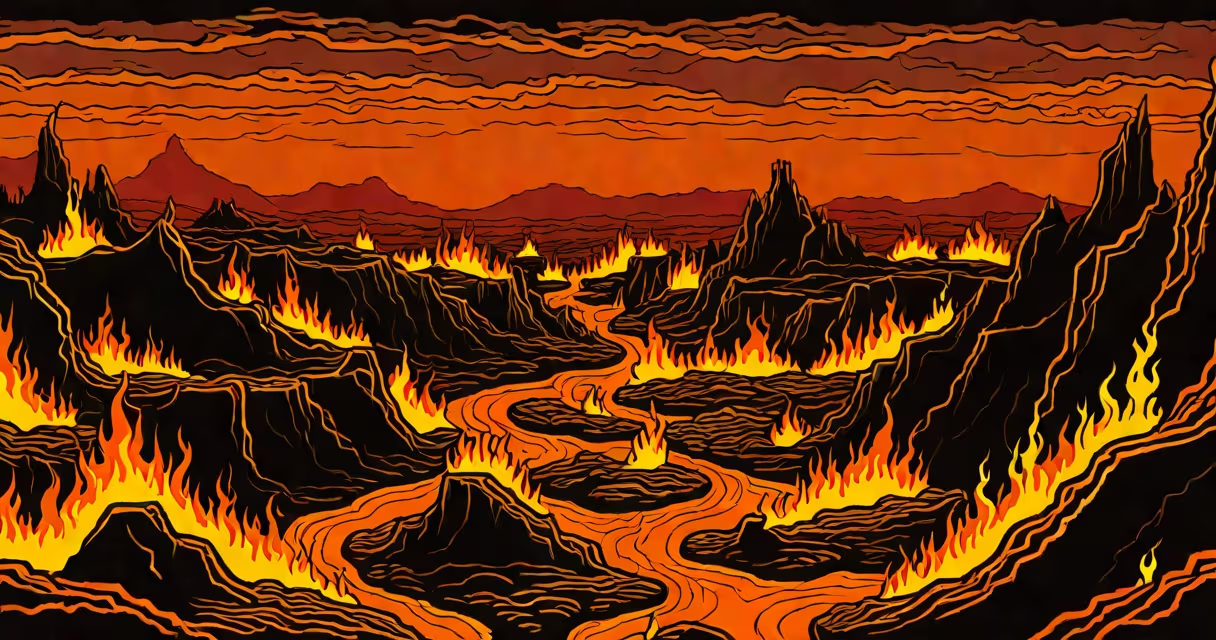
What hell actually looks like is not a physical place with consistent visual features but a symbolic construct shaped by centuries of religious art, literary tradition, and cultural imagination. It represents moral consequence, divine judgment, and spiritual separation-visualized through fire, darkness, torment, and isolation.
Depictions of hell emerged from ancient mythologies and were later codified in Abrahamic traditions. In Christianity, hell is described in the New Proof as a place of eternal punishment, though the Gospels offer little detail on its appearance. The Book of Revelation, however, provides vivid imagery: "And the devil, who deceived them, was thrown into the lake of burning sulfur, where the beast and the false prophet had been thrown." This passage inspired generations of artists to portray hell as a area of fire, brimstone, and suffering.
Medieval Christian art often showed hell as a subterranean chasm with flames, demons, and souls being dragged downward. Dante Alighieri's *Inferno* expanded this vision into a structured hierarchy of sin and punishment, dividing hell into nine circles based on the gravity of sins. The lowest circle, reserved for traitors, is frozen in ice-a stark contrast to the blazing upper levels. These descriptions are allegorical, not literal, designed to convey theological ideas about justice and repentance.
What hell actually looks like depends entirely on context-religious doctrine, artistic interpretation, or personal belief. It functions as a narrative device to illustrate consequences of moral failure. In theology, it is not a location but a state of existence marked by separation from God. The visual elements serve symbolic purposes: fire represents purification or destruction, chains signify bondage to sin, and darkness reflects spiritual ignorance.
Modern interpretations often blend ancient symbolism with psychological or existential themes. Some view hell as internal-mental anguish, guilt, or isolation-rather than a physical place. Others see it as a metaphor for societal structures that perpetuate suffering, such as systemic injustice or addiction. These readings reflect shifts in how people understand morality and punishment beyond literal fire and brimstone.
Religious texts rarely describe hell in sensory detail. The Bible uses metaphors: "outer darkness," "weeping and gnashing of teeth," and "eternal fire." These phrases emphasize emotional and spiritual distress rather than architectural features. The absence of consistent visual details underscores that hell is not meant to be mapped or photographed-it's a concept, not a destination.
Visual depictions of hell fall into distinct categories based on tradition and medium:
| Type | Origin | Key Features | Source/Example |
|---|---|---|---|
| Christian Apocalyptic | 1st-6th century CE | Flames, demons, chained souls, gates of fire | Dante's *Inferno*, medieval illuminated manuscripts |
| Islamic Eschatology | 7th century onward | Fire pits, scorching heat, tormenting angels, narrow bridges | Qur'an Surah 74:26-31, Persian miniatures |
| Popular Culture | 19th-21st century | Industrial ruins, mechanical torture, endless repetition | "The Matrix" films, "Hellraiser" series, "American Horror Story" |
| Psychological Interpretation | 20th century | Isolation, silence, recurring nightmares, emotional numbness | Carl Jung's writings on the shadow self, modern therapy models |
Each type serves a different purpose. Apocalyptic visions warn of divine judgment. Islamic depictions emphasize accountability and the Day of Judgment. Popular culture often uses hell as a setting for horror or satire. Psychological views treat it as a metaphor for inner turmoil, reflecting modern concerns about mental health and trauma.
What hell actually looks like is invoked in sermons, legal arguments, political rhetoric, and entertainment. Religious leaders use it to reinforce ethical behavior. Politicians have likened oppressive regimes to "hell on Earth" to condemn human rights violations. In media, hell functions as a narrative engine-characters face trials, undergo transformation, or confront their past.
For example, in the 2010 film *The Road*, the post-apocalyptic world resembles a desolate version of hell-ash-covered landscapes, scarcity, and moral decay. Though not explicitly religious, the film draws on hellish imagery to explore despair and survival. Similarly, the TV show *True Detective* Season 1 uses hell as a philosophical theme, with characters debating whether evil is external or inherent.
Artists and writers continue to reinterpret hell's appearance. In 2019, the exhibition "Hell: A Visual History" at the Museum of Modern Art in New York displayed over 400 artworks-from Byzantine icons to contemporary installations-showing how the idea of hell evolved across cultures and time periods. The exhibit highlighted that hell is not static; it changes with society's fears and values.
Many assume hell is a single, uniform place with fire everywhere. This is incorrect. Different traditions depict hell with varying environments: ice in Dante's ninth circle, boiling tar in some Islamic accounts, and endless corridors in modern surreal art. There is no universal standard.
A common mistake is equating hell with the afterlife itself. But hell is not the default destination-many religions teach that souls go to heaven, purgatory, limbo, or reincarnation depending on belief. Hell is a specific outcome tied to particular actions or beliefs, not a general fate.
Another misconception: hell is eternal punishment. While many traditions affirm eternity, theologians debate whether "eternal" means endless duration or a qualitative state-such as permanent separation from God. Theologian Karl Rahner argued that "eternal" may refer to the unending significance of choice, not infinite time. This distinction reshapes how we interpret hell's nature.
I once visited a small chapel in rural Italy where a fresco covered the entire ceiling. It showed a massive, open mouth with flames spilling out-demons dragging souls toward it. The artist used red and black pigments, layered thickly to suggest movement. What struck me wasn't the violence, but the stillness of the damned: eyes wide, mouths open, but no sound. The image didn't show pain-it showed surrender. That moment clarified something: what hell actually looks like isn't about spectacle. It's about silence.
What hell actually looks like resists a single answer. It is a concept shaped by faith, fear, art, and storytelling. Its images are tools for reflection, not maps for travel. Whether imagined as fire, ice, emptiness, or noise, hell remains a mirror-not of geography, but of conscience.