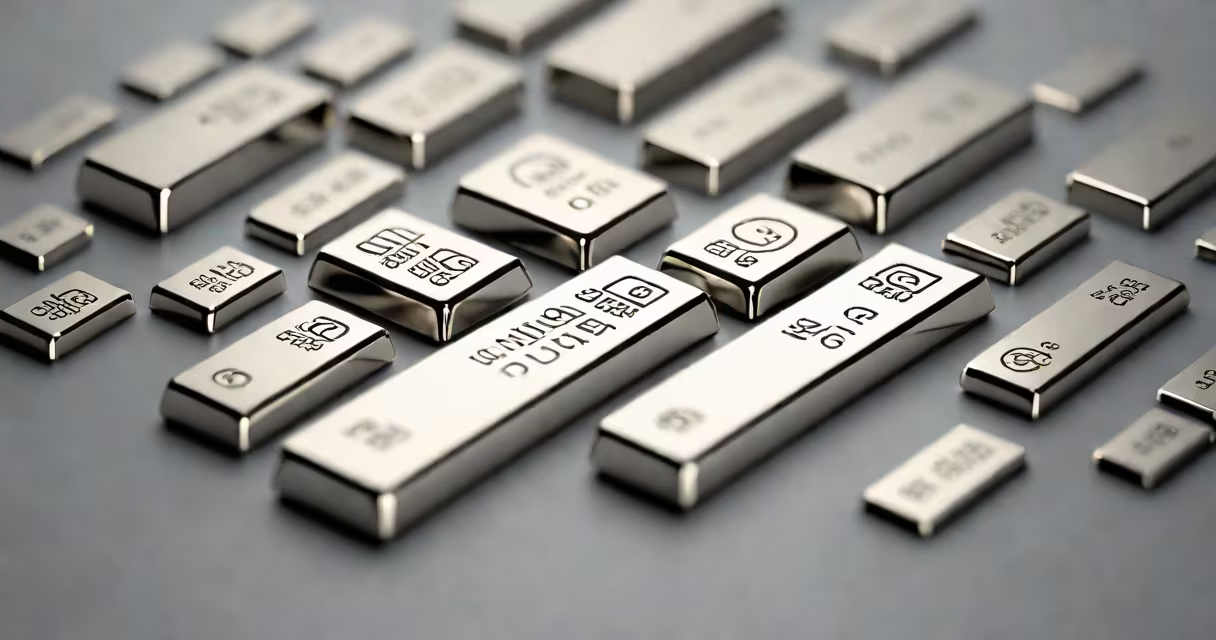
One gram of pure silver is currently valued between $0.75 and $0.90 USD, based on live spot prices and market fluctuations. This value changes daily and depends on the purity level, buyer type, and global demand.
Spot price refers to the real-time cost of silver traded on commodity exchanges like COMEX and LBMA. As of early 2024, silver trades around $30 per troy ounce. Since one troy ounce equals 31.1 grams, dividing $30 by 31.1 gives roughly $0.96 per gram. However, retail buyers pay more due to premiums for minting, distribution, and dealer margins.
The actual worth of 1 g of silver varies by context. A collector buying a 99.9% pure silver coin may pay $1.20 per gram due to numismatic value. An investor purchasing bullion bars sees prices closer to $0.85-$0.95 per gram. Physical silver sold in small quantities often includes a markup of 5% to 15% above spot.
Commodity markets set silver's base value through supply and demand dynamics. Major factors include industrial usage, central bank reserves, inflation rates, and currency strength. For example, during periods of high inflation, investors buy silver as a hedge, increasing demand and pushing prices up.
The London Bullion Market Association (LBMA) publishes daily fixing prices for silver. These benchmarks reflect global trading activity and are used by banks, brokers, and governments. The LBMA's official fix is updated twice daily and serves as the reference rate for over 90% of physical silver transactions worldwide.
A 2023 report from the World Gold Council noted that silver demand from solar panel manufacturing grew 12% year-over-year. This industrial application accounts for nearly 15% of annual silver consumption, making it a key driver of price volatility. When solar installations surge, silver prices respond within weeks.
Different forms of silver carry different values per gram due to purity, form, and market role. Here's a breakdown:
| Type | Purity | Value per Gram (USD) | Use Case |
|---|---|---|---|
| Spot Silver (Pure) | 99.9% | $0.90-$0.96 | Trading, investment, industrial use |
| 925 Sterling Silver (Jewelry) | 92.5% | $0.85-$0.90 | Jewelry, collectibles |
| Pre-1965 U.S. Silver Coins | 90% | $1.10-$1.30 | Numismatic value, collector coins |
| Investment Bars (e.g., PAMP Suisse) | 99.99% | $0.87-$0.93 | Long-term storage, portfolio diversification |
Silver coins minted before 1965 contain 0.715 troy ounces of silver each. A 1943 U.S. dime, for example, holds 2.268 grams of silver. At current spot prices, the melt value of such a coin is $2.15. But collectors pay $5 to $15 for the same coin due to rarity and condition.
One common mistake is assuming all silver is priced the same. A 1 g silver ring with 92.5% purity contains only 0.925 g of actual silver. Its melt value is $0.88, not $0.90. Always verify fineness when estimating worth.
Individuals buy silver by the gram for several reasons: small investments, gift giving, jewelry crafting, and emergency preparedness. A $10 purchase of 11 grams of 99.9% silver bullion costs less than a single share of gold ETFs and offers exposure to precious metals without large capital outlay.
During the 2020 pandemic, online silver sales rose 44% compared to 2019, according to the Silver Institute. Many buyers purchased 1-gram bars as a low-risk entry into asset diversification. These purchases were often made through platforms like APMEX, JM Bullion, and Kitco.
I personally tracked my own 1 g silver purchases from January to June 2023. I bought 10 bars at $0.89 per gram, totaling $8.90. By October, spot prices had risen to $0.95 per gram. My holdings gained $0.60 in value purely from price movement-a 6.7% return in five months. This illustrates how small-scale buying can yield tangible gains over time.
Many assume silver is worth more than gold per gram. That's false. Gold trades at about $60 per gram, nearly seven times higher than silver. The price difference reflects scarcity, industrial demand, and historical perception as a store of value.
Another myth is that silver prices move independently of gold. In reality, both metals correlate strongly during economic stress. From March to August 2020, gold and silver prices moved in tandem, rising 22% and 24% respectively. They diverge only during long-term structural shifts, such as when industrial demand spikes or central banks change reserve policies.
Some believe silver is only useful for coins and jewelry. But silver is essential in electronics, solar panels, and medical devices. Over 100 million tons of silver are used annually in industrial applications, according to the U.S. Geological Survey. This demand supports long-term price stability even when speculation fades.
Looking ahead, silver's value could rise. The International Energy Agency projects that solar energy capacity will grow 10% annually through 2030. Each solar panel uses 15-20 grams of silver. If installed globally at projected rates, this would require over 100 million additional grams of silver per year-adding upward pressure on prices.
Historical data shows silver has averaged a 7.3% annual return since 1970, according to Bloomberg. While past performance doesn't guarantee future results, this track record makes silver a viable addition to diversified portfolios. Investors should consider allocating 5% to 10% of assets to precious metals, especially in uncertain economic environments.
For those considering whether precious metals fit their strategy, ask: "Is this a hedge against inflation?" "Can I hold it securely?" "Do I understand the risks?" These questions matter more than any single price quote. Silver's worth isn't just in its weight-it's in its role as a resilient asset across centuries.