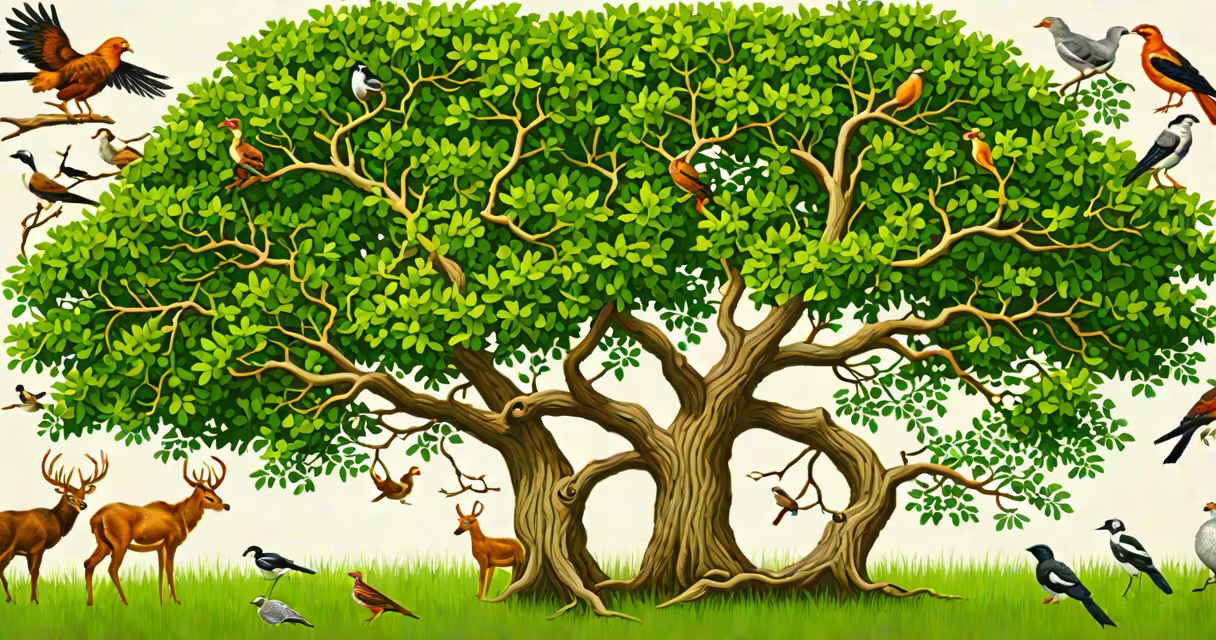
A clade is a group of organisms that includes a common ancestor and all of its descendants, forming a single branch on the evolutionary tree. This definition distinguishes clades from older classification systems based on physical traits alone. Clades are the foundation of modern phylogenetic classification.
Clades are identified through shared derived characteristics-traits that evolved in a common ancestor and were passed to its descendants. These traits are called synapomorphies. For example, feathers are a synapomorphy uniting all birds within a single clade, because they evolved in their last common ancestor and are inherited by all bird species.
Unlike traditional taxonomic ranks such as class or order, which can be arbitrary, clades are objective and testable. They reflect actual evolutionary history rather than human convenience. The concept emerged from cladistics, a method developed by German zoologist Willi Hennig in the 1950s to reconstruct evolutionary relationships using shared traits.
Cladistics uses a set of rules to infer evolutionary relationships. The core principle is parsimony-the idea that the simplest explanation, requiring the fewest evolutionary changes, is most likely correct. Scientists analyze morphological, genetic, or behavioral traits across species to build branching diagrams called cladograms.
Each node on a cladogram represents a hypothetical common ancestor. The branches extending from it represent descendant lineages. A clade forms when all descendants of a node are included. If a group excludes any descendant of the ancestor, it is not a clade-it's a paraphyletic group.
For example, the group "reptiles" as traditionally defined excludes birds, even though birds descended from dinosaurs, which are reptiles. Therefore, "reptiles" is not a clade. But the group including lizards, snakes, turtles, crocodiles, and birds-because they all descend from a single ancestor-is a valid clade: the amniotes.
Clades vary in size and inclusivity. A small clade might include only a few closely related species, while a large one spans millions of years and hundreds of thousands of species. All clades are nested within larger ones-a hierarchical structure reflecting shared ancestry.
The table below shows major vertebrate clades and their defining traits:
| Clade | Defining Synapomorphy | Example Members |
|---|---|---|
| Mammalia | Hair and mammary glands | Humans, whales, bats |
| Birds (Aves) | Feathers and lightweight bones | Eagles, penguins, ostriches |
| Amniota | Amniotic egg | Reptiles, birds, mammals |
| Vertebrata | Bony spine and skull | Fish, amphibians, reptiles, birds, mammals |
Notice how each clade builds on the previous one. Birds are part of Amniota, which is part of Vertebrata. This nesting reflects shared ancestry. A clade is not defined by similarity alone-two species may look alike but belong to different clades if they didn't inherit the trait from a shared ancestor.
Many people confuse clades with taxonomic groups like "family" or "genus." These are rank-based categories created by humans. A clade is not tied to a name or rank-it's defined solely by descent. For example, the family Felidae (cats) is a clade, but so is the entire order Carnivora, which includes bears and weasels.
Another misconception is that clades must include living species. They don't. Fossil species can be part of a clade if they share a common ancestor with living members. The discovery of Archaeopteryx, a fossil with both dinosaur and bird features, helped confirm that birds are a subgroup of theropod dinosaurs-a clade within the larger group of archosaurs.
A lesser-known but critical point: clades are not static. As new evidence emerges-especially from DNA sequencing-clades can be revised. The group known as "insects" was long considered a clade, but molecular data show that insects are actually a subset of arthropods that evolved from a lineage that also gave rise to crustaceans. So "insects" is not a clade; the true clade is "Pancrustacea," which includes both insects and crustaceans.
Consider the group of primates. Traditional classification placed lemurs, monkeys, apes, and humans into separate families. Modern cladistics reveals that all these animals form a single clade-Anthropoidea-defined by shared traits like forward-facing eyes, complex brains, and grasping hands.
To verify this, scientists compare DNA sequences across primate species. A 2016 study published in *Nature* analyzed 112 mammalian genomes and confirmed that anthropoids share a unique mutation in the gene *FOXP2*, linked to vocal learning. This genetic synapomorphy supports the existence of the Anthropoidea clade.
When researchers reconstructed the phylogeny using this data, they found that New World monkeys (like spider monkeys) diverged earlier than Old World monkeys (like macaques), and apes split off later. The resulting tree showed a clear branching pattern consistent with a single clade. This model replaced older classifications based on anatomy alone.
As a biologist who spent months analyzing primate skulls and DNA samples during fieldwork in Madagascar, I saw firsthand how misleading morphology can be. A lemur's small brain and flat face suggested it was primitive-but genetic analysis placed it firmly within the Anthropoidea clade, alongside humans. That moment confirmed that clades are about shared descent, not appearance.
Clades provide a universal structure for understanding biodiversity. They allow scientists to predict traits, behaviors, and vulnerabilities across species. For example, if a disease affects one member of a clade, others in the same clade are more likely to be susceptible due to shared genetics.
Conservation efforts increasingly rely on clade-based strategies. Protecting a clade preserves evolutionary potential. The International Union for Conservation of Nature (IUCN) now evaluates species not just individually but about their clade, recognizing that losing a whole clade means losing millions of years of evolutionary history.
According to the National Center for Biotechnology Information (NCBI), over 95% of current biological research uses clade-based models. The Tree of Life Web Project, hosted by the University of Arizona, maps over 1 million species into clades using genomic data, making evolutionary relationships accessible to educators and researchers worldwide.
Understanding what is a clade is essential for anyone studying evolution, ecology, or conservation. It shifts focus from superficial similarities to deep ancestry. A clade is not a label-it's a historical record written in genes and fossils.
Recognizing a clade requires evidence, not opinion. Whether analyzing a fossil, comparing DNA, or observing behavior, the presence of shared derived traits confirms a clade. This method helps biological classification reflects reality-not tradition.