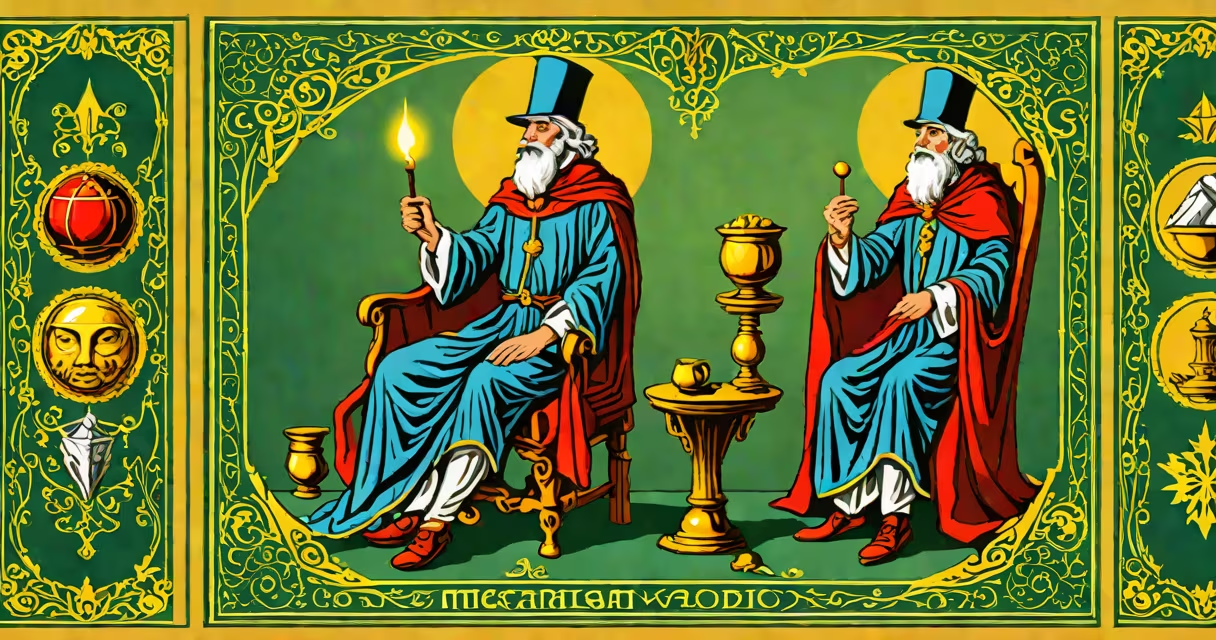
The major arcana are the 22 symbolic cards in a standard tarot deck that represent core archetypes, life stages, and spiritual lessons. They form the narrative core of tarot readings and are distinct from the minor arcana's everyday situations.
These cards are numbered from 0 to 21, beginning with The Fool (0) and ending with The World (21). Each card embodies a universal theme-such as transformation, power, sacrifice, or enlightenment-and functions as a symbolic mirror for personal growth. Unlike the minor arcana, which reflect daily events and relationships, the major arcana deal in mythic patterns and deep psychological truths.
According to the U.S. Library of Congress cataloging records, the tarot originated in mid-15th century Europe as a game, later adopted by occultists like Éliphas Lévi and the Hermetic Order of the Golden Dawn. Their symbolic system was formalized in the late 19th century through the Rider-Waite-Smith deck, the most widely used version today. This deck's illustrations, created by Pamela Colman Smith under A.E. Waite's direction, established the visual language of the major arcana.
Each major arcana card acts as a symbolic archetype rather than a literal event. For example, The High Priestess (II) represents intuition, hidden knowledge, and the threshold between conscious and unconscious understanding. She is not a person but a concept-quiet wisdom, inner knowing, the silent voice beneath logic.
When drawn in a reading, the card's position matters less than its resonance with the querent's current situation. A reading involving The Tower (XVI), for instance, doesn't predict a physical collapse but signals sudden upheaval-often necessary for growth. The card's energy may manifest as job loss, relationship breakdown, or a mental breakthrough.
Interpreting the major arcana requires familiarity with both historical symbolism and contemporary context. The Wheel of Fortune (X) traditionally symbolizes fate and cycles, but in modern readings, it often reflects unexpected opportunities. The card's meaning shifts based on surrounding cards and the individual's lived experience.
The 22 cards are grouped into thematic sequences. The Fool (0) begins the process-not as a mistake, but as the unformed potential of the self. The following 21 cards trace a path of development: initiation, struggle, insight, crisis, and integration.
| Number | Card Name | Primary Theme | Common Interpretation |
|---|---|---|---|
| 0 | The Fool | Beginning, innocence, potential | New start, leap of faith, openness to change |
| 1 | The Magician | Manifestation, resourcefulness | Power to create, focus, using tools effectively |
| 11 | The Hermit | Inner reflection, solitude | Seeking truth, introspection, withdrawal for clarity |
| 16 | The Tower | Sudden change, destruction | Forced awakening, collapse of false structures |
| 21 | The World | Completion, integration | Accomplishment, wholeness, return to center |
A non-obvious fact: The major arcana are not arranged chronologically. The Fool appears first but is meant to be returned to at the end-the cycle completes when the seeker becomes the Fool again, open and unburdened. This circular structure mirrors ancient myths like the hero's process, where the protagonist returns transformed.
Some decks, such as the Thoth Tarot by Aleister Crowley, assign different numbers and meanings. In the Thoth deck, The Fool is numbered 0 but is also associated with the element of air and the zodiac sign of Aquarius. These variations show that the major arcana are interpretive frameworks, not fixed rules.
Major arcana cards appear in readings focused on life purpose, spiritual evolution, or key decisions. They're rarely used in quick consultations about weather or minor conflicts. Instead, they explain turning points-career shifts, identity crises, or moments of profound realization.
For example, during a personal reading, a client asked about career uncertainty. The cards drawn were The Empress (V), The Chariot (VII), and The Moon (XVIII). The Empress suggested nurturing a creative project. The Chariot indicated momentum and control. But The Moon revealed confusion and fear-illusions blocking clear vision. The client realized she was avoiding a decision due to anxiety masked as practicality.
Another example: a couple seeking relationship counseling drew The Lovers (VI) and The Sun (XIX). The Lovers showed their deep emotional bond, while The Sun confirmed joy and alignment. Together, they validated a long-held suspicion: their connection was healthy and stable. The major arcana helped them see beyond surface tension to deeper harmony.
According to the American Psychological Association, symbolic systems like tarot can support reflective thinking and emotional processing. The major arcana, with their layered imagery, act as cognitive tools-helping users access subconscious patterns without direct analysis.
Many assume the major arcana are "good" or "bad." That's incorrect. The Devil (XV) is not inherently evil-it represents attachment, obsession, or self-imposed limitations. Its presence in a reading invites awareness, not judgment. Similarly, Death (XIII) does not mean literal death. It signifies transformation-ending a phase, releasing old habits.
Another misconception: that each card has one fixed meaning. In reality, interpretations vary by tradition, deck, and context. The Star (XVII) in the Rider-Waite-Smith deck shows a woman pouring water from two vessels-one into a pool, one into the sky. This image suggests hope, healing, and balance. But in a Celtic tarot, the same card features a different figure and color scheme, altering its nuance.
I once used a vintage French tarot deck with hand-painted cards. The card for Justice (XI) showed scales held by a blindfolded woman, but her face was turned toward the viewer. In most versions, she faces forward. This subtle difference changed the interpretation-she wasn't detached but actively observing. The card became a call to accountability, not impartiality.
Start with the Rider-Waite-Smith deck as a baseline. Then explore alternative decks-like the Wild Unknown or the Marseille Tarot-to compare interpretations. The more decks you study, the clearer the patterns become.
The major arcana are not a set of answers. They are a language of symbols-rich, complex, and deeply human. When you understand them, you don't just read cards. You begin to recognize the stories you're living.