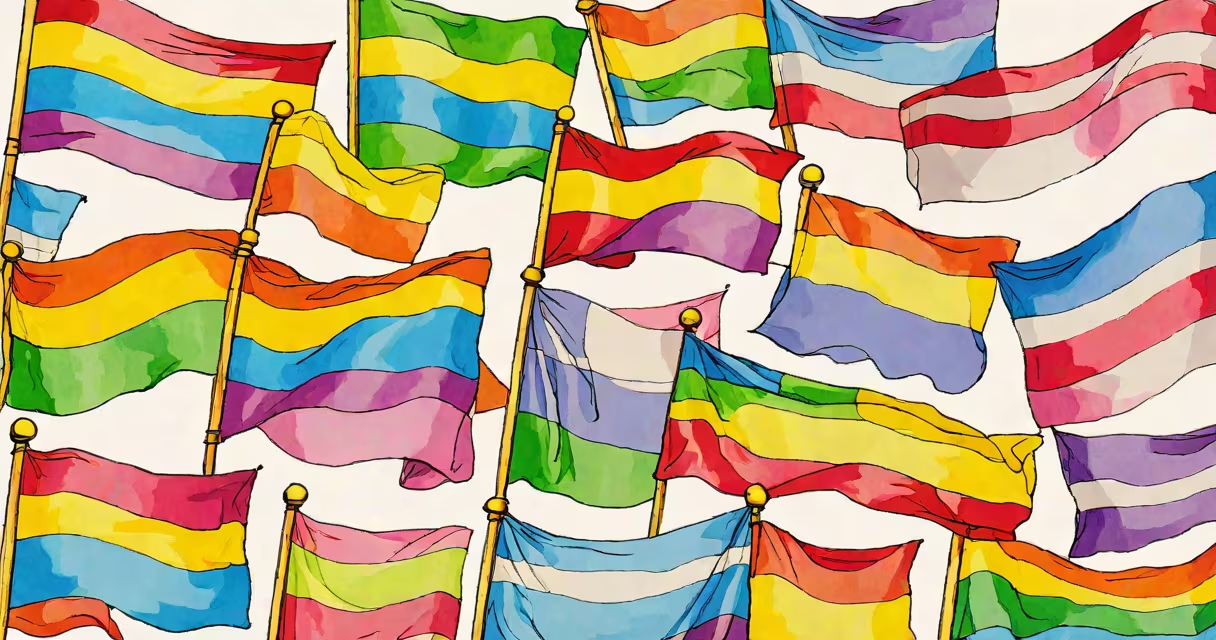
Pride flags are symbolic banners representing specific identities within the LGBTQ+ community. Each flag uses color, design, and layout to communicate belonging, history, and visibility. The most widely recognized is the rainbow flag, but dozens of flags exist for gender identity, sexual orientation, and intersectional identities.
Flags function as visual shorthand for identity. They use color symbolism, arrangement, and sometimes icons to convey meaning. A single flag may represent a single identity (e.g., the transgender flag) or a broader community (e.g., the bisexual flag).
Designs often draw from historical symbols. The rainbow flag, created in 1978 by Gilbert Baker, was inspired by the natural rainbow and the idea of diversity. Each color originally had a specific meaning: red for life, orange for healing, yellow for sunlight, green for nature, blue for harmony, and violet for spirit.
Modern flags are developed through community consensus. For example, the non-binary flag was designed in 2010 by Kye Rowan after a public call for input. The process ensures representation reflects lived experience rather than external assumptions.
The following table outlines major pride flags, their colors, and symbolic meanings based on official descriptions and community usage.
| Flag | Colors | Meaning |
|---|---|---|
| Rainbow (LGBTQ+) | Red, Orange, Yellow, Green, Blue, Violet | Represents the full spectrum of LGBTQ+ identities. Originally six colors; some versions use eight. |
| Transgender | Pink, Light Blue, White | Pink and light blue represent traditional gender associations; white symbolizes those who are intersex, non-binary, or transitioning. |
| Bisexual | Purple, Pink, Blue | Purple blends pink and blue, symbolizing attraction to both men and women. |
| Pansexual | Red, Yellow, Blue | Red for attraction to people of any gender, yellow for emotional connection, blue for romantic feelings. |
| Non-Binary | Yellow, White, Purple, Black | Yellow for those whose gender exists outside the binary, white for agender, purple for those who identify with multiple genders, black for those who feel no gender. |
| Asexual | Black, Gray, White | Black for asexuality, gray for gray-asexuality, white for allosexual allies. |
Pride flags appear at events, on social media, in workplaces, and on personal items. They signal solidarity, visibility, and safety. A school displaying the transgender flag in a hallway indicates support for trans students.
They serve as tools for education. During Pride Month, schools and organizations use flags to teach about identity. The inclusion of the aromantic flag-black, gray, and white-helps clarify that romantic attraction is separate from sexual attraction.
Some flags have regional variations. The South African rainbow flag includes a green stripe to honor the country's anti-apartheid struggle. The Palestinian LGBTQ+ flag combines the rainbow with the Palestinian flag's colors, asserting dual identity.
One widespread error is equating the rainbow flag with all LGBTQ+ identities. While it represents the broader community, it does not capture the specificity of individual flags. Using the rainbow flag to represent a trans person's identity erases their unique experience.
Another mistake is assuming all flags follow the same format. The intersex flag features a purple circle on a yellow field-symbolizing intersex people and the medical community's role in their lives. Its design differs from the horizontal stripes of the bisexual flag.
Some assume flags are standardized globally. The pansexual flag's red-yellow-blue sequence is widely accepted, but variations exist. In Japan, a version with red, yellow, and blue arranged vertically is used. Context matters.
In 2022, a high school in Portland, Oregon, installed pride flags in its main corridor. The administration consulted student groups and local LGBTQ+ nonprofits. They hung the rainbow flag, the transgender flag, the non-binary flag, and the asexual flag.
After the display, 68% of surveyed students reported feeling safer. Teachers noted increased participation from previously silent students. One trans student wrote, "Seeing my flag on the wall made me feel seen for the first time."
This example shows how flags aren't just symbols-they create measurable change in belonging and mental health. According to the Trevor Project's 2023 National Survey, LGBTQ+ youth who see affirming symbols at school are 40% less likely to report suicidal thoughts.
I attended a Pride parade in Toronto in 2023. Over 100 different flags were carried. I noticed a group carrying the demisexual flag-gray and black with a small white dot. A participant explained, "The dot is for the moment of connection. We don't feel sexual attraction until we form a deep bond."
That moment clarified something I'd misunderstood: not all identities fit into binary categories. Demisexuality is not a phase or a preference-it's a valid orientation. Seeing the flag in motion made the concept tangible.
Do not use flags as decoration without understanding their meaning. A company using the bisexual flag in a marketing campaign without context risks trivializing identity. The flag is not a trend.
Avoid combining flags unless intentional. Overlapping the transgender and non-binary flags can imply equivalence, which isn't accurate. Each identity has distinct experiences.
Never assume someone's identity based on a flag they carry. A person may display a flag for allyship, protest, or cultural heritage-not because it describes their identity.