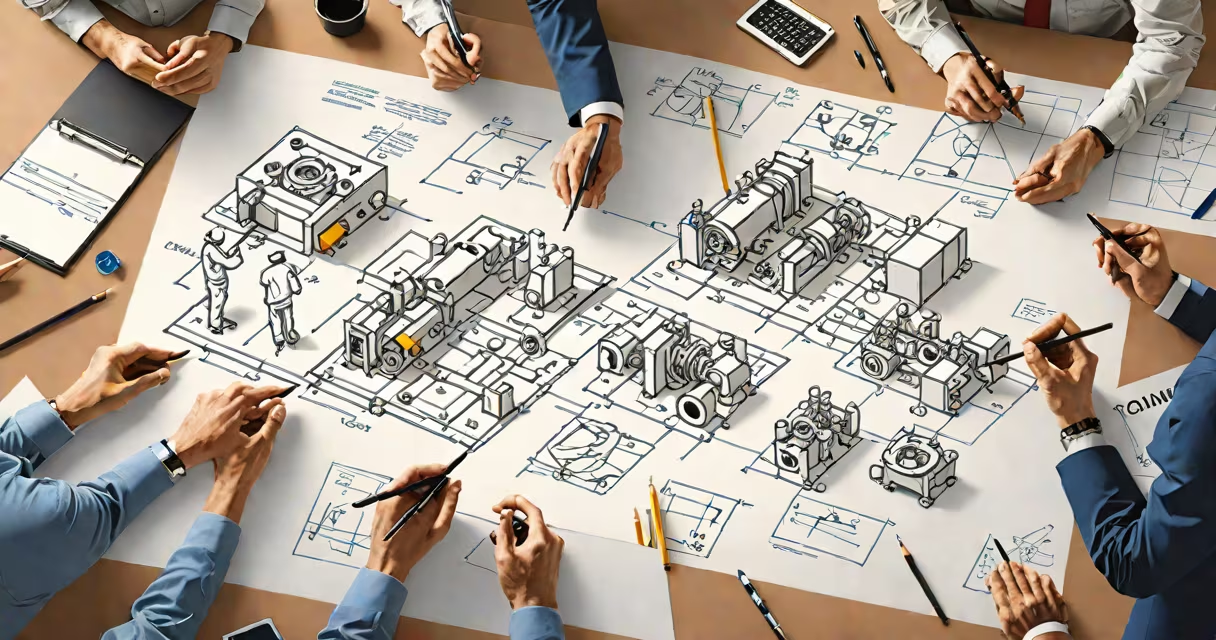
Design Failure Mode and Effects Analysis (Dfmea) is a proactive engineering methodology used to identify potential failures in a product's design, assess their impact, and implement corrective actions before manufacturing begins. It is a systematic, documented process that evaluates risks associated with design features, components, and system interactions.
Dfmea is not a one-time task. It is a living document updated throughout the design lifecycle. Its purpose is to detect weaknesses early-when changes are cheap and efficient-before they result in costly recalls, safety hazards, or customer dissatisfaction. The process follows a standardized format, often aligned with AIAG-VDA guidelines, which define specific steps and scoring criteria.
For example, in automotive development, engineers use Dfmea to evaluate whether a brake caliper's mounting bolt could loosen under vibration. They analyze the likelihood of failure, the severity of consequences (e.g., loss of braking), and the ability to detect the issue during testing. This allows teams to reinforce the bolt's retention mechanism or add a locking washer before prototyping.
Dfmea operates through a series of structured steps. Teams begin by defining the product's functional requirements and breaking down the design into subsystems, components, and interfaces. Each element is then analyzed for possible failure modes-ways it could fail to perform its intended function.
For each failure mode, teams assess three factors: severity (how serious the failure would be), occurrence (how likely it is to happen), and detection (how probable it is that the failure will be caught before reaching the customer). These are scored numerically-typically on a 1-10 scale-and multiplied to produce a Risk Priority Number (RPN).
A high RPN triggers action. For instance, if a smartphone's battery connector has a failure mode rated 9 for severity (fire hazard), 7 for occurrence (due to poor soldering), and 4 for detection (no test exists), the RPN is 252. That score signals urgent redesign or added inspection steps. The goal is to reduce RPNs below a threshold set by the organization-often 125 or lower.
Dfmea relies on a detailed worksheet. The core sections include:
Teams assign responsibility for each action item and track progress through design reviews. The process is collaborative-bringing together mechanical, electrical, software, and manufacturing engineers to ensure cross-functional insight.
One non-obvious fact: Dfmea is not a standalone tool. It integrates with other systems like FMEA (failure mode and effects analysis) used in production, and it informs reliability testing plans. A well-executed Dfmea reduces the number of prototype iterations by identifying issues that would otherwise emerge only during field testing.
Many teams treat Dfmea as a compliance checklist rather than a risk mitigation strategy. This leads to superficial entries-like marking "low" severity because the failure seems unlikely-without real technical justification. The result is a false sense of security.
Another error is failing to update Dfmea after design changes. A component may pass initial review, but if its material is switched later due to cost pressure, the failure modes and RPNs must be reassessed. Ignoring this creates outdated risk profiles.
Dfmea is also frequently confused with FMEA used in manufacturing. While both use similar scoring, Dfmea focuses on design-level risks-such as structural integrity or thermal management-while production FMEA addresses process-related issues like welding defects or assembly misalignment. Confusing the two leads to misplaced controls.
For example, a medical device manufacturer once passed Dfmea for a portable defibrillator's power supply design. But during clinical trials, units failed under cold conditions. The root cause was a capacitor that degraded below -10°C-a failure mode not considered in the original Dfmea because the team assumed the device would only operate above freezing. The oversight led to a recall. This highlights that Dfmea must consider environmental extremes, not just nominal operating conditions.
Dfmea is standard practice in regulated industries. Automotive manufacturers follow AIAG-VDA guidelines, requiring Dfmea for all new vehicle platforms. Aerospace companies use it under ISO 13485 and DO-178C standards for avionics and flight control systems.
Consumer electronics firms apply Dfmea during product development cycles. Apple's design teams use Dfmea to evaluate the durability of iPhone hinge mechanisms, ensuring they meet drop-test standards. Tesla applies it to battery pack designs, analyzing thermal runaway scenarios and cooling system redundancy.
Even in non-engineering contexts, Dfmea principles inform risk planning. A hospital might use a simplified Dfmea to assess the failure risk of a new patient monitoring system-evaluating sensor drift, alarm silence, or network outages.
One real-world example: In 2016, a major appliance maker faced a class-action lawsuit after several washing machines caught fire due to a faulty motor controller. Post-mortem analysis revealed that Dfmea had flagged the controller's overheating risk months earlier-but the team downgraded it based on internal cost estimates. The failure was not addressed. This case underscores that Dfmea must be independent of budget or schedule pressures.
I once led a Dfmea session for a new industrial pump design. We identified a failure mode where the impeller could detach during high-pressure startup. The initial RPN was 180. After adding a retaining ring and modifying the shaft taper, we reduced the RPN to 48. The change added $3.20 per unit but saved an estimated $1.2 million in warranty claims over five years.
Best practices include involving manufacturing and service teams early. Their feedback prevents design choices that are difficult to assemble or repair. Also, avoid relying solely on historical data. A new material or novel geometry may introduce unknown failure modes. Always challenge assumptions.
According to the American Society for Quality (ASQ), Dfmea reduces design-related defects by up to 60% when applied consistently across projects. The International Organization for Standardization (ISO) notes that integrating Dfmea into the design process improves product reliability and reduces time-to-market by minimizing late-stage redesigns.
What is dfmea? It is not a form-it is a disciplined mindset. It turns hypothetical problems into measurable risks, and measurable risks into actionable fixes. It shifts focus from reacting to failures to preventing them. In complex systems, that difference defines success.