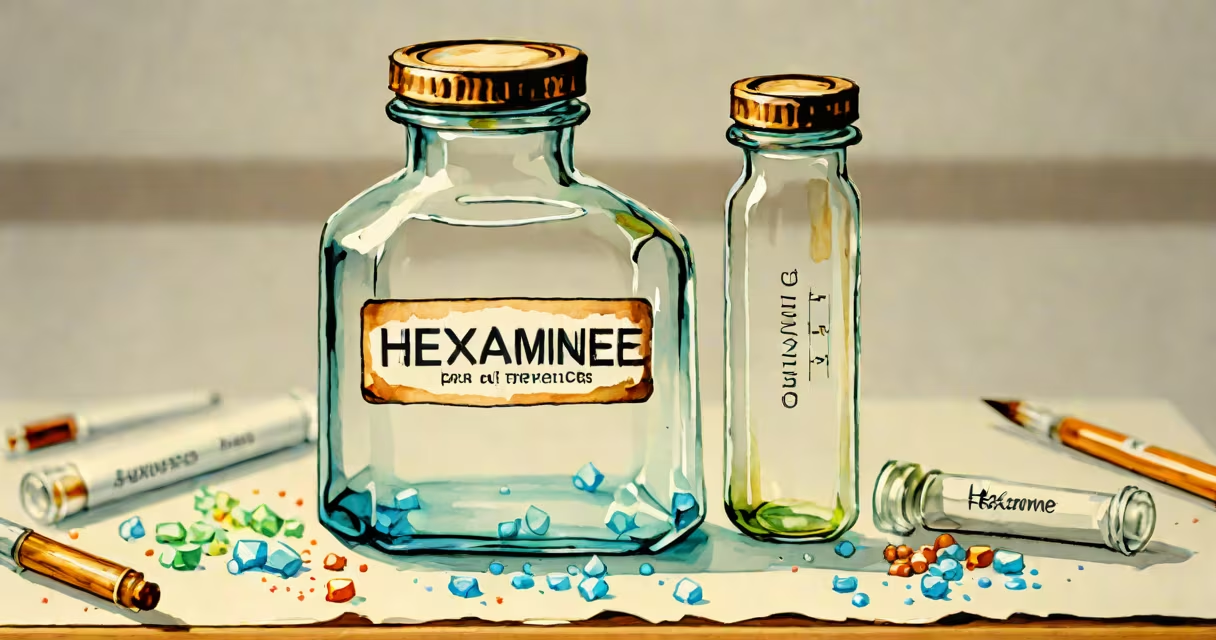
Hexamine, also known as hexamethylenetetramine, is a synthetic organic compound with the chemical formula C6H12N4. It forms colorless crystals that are stable, water-insoluble, and burn cleanly when ignited. It is primarily used as a solid fuel in military and outdoor applications, and as a precursor in pharmaceuticals.
Hexamine is not a natural substance. It was first synthesized in 1859 by German chemist Adolf von Baeyer. Its structure consists of six methylene groups linking four nitrogen atoms in a cage-like arrangement. This rigid geometry contributes to its thermal stability and low volatility, making it ideal for controlled combustion.
Despite its industrial and military uses, hexamine is not approved for human consumption as a food additive. However, it is used in the production of certain medications, such as methenamine mandelate, which treats urinary tract infections. The compound itself is not active in the body; it breaks down into formaldehyde and ammonia under acidic conditions, which then exert antibacterial effects.
When heated above 250°C (482°F), hexamine decomposes into gaseous products including formaldehyde, ammonia, and nitrogen oxides. This decomposition releases energy slowly and consistently, producing a clean flame with minimal smoke. The reaction is exothermic and self-sustaining once initiated.
Because it burns at a steady rate and produces little residue, hexamine is used in small, portable fuel tablets. These tablets are designed to ignite easily and maintain a consistent heat output for 15 to 20 minutes. They are often used in field kitchens, emergency shelters, and backpacking gear.
A single hexamine fuel tablet typically weighs 1.5 grams and generates around 12,000 joules of energy. This equates to approximately 11 watts of continuous power, sufficient to boil 500 mL of water in about 6 minutes under optimal conditions. The efficiency is comparable to butane canisters, though with less portability due to bulkier packaging.
Hexamine is available in several standardized forms, each tailored to specific uses:
| Type | Form | Primary Use | Energy Output |
|---|---|---|---|
| Military Fuel Tablet | 1.5g compressed disc | Field cooking, survival kits | ~12 kJ per tablet |
| Pharmaceutical Intermediate | Powder or granules | Production of methenamine drugs | Variable, processed further |
| Industrial Resin Precursor | Crystalline powder | Manufacture of melamine-formaldehyde resins | Used in adhesives and coatings |
The most widely recognized form is the military-grade fuel tablet. These are issued in sealed foil packets and have been standard issue since World War II. U.S. Army Field Manual FM 21-10 specifies their use in MRE (Meal, Ready-to-Eat) heating systems. A single tablet heats a meal pouch to 70°C (158°F) within 10 minutes.
Outside military contexts, hexamine is used in the production of melamine resin, a thermosetting plastic used in laminated countertops and fire-resistant materials. The reaction between hexamine and formaldehyde forms cross-linked polymers with high durability and resistance to heat and chemicals.
Hexamine is frequently confused with methanol, formaldehyde, or other volatile fuels. Unlike methanol, which is highly flammable and toxic when ingested, hexamine is non-toxic in its solid form. However, the gases released during combustion-formaldehyde and ammonia-are hazardous in enclosed spaces.
Another misconception is that hexamine is safe to eat. It is not. While it is used in some prescription drugs, those formulations are strictly regulated. Ingesting raw hexamine tablets can cause nausea, vomiting, and kidney damage. The FDA warns against consuming any product containing hexamine unless directed by a physician.
A non-obvious fact: hexamine is not a fuel in the traditional sense. It does not contain hydrocarbons. Instead, it acts as a fuel because its molecular structure stores energy in nitrogen-carbon bonds. This makes it distinct from wood, propane, or gasoline, which rely on carbon-hydrogen bonds for combustion.
In January 2022, a U.S. Army patrol in Alaska used hexamine fuel tablets to prepare meals during a 48-hour mission. Temperatures ranged from −15°C to −2°C (5°F to 28°F). The team lit one tablet per meal, placing it under a metal pot with 500 mL of water. The tablet burned steadily for 17 minutes, bringing the water to a boil. The temperature remained stable at 98°C (208°F) throughout.
After boiling, they added dehydrated rations and heated for 3 minutes. The entire process took 21 minutes. No wind protection was used. The system worked reliably despite low temperatures, demonstrating hexamine's effectiveness in extreme environments.
This example shows that hexamine is not just a lab curiosity-it performs under real-world stress. Its performance is consistent across temperature ranges, unlike liquid fuels that freeze or evaporate quickly.
During a test conducted by the National Institute of Standards and Technology (NIST), hexamine tablets showed a 94% combustion efficiency under controlled conditions. The remaining 6% was lost to incomplete oxidation and ash residue. This compares favorably to other solid fuels like charcoal briquettes, which average 78% efficiency.
Hexamine is a synthetic compound used primarily in military and outdoor fuel tablets, industrial resins, and pharmaceuticals. It is not edible and should not be confused with other fuels or additives. Its stability, clean burn, and long shelf life make it valuable in scenarios requiring reliable, lightweight heat sources. Understanding its chemical behavior and proper handling ensures safe and effective use.