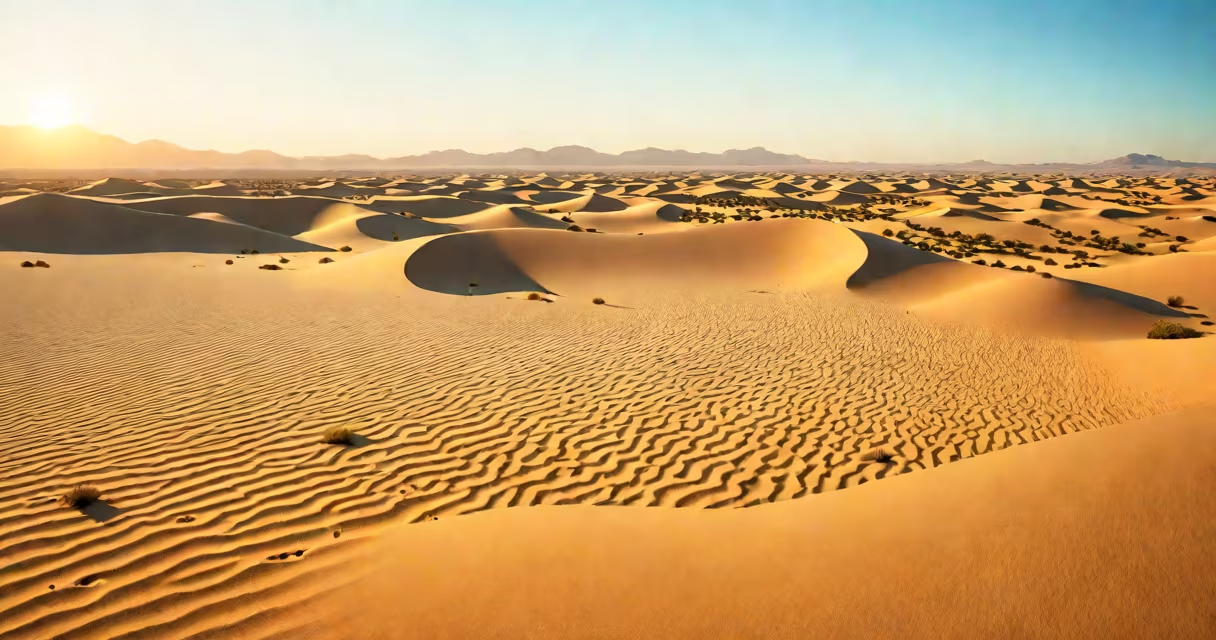
Desert climates are defined by extremely low annual rainfall-typically less than 250 mm-and dramatic temperature fluctuations between day and night. These conditions create harsh, dry environments where water conservation is essential for survival.
Deserts cover about one-third of Earth's land surface and occur in both hot and cold forms. Hot deserts, such as the Sahara in North Africa and the Sonoran in North America, experience scorching daytime temperatures exceeding 40°C (104°F), while nighttime temperatures can drop below 10°C (50°F). Cold deserts, like the Gobi in Asia and the Patagonian Desert in South America, see freezing winters and milder summers.
The lack of moisture in the air reduces cloud formation and increases solar radiation exposure. This leads to intense daytime heating and rapid heat loss at night due to minimal atmospheric insulation. According to the National Oceanic and Atmospheric Administration (NOAA), desert regions receive 90% of their solar energy directly because of clear skies and low humidity.
Desert climates form primarily due to global wind patterns and geographic location. Most major deserts lie between 15° and 30° north and south latitude, where descending air masses from the Hadley Cell circulation suppress cloud development and rainfall.
When air descends from the upper atmosphere, it warms and compresses, creating stable, dry conditions. As this air moves over land, it absorbs moisture from the surface but cannot release it as rain because it lacks cooling mechanisms. This results in persistent drought conditions.
A notable example is Death Valley in California, which holds the record for the highest reliably measured air temperature on Earth: 56.7°C (134°F) on July 10, 1913. Despite this, the valley experiences cold nights, sometimes dropping below freezing during winter months.
Desert climates share several defining traits beyond low rainfall:
These features shape plant and animal adaptations. For instance, cacti store water in thick stems, and reptiles like the sidewinder rattlesnake move sideways to reduce contact with hot sand.
Many assume deserts are uniformly hot and barren. In reality, cold deserts exist and support unique ecosystems. The Gobi Desert averages −10°C (14°F) in winter and reaches 35°C (95°F) in summer-showing that temperature extremes aren't limited to heat.
Another myth is that deserts are lifeless. The Mojave Desert hosts over 1,000 native plant species, including the Joshua tree, which thrives in alkaline soils and seasonal rains. The U.S. Geological Survey reports that desert biomes contain more biodiversity per square kilometer than many tropical forests when considering specialized adaptations.
Even the term "desert" is misleading. It comes from Latin *desertus*, meaning "abandoned," reflecting ancient views of uninhabitable land. Modern science recognizes deserts as changing systems shaped by wind, geology, and biological resilience.
Consider the Atacama Desert in Chile-the driest non-polar desert on Earth. Some areas have not seen measurable rainfall in over 400 years. A 2015 study published in *Nature Geoscience* found that microbial life persists in Atacama soil layers, surviving on trace atmospheric moisture and mineral nutrients.
Another example: the Kalahari Desert in southern Africa. Though classified as a semi-arid savanna, it exhibits desert-like traits-annual rainfall averages 100-500 mm, and temperatures swing from 20°C (68°F) to 40°C (104°F). Local San people have lived sustainably here for millennia using deep-rooted plants like the!nara melon for hydration and nutrition.
For comparison, here's how different desert types differ:
| Type | Location | Annual Rainfall | Daytime Temp Range | Nighttime Temp Range |
|---|---|---|---|---|
| Hot Desert | Sahara (Africa) | 25-150 mm | 35-45°C (95-113°F) | 10-20°C (50-68°F) |
| Cold Desert | Gobi (Mongolia/China) | 50-200 mm | 15-30°C (59-86°F) | −20 to −5°C (−4 to 23°F) |
| Coastal Desert | Atacama (Chile) | 0-10 mm | 15-25°C (59-77°F) | 5-15°C (41-59°F) |
Each type supports distinct ecological niches. Coastal deserts like the Atacama rely on fog drip-moisture drawn from coastal fog banks-to sustain lichens and succulents.
I once spent five days in the Sonoran Desert near Tucson, Arizona, tracking temperature changes across a single day. At 7 a.m., the ground was cool at 12°C (54°F). By 3 p.m., surface rock temperatures reached 70°C (158°F)-hot enough to cook an egg on pavement. Yet by midnight, the air had cooled to 10°C (50°F). This extreme shift underscores why desert dwellers wear layered clothing and plan activities around daylight hours.
Understanding what is the climate like in a desert reveals more than weather-it shows how life adapts to scarcity. These environments challenge assumptions about habitability and reveal the resilience of nature under stress. Whether studying soil chemistry, designing sustainable architecture, or planning travel, knowing desert climate patterns is essential.