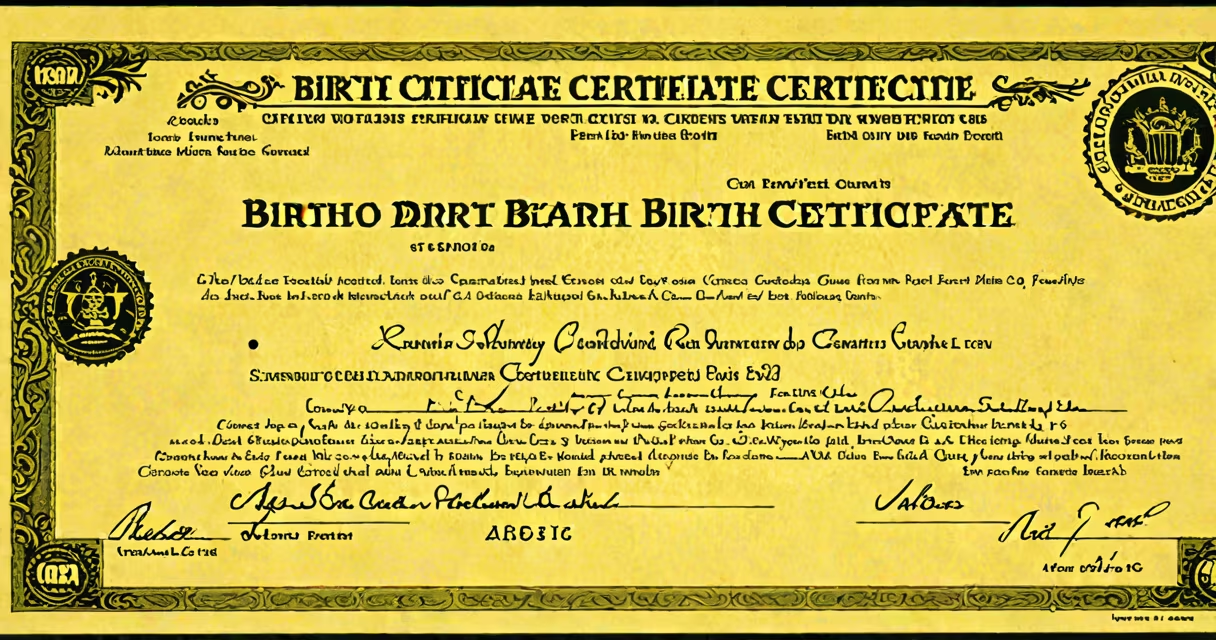
A birth certificate is a government-issued document that records a person's birth details, including date, time, location, and parents' names. It serves as primary proof of identity, citizenship, and age in the U.S. and many other countries. To obtain a certified copy, applicants must provide valid identification and meet state-specific requirements.
Certified birth certificates are issued by state or local important records offices. They differ from informational copies, which lack legal standing. Only certified versions are accepted for immigration, passport applications, school enrollment, and employment verification. The process varies slightly by state, but most require the requester to prove identity and relationship to the individual listed.
The National Center for Health Statistics (NCHS) reports that over 3.8 million births were registered in the U.S. in 2022, each generating a unique birth record. These records are maintained under state jurisdiction, meaning you must apply through the state where the birth occurred. Some states allow online requests, while others require in-person or mail submissions.
To request a birth certificate, you typically need:
For minors, a parent or legal guardian must submit the request. For adults, the individual may apply themselves. If requesting for someone else, additional documentation such as a notarized consent form may be required. States like California and New York mandate that applicants provide a physical address and sign the application in person or via notarization.
Some states accept electronic signatures on forms submitted online. Others require wet-ink signatures. Always verify the current requirements on the official state website. The Centers for Disease Control and Prevention (CDC) notes that incorrect or incomplete applications delay processing by up to two weeks.
Birth certificates come in different forms based on purpose and authenticity:
| Type | Use Case | State Example | Fee Range |
|---|---|---|---|
| Certified Copy | Legal proof for passports, visas, school registration | New York: $30 | $15-$50 |
| Informational Copy | Genealogical research, personal records | Texas: $10 | $5-$20 |
| Amended Certificate | Correcting errors (name, gender, date) | Florida: $50 | $25-$75 |
Certified copies include a raised seal and official signature. Informational copies do not. Amended certificates are issued only after a court petition or administrative review. In 2021, the NCHS reported that 6.2% of birth certificates had minor errors requiring correction.
One common mistake is confusing a "certified" copy with a "notarized" version. Notarization verifies the signer's identity but does not certify the document's authenticity. Only a state-issued certified copy holds legal weight.
Most states offer multiple application methods:
For example, in Illinois, applicants can apply online via the Illinois Department of Public Health portal. The system requires uploading a scanned ID and selecting delivery options. Results arrive within 10 business days. In contrast, Mississippi requires mail-in applications with a self-addressed envelope and two forms of ID.
I once applied for my sister's birth certificate during a family reunion. I submitted the request online using her Social Security number and a copy of her driver's license. The state returned the certified copy in 12 days. The fee was $25, and the document included a holographic seal and official signature.
Many assume they can get a birth certificate from the hospital where the birth occurred. Hospitals do not issue certified copies. They may provide a temporary record or a copy of the original birth report, but these are not legally valid for official purposes.
Another misconception is that a birth certificate can be obtained without proof of identity. This is false. All states require photo ID to prevent fraud. In 2020, the National Association for Public Health Statistics reported that 12% of birth certificate requests were denied due to insufficient ID verification.
Also, some people believe that a birth certificate from one state is valid everywhere. While federal agencies recognize state-issued birth certificates, some international institutions require apostille certification for documents sent abroad. The Hague Convention outlines this process for 121 member countries.
Always confirm the latest requirements directly from your state's important records office. Policies change frequently, especially regarding remote access and biometric verification. Keep your original documents in a fireproof safe or digital vault. A certified copy is not a replacement for the original.