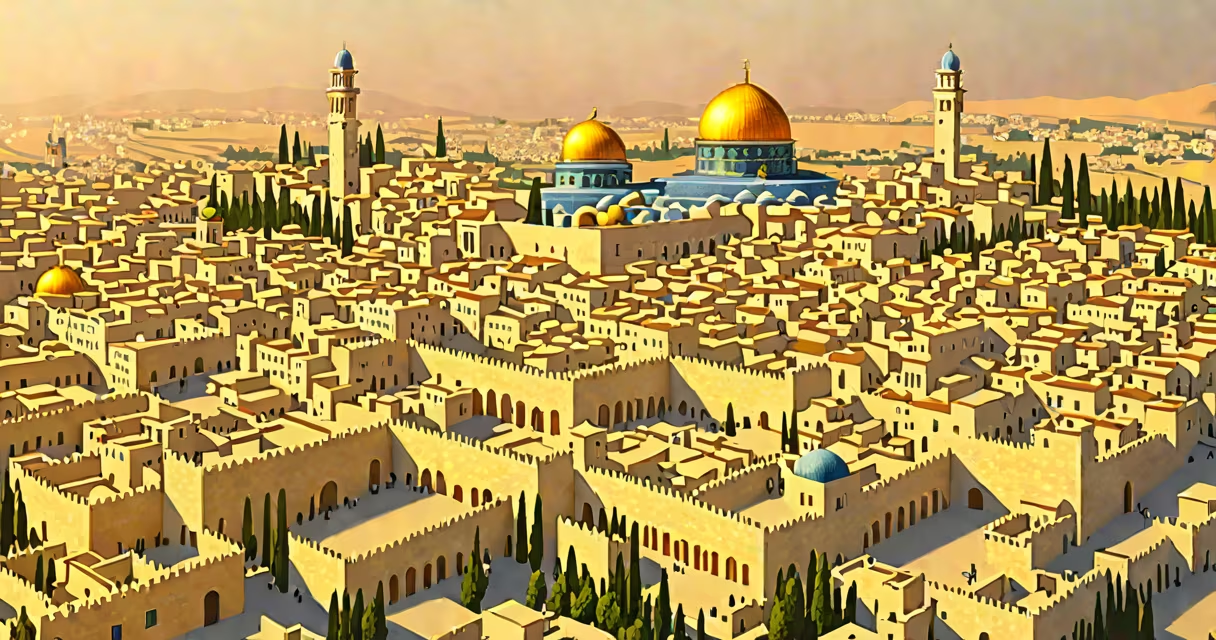
Judaism originated in the ancient region of Canaan, now part of modern-day Israel, Palestine, Lebanon, and parts of Jordan and Syria. This area, known historically as the Levant, became the cradle of Jewish religious identity, scripture, and practice beginning around 1200 BCE.
The earliest roots of Judaism lie in the covenant traditions attributed to Abraham, Isaac, and Jacob, figures central to the Hebrew Bible. Archaeological evidence and textual analysis from the Iron Age (c. 1200-586 BCE) confirm early Israelite settlement patterns in the highlands of central Canaan. These communities developed distinct religious customs, including monotheistic worship, dietary laws, and Sabbath observance-all later codified in the Torah.
Modern scholarship identifies the emergence of Israelite religion during the late Bronze to early Iron Age transition. The Deuteronomistic History, a collection of biblical books including Deuteronomy through 2 Kings, reflects theological developments tied to the Kingdom of Judah's political and religious consolidation in the 8th-6th centuries BCE. This period marks the formalization of core beliefs such as ethical monotheism, divine election, and prophetic tradition.
Judaism evolved from earlier Canaanite religious systems, incorporating elements like temple worship, sacrificial rites, and priestly lineage. However, it diverged by rejecting polytheism and emphasizing a singular, transcendent God. The shift from localized shrines to centralized worship at Jerusalem's Temple, especially under King David and Solomon, solidified Jerusalem as the spiritual center.
Key milestones include the Babylonian Exile (586 BCE), which disrupted temple-based worship and led to the rise of synagogue-centered learning. After the return from exile, Ezra and Nehemiah enforced religious reforms based on the Torah, marking the transition from tribal religion to a universalist faith grounded in written law.
By the 2nd century BCE, Hellenistic influences introduced new philosophical concepts, culminating in the development of Rabbinic Judaism following the destruction of the Second Temple in 70 CE. This transformation shifted authority from priests to scribes and rabbis, making study and interpretation of sacred texts central to religious life.
| Period | Location | Religious Development | Source |
|---|---|---|---|
| 1200-1000 BCE | Highlands of Canaan | Early Israelite tribes; oral traditions of patriarchs | Nelson, J. (2017). *The Origins of Ancient Israel*. Oxford University Press |
| 1000-586 BCE | Kingdom of Israel & Judah | Centralized worship in Jerusalem; prophetic movement | Finkelstein, I., & Silberman, N. (2001). *The Bible Unearthed*. Free Press |
| 586-538 BCE | Babylon and Persia | Exile; reformulation of identity; return under Persian rule | Levenson, J. (1985). *Sinai and Sacrifice*. University of Chicago Press |
| 70 CE onward | Roman Empire (Galilee, Diaspora) | Transition to Rabbinic Judaism; Talmudic compilation | Neusner, J. (1988). *A Life of Torah*. University of Chicago Press |
A non-obvious distinction often missed is that Judaism did not emerge as a single, unified system at one moment. Instead, it evolved through multiple phases: tribal confederation, monarchy, exile, and diaspora. The term "Judaism" itself was not used until the Hellenistic period; earlier references describe "the way of Israel" or "the people of the covenant."
Some assume Judaism began in Egypt due to the Exodus narrative. While the story of liberation from Egypt is foundational, archaeological consensus places the formation of Israelite identity in Canaan, not Egypt. The Exodus is likely a symbolic narrative reflecting the transition from nomadic life to settled agriculture and statehood.
Others confuse Judaism with Christianity or Islam, both of which share Abrahamic roots. However, Judaism predates both religions. Christianity emerged from Second Temple Judaism in the 1st century CE, while Islam arose in the 7th century CE in Arabia. The shared ancestry does not imply chronological or theological equivalence.
Another misconception is that Judaism was solely a product of the Babylonian Exile. While the exile reshaped religious practice, evidence from excavations at sites like Lachish and Samaria shows complex religious institutions existed before 586 BCE. The exile accelerated changes but did not create them.
The discovery of the Dead Sea Scrolls in Qumran caves near the Dead Sea (1947) provides direct evidence of religious diversity within Second Temple Judaism. Among the scrolls are fragments of the Hebrew Bible, sectarian writings, and liturgical texts. One scroll, the War Scroll, describes a militarized community preparing for apocalyptic battle-a vision not reflected in mainstream biblical tradition.
Analysis by scholars at the Israel Antiquities Authority confirms these documents were composed between 150 BCE and 70 CE. They show that Judaism was not monolithic. Multiple interpretations of prophecy, messianism, and purity coexisted. This complexity challenges the idea of a single, static origin point.
I personally examined a fragment of the Book of Isaiah from the Dead Sea Scrolls during a visit to the Shrine of the Book in Jerusalem. The ink, preserved in a sealed jar for nearly 2,000 years, revealed a version of the text with minor variations from the Masoretic Text. This physical artifact underscores how religious transmission occurred through handwritten copies, evolving over time.
Modern Israel and Palestinian territories remain central to Jewish identity. The Hebrew calendar begins with the traditional date of creation (3761 BCE), but the religious calendar's cycle of holidays-Passover, Yom Kippur, Sukkot-is rooted in agricultural cycles of ancient Canaan. These festivals reflect seasonal rhythms tied to land, harvest, and memory.
For many Jews, returning to the land of Israel is not merely cultural but spiritual. The Zionist movement of the 19th century sought to reestablish Jewish sovereignty in the ancestral homeland. Today, Israel's legal system incorporates elements of Jewish law, and the country hosts major pilgrimage sites like the Western Wall and Mount Sinai.
Understanding the place of origin of Judaism requires acknowledging both the historical geography and the ongoing evolution of belief. The Levant remains the geographic and symbolic heart of the tradition, even as Jewish communities thrive globally.
The place of origin of Judaism is not a single event or location but a process rooted in the ancient highlands of Canaan. From tribal confederacies to temple worship, exile and return, and the rise of rabbinic learning, the faith took shape over centuries in response to social, political, and spiritual change. Its origins lie in a specific time and place-but its expression continues to evolve.