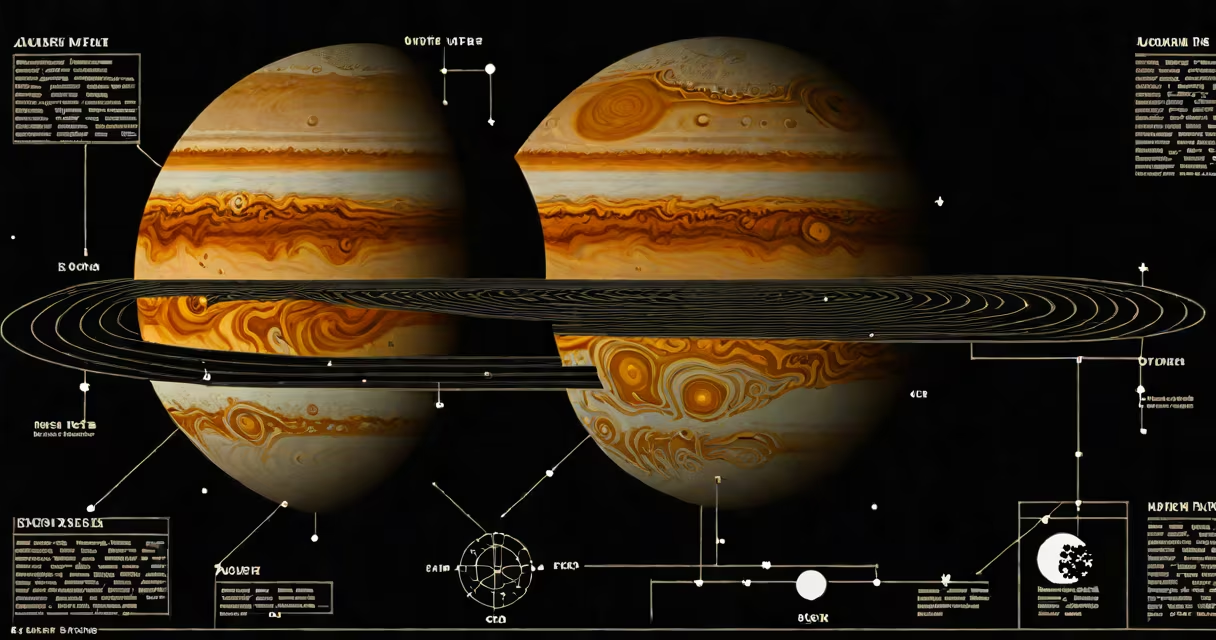
Jupiter has a diameter of 139,820 kilometers, making it the largest planet in the solar system by both mass and volume. It is so large that more than 1,300 Earths could fit inside it.
Jupiter is a gas giant, composed mostly of hydrogen and helium. Its immense size results from gravitational compression of these light gases, not a solid surface. Unlike rocky planets such as Earth, Jupiter lacks a well-defined boundary between atmosphere and interior. Instead, pressure increases gradually toward the core, where temperatures reach tens of thousands of degrees Celsius.
The planet's size is measured at its equator, where it bulges due to rapid rotation. Jupiter spins once every 9 hours and 55 minutes, causing significant equatorial flattening. This means its polar diameter is slightly smaller than its equatorial diameter-about 133,708 km versus 139,820 km.
Astronomers determine planetary sizes using angular diameter and distance measurements. By observing Jupiter through telescopes-both ground-based and space-based-they calculate its apparent size in the sky. Combined with known distances from Earth, this yields precise physical dimensions.
For example, during opposition (when Jupiter is closest to Earth), its angular diameter reaches about 50 arcseconds. Using trigonometry and the planet's distance (around 628 million km), scientists derive its actual diameter. NASA's Juno mission, which entered orbit in 2016, refined these measurements using onboard instruments and high-resolution imaging.
Size matters because it influences gravity, atmospheric dynamics, and internal structure. Jupiter's massive gravity shapes the orbits of nearby moons and controls the distribution of asteroids in the asteroid belt. Its size also enables extreme weather systems, including storms larger than Earth itself.
Jupiter dwarfs all other planets in the solar system. Here's how it compares:
| Body | Diameter (km) | Relative Size |
|---|---|---|
| Sun | 1,391,000 | ~9.9 times smaller |
| Jupiter | 139,820 | 1.0 (baseline) |
| Earth | 12,742 | ~11 times smaller |
| Neptune | 49,244 | ~2.8 times smaller |
| Saturn | 116,460 | ~1.2 times smaller |
Even though Saturn is often considered the most visually striking planet due to its rings, Jupiter is larger in both diameter and mass. Jupiter's mass is 2.5 times greater than all other planets combined.
One non-obvious fact: Jupiter's size isn't static. The planet slowly contracts under its own gravity, releasing heat. This process, called Kelvin-Helmholtz contraction, causes Jupiter to shrink by about 2 centimeters per year. Over billions of years, this has contributed to its internal energy output-Jupiter emits more heat than it receives from the Sun.
Many assume Jupiter is a "giant ball of fire" due to its bright appearance. That's incorrect. Jupiter has no surface to burn. Its visible cloud layers are made of ammonia ice, water vapor, and methane. The colors come from chemical reactions in the atmosphere, not combustion.
Another misconception is that Jupiter's Great Red Spot-a storm larger than Earth-is shrinking. While it has decreased in width from ~41,000 km in the 1800s to ~16,000 km today, it remains stable. Data from the Hubble Space Telescope and Juno show the storm still persists, driven by deep atmospheric currents.
Some confuse Jupiter's size with its density. Despite being the largest planet, Jupiter is less dense than water-about 1.33 g/cm³. Earth's average density is 5.5 g/cm³. This reflects Jupiter's gaseous composition rather than solid material.
To grasp Jupiter's scale, imagine Earth as a standard basketball (about 24 cm in diameter). On this scale, Jupiter would be a sphere roughly 2 meters wide-about the height of a tall person. You'd need a room larger than a gymnasium to hold it.
If you placed Earth and Jupiter side by side, Jupiter would stretch from the floor to the ceiling of a typical house. Even then, the gap between them would be vast-over 100 meters apart on this scale.
This comparison illustrates why Jupiter dominates the inner solar system. Its gravity affects the orbits of asteroids, comets, and even nearby planets. The planet acts as a cosmic vacuum cleaner, deflecting many objects that might otherwise collide with Earth.
I once observed Jupiter through a 10-inch telescope during a clear night in New Mexico. The planet appeared as a pale yellow disk with distinct bands and the faintest trace of the Great Red Spot. Knowing that this small image represented a world 139,820 km wide gave me a visceral sense of scale. It wasn't just a dot-it was a living, rotating world larger than all the others combined.