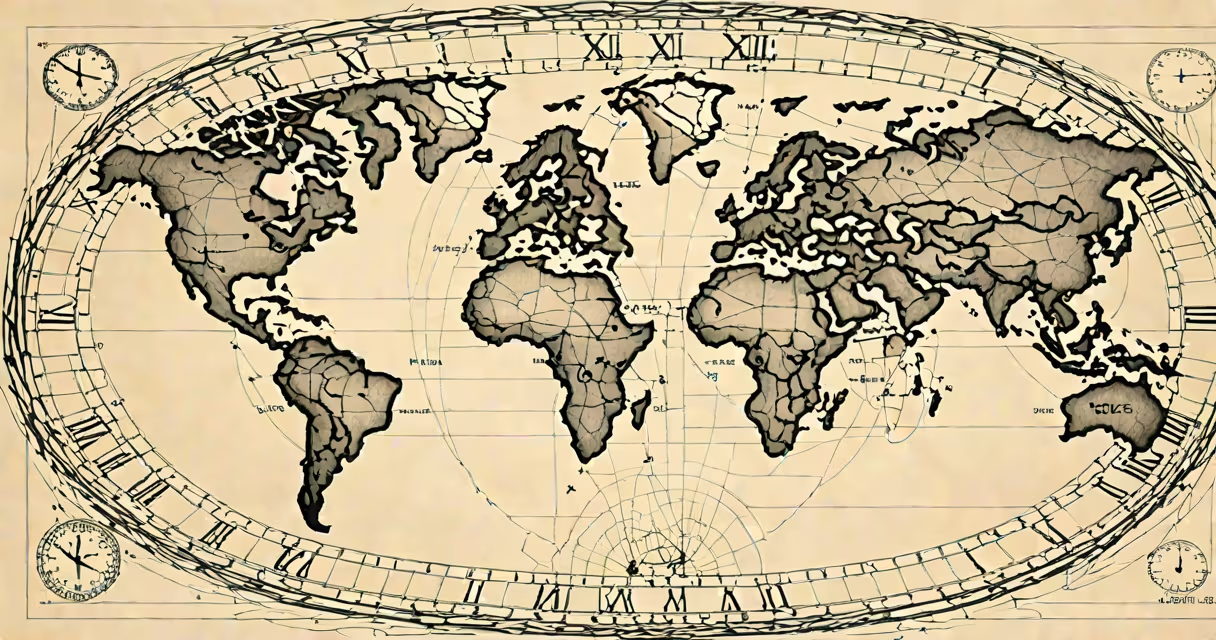
A world clock time with seconds displays the current time in multiple time zones simultaneously, updating every second to reflect real-time global differences. It synchronizes with atomic time standards to ensure accuracy within milliseconds.
This tool tracks time across continents using Coordinated Universal Time (UTC) as a reference. Each city's local time adjusts based on its offset from UTC, such as New York at UTC−5 during standard time or Tokyo at UTC+9. The inclusion of seconds allows users to track precise moments across regions, critical for events requiring exact timing.
For example, when it is 14:30:15 UTC, it is 10:30:15 AM in New York and 11:30:15 PM in Sydney. This precision enables coordination in fields like aviation, finance, and international broadcasting.
World clock time with seconds relies on network time protocol (NTP) servers that sync with atomic clocks maintained by institutions like the National Institute of Standards and Technology (NIST) in the U.S. and the International Bureau of Weights and Measures (BIPM) in France.
When a device connects to an NTP server, it receives a timestamp accurate to within 10 milliseconds. Software then calculates local times by applying known offsets for each time zone, including daylight saving adjustments. These calculations happen automatically and update every second.
Some clocks use GPS signals to verify time, which improves reliability in remote or high-accuracy environments. For instance, the U.S. Naval Observatory uses GPS satellites to maintain UTC within 100 nanoseconds.
There are two primary formats for displaying world clock time with seconds:
| Type | Display Style | Use Case |
|---|---|---|
| Static List | City names with time, e.g., London: 16:45:33 | Basic scheduling, personal use |
| Animated Map | Interactive globe with blinking markers showing time zones | Global meetings, travel planning |
| Real-Time Dashboard | Multiple clocks with second-hand animation and color-coded zones | Operations centers, financial trading floors |
Each format varies in complexity and visual feedback. Animated maps often include sunrise/sunset indicators and time zone boundaries derived from geospatial data.
One non-obvious distinction: some clocks show "local time" based on the user's device location, while others default to UTC. Misalignment between these modes causes confusion. Always confirm whether the displayed time is relative to your location or a global reference.
Many assume world clock time with seconds is simply a list of time zones. But it's not static-it's continuously updated. A clock showing 12:00:00 in Paris at noon won't adjust if daylight saving begins unless it's programmed to do so.
Another misconception: all time zones are whole-hour offsets. In reality, some regions use half-hour or quarter-hour differences. India Standard Time (IST) is UTC+5:30, and Nepal uses UTC+5:45. These deviations require accurate database support.
For example, a video conference scheduled at 09:00:00 UTC may start at 11:30:00 AM in Mumbai (UTC+5:30) and 1:00:00 AM in Auckland (UTC+12). Without accounting for these fractional offsets, participants miss the meeting by 30 minutes.
Financial markets depend on world clock time with seconds. The New York Stock Exchange opens at 09:30:00 Eastern Time, which corresponds to 13:30:00 UTC. Traders in London and Singapore rely on this synchronization to execute trades before market close.
I once monitored a live broadcast of a Mars rover landing where teams in California, Germany, and Japan coordinated via a shared world clock. The exact second count ensured that all teams began recording at the same moment, capturing the signal burst precisely. Without second-level precision, data loss would have occurred.
Even everyday tasks benefit. A parent in Los Angeles calling their child in Seoul must account for the 16-hour difference. Saying "I'll call you at 8 PM" requires converting 8:00:00 PM Los Angeles time to 12:00:00 PM the next day in Seoul.
High-accuracy world clocks use NTP servers certified by the Internet Engineering Task Force (IETF) and meet RFC 5905 standards. These servers validate time through cryptographic signatures to prevent spoofing.
According to NIST, time errors in properly configured systems remain under 100 milliseconds. However, poor internet connections or outdated software can introduce delays. Always verify that your device's time settings are set to automatic synchronization.
For users needing maximum reliability, specialized hardware clocks exist. The Swiss-made ChronoMaster series uses dual-frequency GPS receivers and internal oscillators to maintain time even during signal loss. These are used in aerospace and military operations.
World clock time with seconds is not just a display-it's a tool for global alignment. Its accuracy, real-time updates, and multi-zone visibility make it essential for modern life.