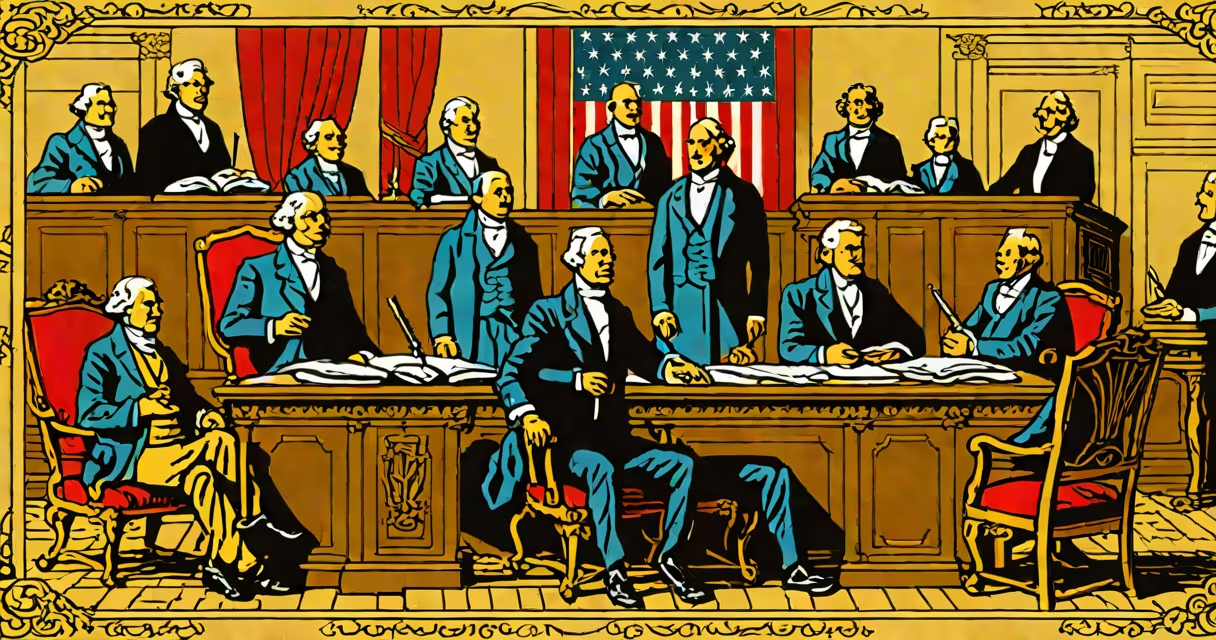
The first ten amendments to the U.S. Constitution, known collectively as the Bill of Rights, were ratified in 1791 and protect individual liberties such as free speech, religious freedom, and protection from unreasonable searches. These amendments form the foundation of civil rights in American law.
These amendments were added to address concerns raised during state ratification debates. Many states insisted on explicit guarantees of personal freedoms before approving the original Constitution. The framers responded by proposing a set of amendments that limit federal power and affirm core rights.
Each amendment addresses a specific area of government authority or individual protection. For example, the First Amendment prohibits Congress from making laws that establish a religion or restrict free expression. The Fourth Amendment protects against warrantless searches of homes and personal property. These provisions are not theoretical-they have shaped landmark court rulings and everyday legal outcomes.
Amendments function as binding constraints on federal and state governments. They are enforceable through the courts, particularly the Supreme Court, which interprets their meaning in specific cases. When a law or government action violates an amendment, individuals can challenge it in court.
For instance, in *Tinker v. Des Moines Independent Community School District* (1969), students wore black armbands to protest the Vietnam War. The school suspended them. The Supreme Court ruled that symbolic speech in public schools is protected under the First Amendment. This decision affirmed that free expression applies beyond political rallies-it includes quiet acts of dissent.
Similarly, the Fifth Amendment's protection against self-incrimination helps people cannot be forced to testify against themselves. In *Miranda v. Arizona* (1966), the Court required police to inform suspects of their right to remain silent and to have legal counsel. This rule, now known as the Miranda warning, stems directly from the Fifth Amendment's due process clause.
The first ten amendments cover distinct categories of rights: freedom of expression, fair trial protections, gun ownership, privacy, and limits on government power. They fall into three broad groups: expressive rights, procedural safeguards, and individual liberties.
| Amendment | Type | Key Protection |
|---|---|---|
| First | Expressive Rights | Freedom of speech, religion, press, assembly, petition |
| Second | Individual Liberty | Right to keep and bear arms |
| Third | Privacy/Property | Prohibits quartering soldiers in private homes |
| Fourth | Procedural Safeguard | Protects against unreasonable searches and seizures |
| Fifth | Procedural Safeguard | Due process, protection from double jeopardy, right to remain silent |
| Sixth | Procedural Safeguard | Right to a fair and speedy trial, legal counsel, confrontation of witnesses |
| Seventh | Procedural Safeguard | Right to jury trial in civil cases involving more than $20 |
The Third Amendment is rarely invoked in modern litigation. Its purpose was to prevent abuses seen during the Revolutionary War, when British troops were housed in civilian homes without consent. While no major Supreme Court case has centered on it since 1791, it remains a symbol of resistance to military overreach in private spaces.
These amendments apply to all levels of government. Federal, state, and local authorities must comply with them. Courts routinely cite them in challenges to laws, police actions, and administrative decisions.
A concrete example: In 2019, a man in Texas sued his employer after being fired for refusing to attend a mandatory religious retreat. He claimed the requirement violated his First Amendment rights. The court ruled in his favor, stating that employers cannot compel employees to participate in religious activities. This case illustrates how the First Amendment protects individuals from coercive religious practices in the workplace.
Another example involves the Fourth Amendment. In *United States v. Jones* (2012), the Supreme Court ruled that attaching a GPS tracker to a vehicle without a warrant constitutes a search under the Fourth Amendment. The decision reaffirmed that physical intrusion into private property-even via technology-requires judicial authorization.
Many assume the Second Amendment grants an unlimited right to own firearms. The Supreme Court clarified in *District of Columbia v. Heller* (2008) that while individuals have a right to possess guns for self-defense, this right is not absolute. Laws banning handguns in cities or requiring registration are permissible under the amendment's structure.
Another misconception is that the First Amendment protects all speech. The Supreme Court has consistently ruled that certain categories-such as incitement to violence, threats, defamation, and child pornography-are not protected. In *Schenck v. United States* (1919), Justice Oliver Wendell Holmes Jr. established the "clear and present danger" test: speech that poses an immediate threat to national security or public order may be restricted.
Also, the Bill of Rights originally applied only to the federal government. State governments were not bound until the Fourteenth Amendment's incorporation doctrine was developed in the 20th century. This evolution meant that states had to respect First Amendment rights too-something the framers did not anticipate.
In 2017, I attended a protest in Portland, Oregon, where police used tear gas and flashbangs against demonstrators. Afterward, several participants filed lawsuits claiming violations of their First and Fourth Amendment rights. The courts reviewed whether the force used was proportional and whether warrants were obtained for surveillance. The case highlighted how these amendments are not static texts-they adapt to new technologies and tactics in law enforcement.
When reviewing a situation involving government action, ask: Does this interfere with free expression? Is there probable cause for a search? Was due process denied? These questions stem directly from the 7 amendments of the Constitution.